
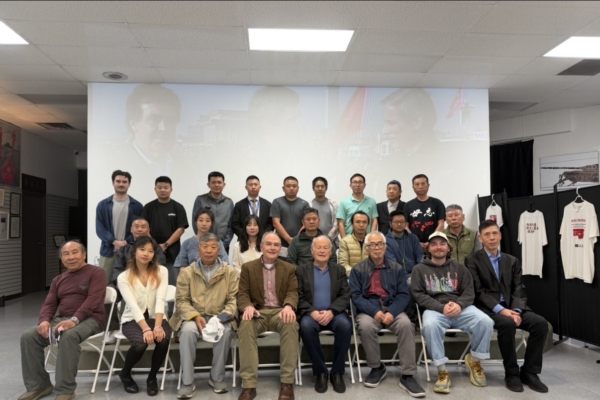
37 years ago, the tragic massacre of the June Fourth Incident at Tiananmen Square shocked the world. However, under the information blockade of the CCP, many young generations are not fully aware of this profoundly impactful historical event. This week on Wednesday (4th), a documentary shown at the June Fourth Memorial Hall gave audience a firsthand look at “Tiananmen Tonight”.
The film, produced by Northern Light Productions, directed by Bestor Cram and Michael Streissguth, runs for nearly 90 minutes. It utilizes precious footage of CBS senior reporter Dan Rather and his team before and after June Fourth at Tiananmen Square, bringing back to life the history deeply imprinted in the minds of the Chinese people.
Prior to the screening, the two directors introduced the motivation behind their creation to the reporters. Cram, a seasoned filmmaker and founder of “Northern Light,” pointed out that many people have little knowledge about the June Fourth incident. He emphasized that most people are unaware of the scale and duration of the 1989 democracy movement, both in China and the United States. He hoped that this documentary could spark discussions about the “suppressed truth” to prevent history from disappearing.
In 1989, Streissguth was an intern reporter for CBS’ “Evening News.” He shared that the film provided them with a fresh perspective to retell the story of the protests at the square, showcasing the dedication of American journalists in reporting in China, Australia, Japan, and Germany. He aimed to evoke memories of the courage of students and other protesters in China.
The film, set to a tense musical rhythm, gradually unfolds the journey of Rather and his team as they dive into reporting on student demands during the protests and eventually confront the pressures of CCP censorship and the risks of losing personal freedom while in China for over fifty days.
According to the directors, the film was originally planned to premiere during the commemoration of the 30th anniversary of June Fourth in 2019 but missed the opportunity. This delay allowed them to continue observing and evaluating China, reflecting on the connection between the current situation and the events of June Fourth.
The documentary had a total budget investment of approximately $200,000, covering copyright acquisitions and multiple trips to China for filming. The directors speculated that they might have incurred additional personal costs, such as being listed on the CCP’s “blacklist”.
After the screening, a panel discussion focused on the courage and ethics of journalists in pursuing the truth. Former Hong Kong senior journalist Cheng Xiang engaged in a dialogue with the two directors, moderated by former June Fourth student leader Zhang Boli. Cheng praised the professionalism and courage depicted in the film by media professionals.
Citing Rather’s words, Cheng emphasized the risks involved in reporting the truth, stating that true journalists are always on the front line rather than staying in the comfort of the newsroom. He recalled his own experiences from the late 1980s in China, leaving Tiananmen Square just before the crackdown upon the newspaper’s request.
Cheng believed that journalists have the responsibility to convey knowledge to the people, especially during political crises. He admired the journalists in the film as the best challengers of political power, emphasizing the strength in speaking out the truth.
Considering the current political situations in China and Hong Kong, Cheng felt that the timing of the film’s release was perfect. With the restrictions posed by the National Security Law in Hong Kong, commemorating June Fourth suddenly became a crime of endangering “national security.” He connected this to the ongoing trial of three former leaders of the Hong Kong Alliance in Support of Patriotic Democratic Movements of China.
Expressing gratitude, the former June Fourth students who witnessed the events of that night at the hospital near Tiananmen Square felt that a significant portion of the young generation in China today lacks an understanding of the truth behind June Fourth. They appreciated the directors for bringing back this crucial historical event through the documentary.
Zhang Boli, in his speech, expressed that the scenes from 36 years ago during June Fourth still vividly linger in his memory. He drew parallels to the current situation in Iran where a dictatorial regime is also perpetrating violence against its people, evoking a strong sense of empathy.
Zhang admired and thanked the two filmmakers for their courage, conscience, and sense of historical responsibility in capturing the film. He believed that their depiction through the lens confronts lies with light and shadows, expecting the film to have a profound impact in the West.