
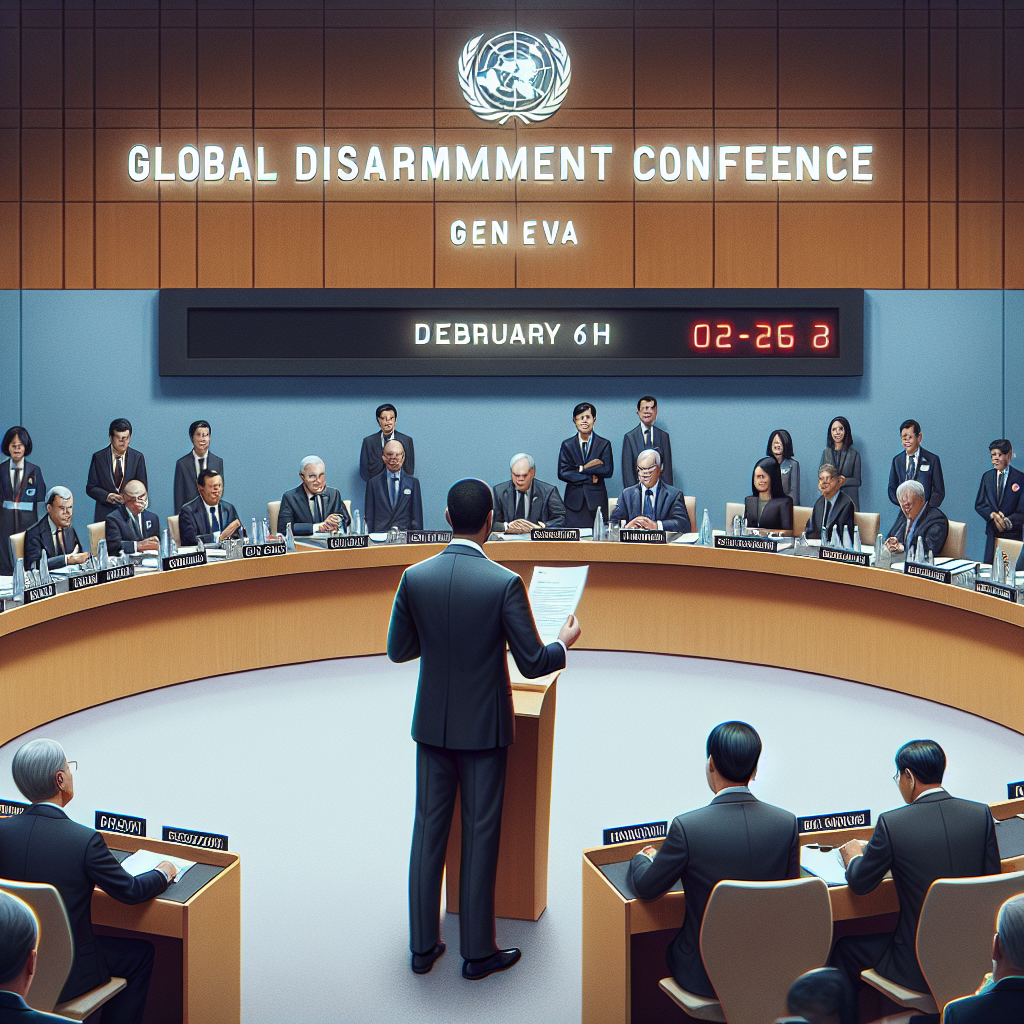
On Friday (February 6th) at the Global Disarmament Conference in Geneva, the United States accused the Chinese Communist Party of conducting a secret nuclear test in 2020, calling on the US, China, and Russia to develop a new, broader nuclear weapons control treaty.
Just the day before on Thursday (February 5th), the US-Russia Treaty on the limitation of missile and warhead deployments had just expired, putting global nuclear weapons control at a critical juncture. This accusation by the United States highlights the renewed tension between Washington and Beijing.
Thomas DiNanno, the US Deputy Assistant Secretary of State for Arms Control and International Security, stated at the conference that the US government is aware that the Chinese military conducted a yield-producing nuclear test on June 22, 2020, in a secretive manner to mask the test’s effectiveness using “decoupling” to reduce the seismic monitoring.
Chinese Ambassador for Disarmament Affairs Shen Jian did not directly respond to DiNanno’s accusations but instead accused the US of continuing to exaggerate the Chinese nuclear threat.
Diplomats at the conference expressed concern over the US accusation against China, which had not been previously heard.
The New START treaty signed in 2010 expired on Thursday, and President Trump hoped to sign a new treaty that would incorporate the rapid expansion of nuclear arsenals into the background.
DiNanno stated at the conference that the US is facing threats from multiple nuclear powers and that signing bilateral treaties with only one nuclear power in the future is no longer feasible. The US predicts that by 2030, China will possess over 1,000 nuclear warheads.
Shen Jian stated that China will not participate in US-Russia negotiations at the current stage. He also argued that China’s current number of nuclear warheads is only a fraction of the US and Russia, estimating it to be around 600 warheads, while the US and Russia each have approximately 4,000 warheads.
At the Geneva conference, the UK expressed concerns about Beijing’s nuclear expansion, indicating the need for a new era of nuclear weapons control involving China, Russia, and the US sitting at the negotiating table. France highlighted the critical importance of reaching agreements between nuclear powers under the current unprecedented weakening of nuclear norms.
In 2010, then-US President Obama and Russian President Medvedev signed the New START treaty aimed at limiting the deployment of portable nuclear weapon systems and setting restrictions on the number of active warheads. The treaty was based on mutual verification and data exchange mechanisms and was the only remaining arms control treaty between the US and Russia, which expired on February 5, 2026.
Russian Foreign Minister Sergei Lavrov stated on Friday that after the expiration of the New START treaty, Russia hopes to start negotiations with the US as soon as possible and is prepared to deal with any situation.
President Trump posted on the social media platform “Truth Social” on Thursday, stating that the US should not extend the “failed negotiations” of the New START treaty with Russia but should instead focus on developing a new nuclear treaty.
He emphasized that the treaty was a “bad agreement negotiated by the US in the past and faced serious violations in addition to other problems.”
“Extending New START is less effective than having our nuclear experts work on creating a new, improved, and modernized treaty for long-term effectiveness,” the President wrote.
Secretary of State Marco Rubio stated on Wednesday that any new arms control agreement should include China. “The President has clearly stated that to achieve real arms control in the 21st century, any agreement cannot exclude China, as the size and rapid growth of China’s nuclear arsenal. It is immense,” Rubio said.
The White House stated in a release on Thursday that “the President (Trump) will decide the future of nuclear arms control and will clarify this according to his own timeline.”
Negotiations for nuclear weapons control agreements are extremely complex, and since the signing of the New START treaty in 2010, there have been significant changes in the global situation. Currently, Russia is developing numerous “new” systems, including the “Burevestnik” cruise missile and “Poseidon” underwater torpedoes. Tactical nuclear weapons systems like the “Poseidon” are currently outside the jurisdiction of New START.