
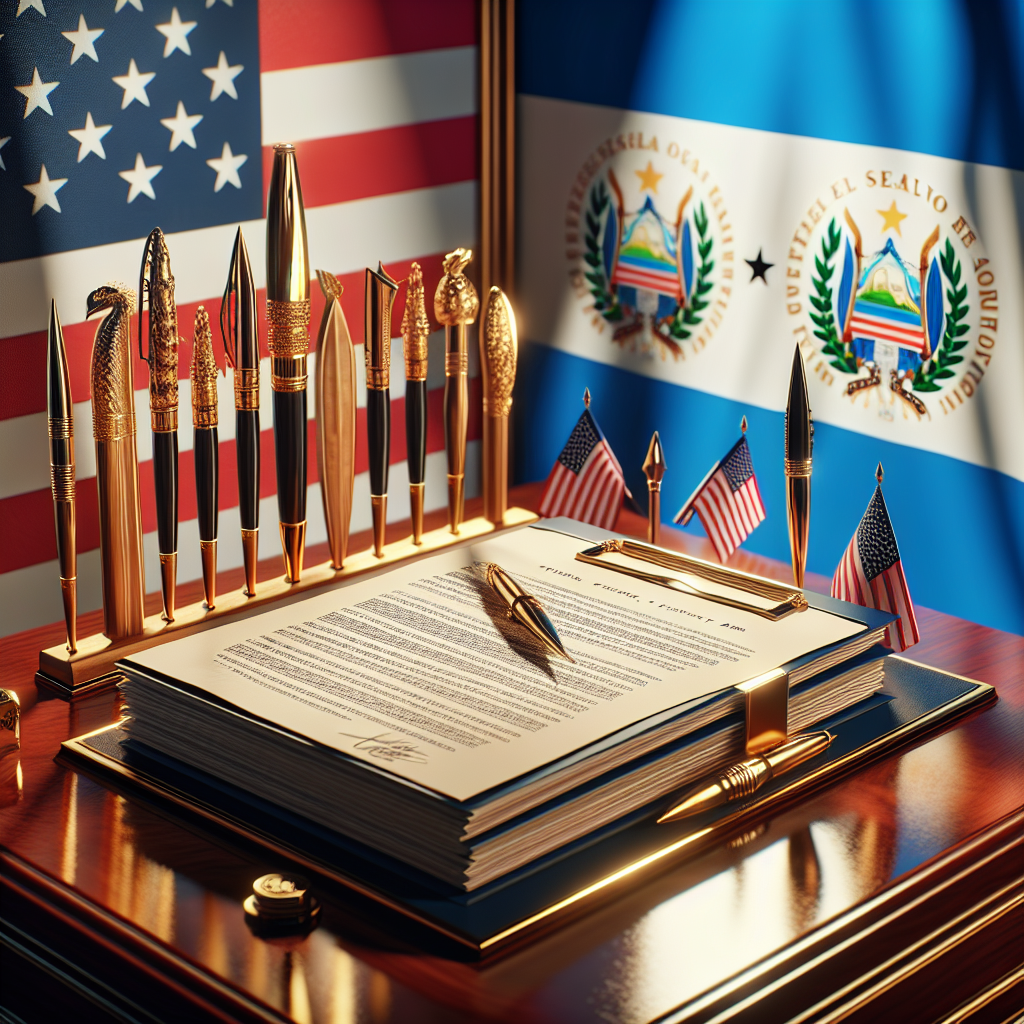
On Thursday the 29th of January, in the Eastern time zone of the United States, a new trade agreement was signed between the US and El Salvador. This agreement aims to reduce reciprocal tariffs on El Salvador to lower barriers for American exports to El Salvador.
The US Trade Representative Jamieson Greer and El Salvador’s Minister of Economy María Luisa Hayem signed the agreement in Washington. El Salvador is located in northern Central America and is the only country in Central America that does not reach the Atlantic Ocean. It shares borders with Guatemala to the northwest and Honduras to the northeast.
The current agreement will eliminate some import tariffs on certain goods from El Salvador but will maintain some tariffs. It also specifies that the tariff rate for certain goods should not exceed 10%. El Salvador has committed to adopting US regulatory standards to govern its imports from the US, allowing American products to enter the country with minimal non-tariff barriers.
According to the text of the agreement, El Salvador has pledged to join various intellectual property treaties, prohibit the importation of products made by forced labor, and refrain from imposing value-added taxes, among other conditions.
In a statement regarding the agreement, US Trade Representative Greer said, “The first reciprocal trade agreement in the Western Hemisphere signed today will further strengthen the US export market while reducing trade barriers faced by American workers and producers.”
On January 30, President of El Salvador Nayib Bukele announced the news on social media platform X, stating, “This is the first reciprocal trade agreement in the entire Western Hemisphere.” Bukele’s post also included a photo of trade representatives from both countries showcasing the agreement.
Data released by the US Trade Representative’s Office shows that bilateral trade between the US and El Salvador reached $10.7 billion in 2024. Currently, the US enjoys a $2.2 billion trade surplus with El Salvador, and both countries announced in November 2025 that a new trade framework had been agreed upon.
This agreement amends the 10% tariff imposed by former US President Donald Trump on El Salvador in April of last year, as part of Trump’s policy of imposing reciprocal tariffs on all countries. Prior to the implementation of the 10% tariff through Executive Order 14257 signed by Trump, most of El Salvador’s exports already enjoyed duty-free access to the US market under the Central America-Dominican Republic Free Trade Agreement signed in 2006, which is still in effect.
The agreement with El Salvador is the latest trade agreement signed by the US government with a Latin American country since the implementation of reciprocal tariffs. Previously, the US had reached agreements with Argentina, Ecuador, and Guatemala.
However, the tariffs imposed under Executive Order 14257 have sparked controversy in the US, with a Supreme Court ruling potentially overturning these tariff policies. The oral argument for the case took place on November 5, 2025, with Trump stating that the court’s forthcoming decision is “one of the most important in history.”
Greer stated that if the court rules the tariffs illegal, the Trump administration will implement a “backup plan,” but he did not provide specific details.
Some Democratic and Republican elected officials have expressed concerns and dissatisfaction with Trump’s tariff policies. They believe that tariffs lead to higher prices for goods purchased by American consumers and fail to deliver benefits such as promoting domestic manufacturing.
Senate Minority Leader Chuck Schumer (Democrat, New York) criticized Trump on social media platform X after the tariffs were imposed, calling the tariff policy “disastrous” and “ill-considered,” pointing out that “this will lead American families to spend an average of $5,000 more per year.”
Trump defended the tariffs, citing that they increased revenue for the US Treasury.
On January 5, Trump wrote on the Truth Social platform, “We will soon have over $600 billion in tariff revenue. Tariffs will make our country stronger and more respected than ever before in terms of fiscal and national security.” Previously, he had mentioned that future tariff proceeds could potentially be distributed to Americans in the form of cash checks.
Analysis from the Federal Reserve Bank of Richmond shows that the US collected at least $287 billion in tariff revenue in 2025, a 192% increase from 2024.