
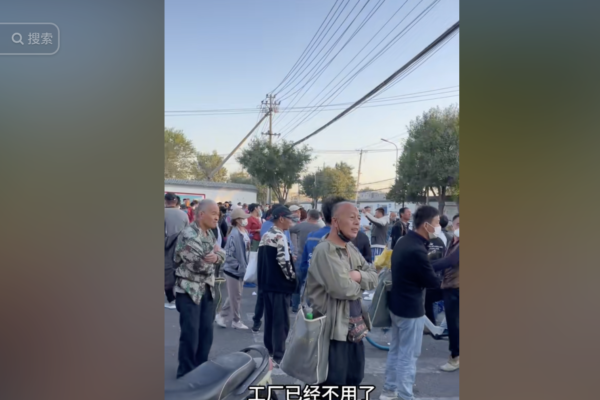
With the crisis or downturn of traditional industries like real estate in China that create employment, the “flexible employment” gig workers have now become one of the largest groups in the Chinese labor market. They rely on gig work for survival, facing difficult situations such as selling personal information or blood due to the lack of available work, a scenario never highlighted in the official narratives emphasizing the “bright economic prospects.”
“Temporary workers” and “gig workers” are often used interchangeably, including traditional short-term and temporary labor as well as modern gig work – providing services based on tasks/one-off/hourly/project basis. In China, these all fall under the official definition of so-called “flexible employment” or non-standard employment category, but seen from the outside, it is considered a gray employment model on the verge of unemployment.
China is gradually evolving into a gig economy country, with the gig workforce expanding continuously. According to official CCP reports, “it is estimated that the number of flexible employees has exceeded 200 million.” Gig labor typically includes freelancers, food delivery drivers, ride-hailing drivers, and live-streaming sales hosts.
Official Chinese data shows that in the four years leading up to 2024, the number of ride-hailing drivers in China doubled to reach 7.5 million, but during the same period, the ride-hailing orders only increased by about 60%, highlighting fierce competition.
The youth unemployment rate in China is nearing 20%. More and more young people are starting their first jobs not in offices but on food delivery platforms. There is currently no official statistic for the number of food delivery drivers. However, data from the renowned mobile data analytics agency QuestMobile in July 2025 indicated that the number of food delivery drivers in China has surpassed 14 million, with female riders accounting for 24.3%, primarily among the under-35 age group (61.8%).
The Maqu Qiao gig market in Tongzhou is one of the largest labor markets in Beijing, attracting people from all walks of life struggling for sustenance.
A contact was made with a post-90s gig worker named Xiaoyuan (pseudonym) at the Maqu Qiao in Beijing by Epoch Times reporter. Having graduated from university in 2011, Xiaoyuan previously worked in IT. After being laid off by a large company a year ago, divorced and with the child living with the mother, he had to provide financial support for the child as well.
Unable to secure a job, Xiaoyuan has been doing gig work at Maqu Qiao for the past year, doing express delivery sorting and working night shifts.
“In daytime, you have to be at the market by four or five in the morning, for the night shifts, you need to be here before 5 pm and after 7 pm, there isn’t much work left.”
Having lived in Beijing for over a decade, Xiaoyuan lamented the deteriorating environment in Beijing and the stiff competition in the gig market, with more job seekers than available work. Many individuals over 50 find it challenging to secure gigs.
Xiaoyuan mentioned that there are fewer people at Maqu Qiao now compared to last year due to the difficulty in finding work. “The types of gig work here are mainly express delivery sorting and site cleaning. The gig opportunities are mostly short-term now; long-term ones are rare. Many construction sites are halted, and almost all industries are suffering.”
Gig work ranges from daily pays to short-term engagements; however, complications can arise with short-term pay arrangements, as labor intermediaries may deceive the workers.
Xiaoyuan noted that the accommodation at Maqu Qiao is chaotic and unsafe, with frequent fights and even fatal incidents occurring, offering beds for as low as 15 to 30 yuan, while renting a room can cost over a thousand yuan per month. He refrains from residing at Maqu Qiao, instead opting to sleep at the 24-hour library.
A blogger highlighted the gig workers at Maqu Qiao, distinguishing them from other migrant workers by their daily pay and working non-stop for 12 hours. Before dawn, with Beijing’s sky just lighting up, hundreds of people could be found at Maqu Qiao’s intersection seeking work. Their work requirements are simple – as long as the pay is suitable, they are up for the job.
The blogger classified the individuals coming to search for work into several categories: those who have just arrived in Beijing and yet to find proper employment opt for gig work to sustain themselves temporarily, finding comfort in the stability it provides; those who appreciate the freedom gig work offers, enabling them to work a day and rest for three; and older migrant workers no longer employable in factories, turning to gig work to support their families. However, complaints abound as wages continue to drop, the competition heats up, and the prospects of finding work diminish, leaving many to try their luck later in the day.
It is said in Beijing that “if you have money, you won’t live in Tiantongyuan; if you’re down on luck, you’ll end up at Maqu Qiao.” Li Banjiang, a mainland blogger, recently conducted research on the gig market at Maqu Qiao.
There are two gig markets at Maqu Qiao – the old and the new. In the early hours of the morning, Li and two friends disguised themselves as vocational school graduates looking for work and explored the old Maqu Qiao market.
They overheard an elderly man from Shanxi saying most young people opt for long-term jobs in factories, while Maqu Qiao is predominantly populated by individuals over 45 previously rejected by factories. Various daily pay jobs like vegetable packaging, express sorting, and cleaning with low skill requirements are common.
Li stayed from five in the morning till seven o’clock, witnessing less than a tenth of the participants finding work. The rest continued waiting in hopes of securing a gig, while some abandoned hope and returned to their accommodations to rest.
Apart from job seekers and recruiters in the gig market, there are four other categories of individuals: those playing TV shows on projectors for fellow workers, others selling inexpensive goods like gloves and scarves (though few buy), some buying personal information for survival, and a group resorting to selling blood as a last resort in desperate times.
A man from Hebei lamented that most individuals at Maqu Qiao are laid off when they reach a certain age, compelling them to turn to gig work, with some even resorting to selling personal information or blood for sustenance. He expressed his struggle, having hoped to earn some money to return home for the new year, yet after two months, he has ended up losing over a thousand yuan and remains unsure of what to do next.
There is also a new gig market at Maqu Qiao, which was officially launched in September 2023 post-government-standardized transformations, providing facilities such as offline service halls, complimentary breakfast, shuttle buses, and infrastructure like hot water, power sources, and television within the hall. Some labor intermediaries have set up offices here for real-time recruitment, although the efficiency of finding work in the new gig market is lower.
As the real estate sector remains sluggish, the availability of gigs at Maqu Qiao has dwindled.
In late January 2026, a blogger noted in a video that even after 4 pm, there were still many people at the Maqu Qiao gig market.
China’s manufacturing sector is witnessing a new trend in labor utilization. Many manufacturing enterprises are reducing labor costs by hiring dispatched workers, practicing “shared gigs,” employing university students and older workers with low stipends. Research data indicates that in manufacturing hubs such as the Yangtze River Delta and Pearl River Delta, dispatched workers constitute up to a third of the labor force, reaching two-thirds during peak seasons.
Dispatched workers (outsourcing) sign labor contracts with dispatch agencies without any direct labor relationship with the hiring enterprise.
Xiaocong (pseudonym), an 80s gig worker who once worked in a shoe factory in Wenzhou, Zhejiang, mentioned that over the past two years, many factories have resorted to hiring gig workers, while others have shut down entirely.
“Gig work isn’t easy to come by anymore; the competition is fierce. It’s tough for factories to pay social security contributions, so most are given on a labor service basis. Some places indeed hire on a permanent basis, but they then have to contribute to social security for three months and one gold (housing provident fund) for six months, while some don’t even offer one gold.”
Originally working as a piece-rate worker at the Wenzhou shoe factory, Xiaocong decided to return to his hometown in Yunnan to farm last June due to the unfavorable circumstances. He has no intentions of seeking employment elsewhere.
Xusheng (pseudonym), a labor intermediary in Suzhou, Jiangsu, believes that the gig economy is indeed prevalent now, with enterprises resorting to hiring gig workers to cut down on costs as they lay off staff. This approach allows for adjusting the workforce according to demand fluctuations without incurring contract breaches, and many individuals face the risk of unpredictable job loss, making it exceptionally challenging.
Yang Ming (pseudonym), an intermediary in Guangdong, noted the proliferation of gig workers in various forms – daily pay, dispatched workers, outsourcing – with more gig positions advertised on recruitment software. Enterprises avoid social security contributions, housing provident funds, holiday leaves, bonuses, and tend to hire in bulk during high activity periods, swiftly dismissing surplus workers when demand decreases – a detrimental scenario for gig workers.
“With significantly reduced wages and no prospects for development or promotion, let alone welfare benefits, young people today refrain from starting families. If their jobs are unstable, how can they support a family?” he pondered.