
Japan’s decision to relax restrictions on the export of lethal weapons has sparked a wave of expansion and capital investment by domestic defense companies such as Mitsubishi Heavy Industries and IHI, as they actively pursue opportunities in the international market.
According to a report by Nikkei Asia, Japan’s Cabinet and National Security Council approved the revision of the “Three Principles on Transfer of Defense Equipment,” abolishing long-standing restrictions that limited weapon exports to five non-combat categories. This move allows Japanese defense companies to export finished weapons equipment such as destroyers and missiles to qualified countries.
Analysts at Okasan Securities predict that with the continuous growth of defense budgets, the average annual sales growth rate of related companies is expected to exceed 10% by the mid-2030s. The lifting of export restrictions could further boost this figure.
Japan’s defense budget for the 2026 fiscal year is estimated at 10.6 trillion yen (approximately 66 billion U.S. dollars), with the global market size exceeding 40 trillion yen (about 250 billion U.S. dollars).
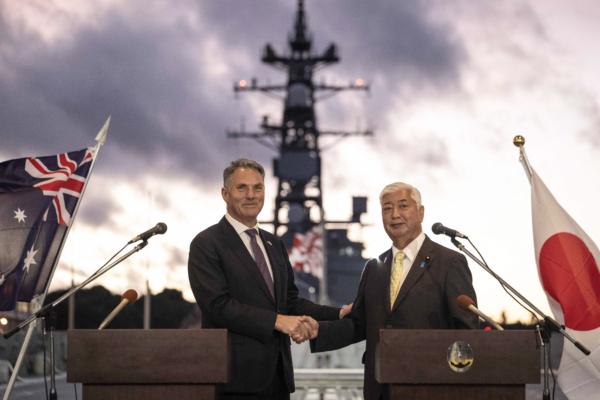
The effects of the policy change have already been demonstrated at Mitsubishi Heavy Industries. The company outbid Germany’s ThyssenKrupp Marine Systems in a tender and signed a contract with the Australian Navy on April 19 to export next-generation warships.
Australia plans to introduce a total of 11 upgraded Mogami-class frigates, with Mitsubishi Heavy Industries responsible for building three of them. The key factors in the decision were the performance and delivery schedule of the vessels, which feature a manpower-saving design requiring only around 90 crew members and high stealth capabilities. Mitsubishi’s track record of building over 10 similar vessels for the Japan Self-Defense Forces was highly praised.
To meet the rapidly growing demand for orders, Mitsubishi Heavy Industries plans to expand its aerospace and defense division from 7,868 employees in the 2024 fiscal year to around 10,000 employees. They are actively recruiting new graduates and mid-career professionals to strengthen their research and development capabilities and supply chain.
IHI is constructing a new facility for solid rocket engine production in Tomioka, Gunma Prefecture, which is expected to be completed by 2028 to increase the output of air defense and intercept missiles for the Self-Defense Forces.
Japan Steel Works has initiated the construction of a new facility in Hiroshima and upgraded the missile launch tube production line at its Muroran plant in Hokkaido.
With ongoing conflicts in the Middle East and Iran, the demand for anti-aircraft missiles has surged, creating a global shortage. Japanese companies are expected to help fill this supply gap.
Japanese Defense Minister Shinjiro Koizumi emphasized in an interview with Nikkei Asia that the government will lead the expansion of domestic arms production and collaborate with the Ministry of Economy, Trade, and Industry to address labor and equipment shortages faced by businesses.
He revealed that countries like the Philippines, Indonesia, and New Zealand have shown interest in Japanese equipment.
Analysts also see potential export prospects for advanced weapons such as underwater drones developed by companies like Mitsubishi Heavy Industries, as well as electromagnetic pulse cannons developed by NEC and Daikin Industries.
However, some analysts caution about underlying concerns. The prolonged period of low demand in the past led Japanese defense companies to significantly reduce facilities and personnel. The rebuilding process not only takes time but also faces challenges such as a shortage of skilled workers and slow equipment upgrades. Additionally, Japan’s lack of combat experience with weapon systems raises questions about fulfilling performance commitments in overseas markets, a challenge that remains to be seen.