
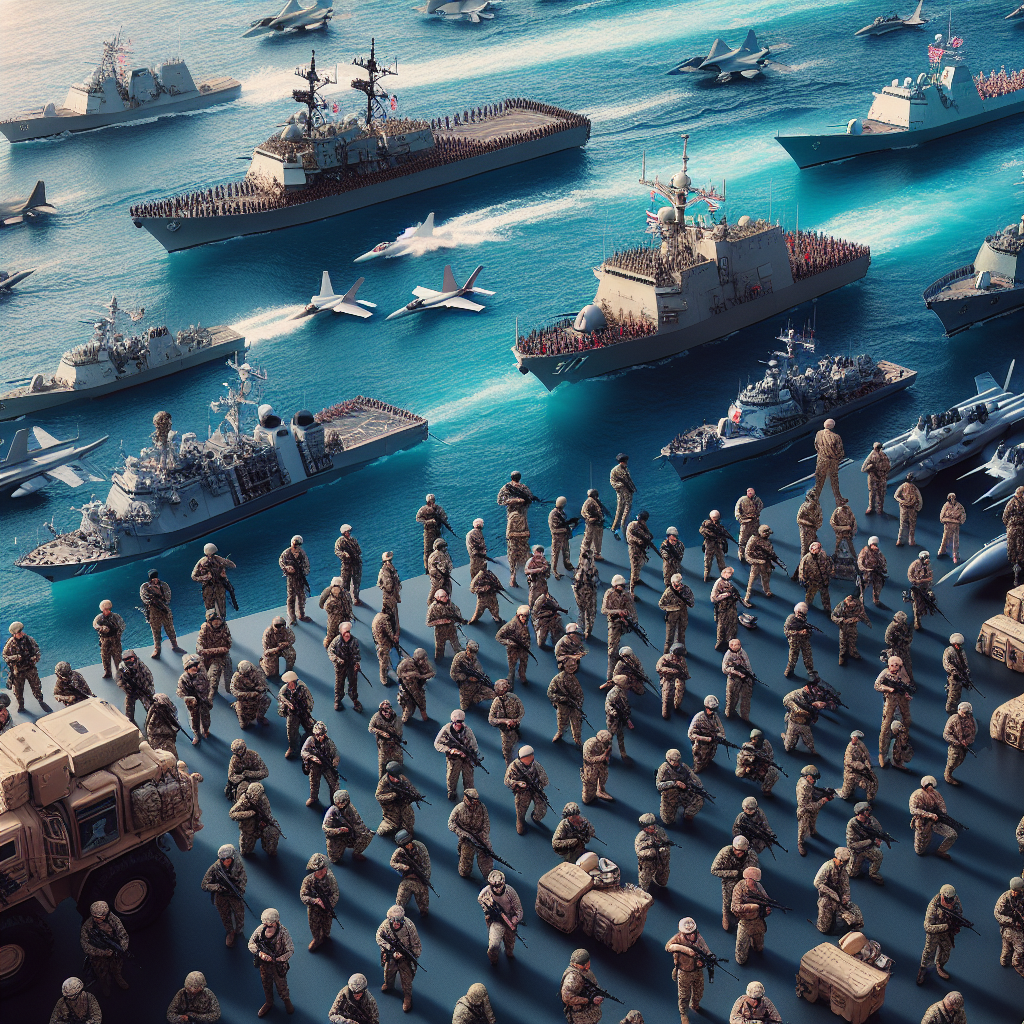
In a significant development, democratic allies such as the United States, Japan, and the Philippines are currently hosting the largest-ever “Shoulder-to-Shoulder” joint military exercise in the Indo-Pacific region. Meanwhile, the Chinese Communist Navy has initiated multiple operations around the first island chain, with movements ranging from the aircraft carrier Liaoning passing through the Taiwan Strait to the Bao Tou ship crossing the Tsugaru Strait in Japan to head towards the Western Pacific.
Experts point out that Beijing is eager to shift from land power to sea power expansion, attempting to challenge the existing international order. Therefore, democratic alliance countries must build a “firewall” to counter these moves. Recently, Japan participated in a large-scale military exercise with the US and the Philippines for the first time, actively countering the Chinese infiltration and expansion, thus thwarting the Chinese conspiracy of “regional exclusion.”
On April 20th, the Chinese aircraft carrier Liaoning once again transited through the Taiwan Strait. This event marks another passage of a Chinese military carrier through the strait since the similar transit of the Fujian vessel was reported by the Taiwanese Ministry of National Defense back in December.
Taiwan’s military promptly issued a statement on platform X, emphasizing that they closely monitored the Liaoning’s movements and responded accordingly. According to Taiwan’s report on that day, there were 24 aircraft sorties, 7 warships, and 1 other vessel active in the strait.
Furthermore, the timing of the Liaoning’s passage through the Taiwan Strait closely follows the recent transit of the Japanese missile destroyer JS Ikazuchi through the same waterway on April 17th.
Subsequently, on the 18th, the Eastern Theater Command of the People’s Liberation Army of China claimed that the 052D destroyer Bao Tou had led a fleet that passed through the Tsugaru Strait in southwest Japan. This route taken is closer to the Japanese mainland compared to the usual Miyako Strait used to travel between the East China Sea and the Western Pacific.
Additionally, a report from Xinhua News Agency on April 21st stated that China’s first Type 076 amphibious assault ship, the Sichuan vessel, had set sail from Shanghai to conduct research experiments and training tasks in related areas of the South China Sea.
Despite China’s claims that these actions were routine tasks and not targeting specific entities, military observers believe that these are clear moves aiming to enhance Beijing’s maritime projection capabilities.
The escalation of this military pressure has been foreshadowed for some time. According to a report by Reuters on April 11th, Taiwan security officials noted a significant increase in the number of Chinese naval ships deployed in the South China Sea, East China Sea, and surrounding waters, a notably unusual surge.
Taiwanese officials disclosed that while the Chinese military typically deploys 50 to 60 ships in the region, this number had risen to nearly 100 ships, including navy and coast guard vessels, by mid-April. It is worth mentioning that this isn’t typically a busy time of the year for Chinese naval exercises.
Dr. Shen Mingshi, a researcher at the National Security Institute of the National Defense Institute of Taiwan, emphasized in an interview that the Liaoning’s passage through the Taiwan Strait is also a military alert to Taiwan, especially relating to President Tsai Ing-wen’s planned visit. The US condemned China’s coercion of African countries and interference in Tsai Ing-wen’s travel plans.
During a meeting in Beijing on April 10th with the leader of the Taiwan Kuomintang Party, Xi Jinping firmly stated that China would never tolerate Taiwan independence. Taiwan’s Ministry of National Defense reported that on that day, there were 7 Chinese aircraft and 7 warships operating in the vicinity of Taiwan.
According to informed experts cited by Reuters, the significant surge in military deployments coincides with the US focus on the Middle East conflict and the upcoming “Xi-Trump” meeting in May, seen by security experts as a “new normal” of military pressure from China.
According to a report by Business Insider, from the end of last year to early this year, an unusual gathering of thousands of Chinese fishing vessels occurred in the East China Sea, forming what appeared to be trained formations.
Data from Starboard Maritime Intelligence and satellite images from Planet Labs showed that on December 25th, over 2,000 ships were arranged in two counter-L shapes outside Shanghai, extending over 290 miles; then on January 11th, nearly 1,500 ships in the same area formed a straight line roughly 300 miles long.
Area specialists pointed out that this behavior aligns with existing perceptions of the operations of the “Chinese maritime militia.” These vessels serve as auxiliary reinforcements of the Chinese navy and coast guard, allowing Beijing to assert control over disputed waters, avoiding direct military conflicts while deflecting responsibility.
Regarding China’s frequent military actions, Su Ziyun, the director of the Strategic Institute of the Taiwan Defense Research Institute, clearly stated in an interview with Epoch Times that the essence of Chinese military operations is to “expand maritime power beyond the First Island Chain” as a strategic display.
Su Ziyun outlined three key recent Chinese naval actions:
Firstly, at the end of March, China announced a 40-day control over parts of the Yellow Sea and East China Sea airspace, in response to Japan’s deployment of long-range missiles.
Secondly, after the Japanese Self-Defense Forces destroyer Ikazuchi transited the Taiwan Strait on April 17th, China sent the Bao Tou ship through the Tsugaru Strait on the 18th.
Thirdly, in coordination with the “Shoulder-to-Shoulder” joint military exercise involving the US, the Philippines, and Japan on April 20th, Beijing deployed the Liaoning aircraft carrier southward to the South China Sea to “face Taiwan.”
Su Ziyun emphasized that the core of geopolitics in the Indo-Pacific region lies in “China’s shift from land power to sea power,” and the expansion of China’s authoritarian regime will inevitably threaten the security of democratic countries.
“It is for this reason that Japan, Taiwan, the Philippines, and allied nations must collaboratively build a ‘firewall’ to contain this expansion,” Su Ziyun said.
Yu Zongji, the former dean of the Political Warfare College of Taiwan’s National Defense University, analyzed that once the US and allied forces complete military deployments along the First Island Chain, Beijing, fearing isolation, may seek cooperation with Russia and North Korea.
Simultaneously, on April 20th, the US, Japan, and the Philippines officially commenced their annual three-week “Shoulder-to-Shoulder” joint military exercise, the largest in history, involving over 17,000 troops, with approximately 10,000 American soldiers, along with military personnel from more than ten countries including France, Australia, Canada, and New Zealand.
For the first time this year, Japan dispatched 1,400 combat troops equipped with warships, an amphibious assault ship, various aircraft types, and deployed the Type 88 medium-range anti-ship missile for sinking a retired warship in the South China Sea.
According to the Financial Times, military experts noted that the “Shoulder-to-Shoulder” exercise is part of the US plan to construct a “counter-ship fortress” in the Philippine archipelago. Both Japan and the Philippines are members of the First Island Chain and hold pivotal strategic locations for the US in counterbalancing China.
Lieutenant General Christian Wortman, the US Marine Corps commander, emphasized at the exercise’s opening ceremony on the 20th that “no matter the challenges faced elsewhere in the world, the US’s commitment to the Indo-Pacific region remains unwavering.”
Yu Zongji analyzed that a highlight of this exercise is the deployment on Batan Island in the Philippines (just 200 kilometers from Taiwan), aiming to simulate blockading the Bashi Channel, complemented by Japan’s deployment of anti-ship missiles in the Miyako Strait, thus forming a dual-direction attack.
He also pointed out that this exercise directly debunks China’s long-claimed military capabilities to prevent external interference, known as the “anti-access/area denial” (A2/AD) strategy, and the recent Iran conflict provides a counterexample.
Yu Zongji highlighted that during the Iran conflict, various anti-ship missiles were launched at the US carrier fleet, but all were successfully intercepted, showcasing the failure of China’s supposed “A2/AD” strategy in modern warfare.
Among China’s recent multiple operations, the passage of the Bao Tou destroyer fleet through the Tsugaru Strait has raised significant international concerns. This strait connects Japan’s Ryukyu Islands with the Western Pacific and is viewed as a direct provocation to Japan’s territorial security being even closer to the Japanese mainland than the usual Miyako Strait route used by Chinese ships.
On Thursday (23rd), a bill establishing the National Intelligence Agency was passed by a majority in the Lower House of Japan’s Parliament and was submitted to the Upper House for deliberation. With some opposition parties also expressing support, the bill is likely to pass the Upper House and establish the agency within this parliamentary term.
The Japanese government introduced this legislation to enhance its intelligence search and analysis capabilities by establishing the National Intelligence Agency, giving it comprehensive coordination authority for integrating and analyzing intelligence from various prefectural agencies.
Yukio Kawamura, a parliamentarian from the governing party, stated that while this bill is a necessary step, Japan’s response to real threats remains inadequate. Legislation related to countering espionage has yet to be fully developed and must be continuously strengthened.
Since taking office in October 2025, Japanese Prime Minister Sanae Takai has repeatedly stated the phrase “What concerns Taiwan concerns Japan,” triggering strong diplomatic protests and military threats from Beijing.
Yu Zongji pointed out that Japan’s robust intervention is due to its maritime lifelines extending to the South China Sea, influencing Japan’s national fate. Therefore, Japan “will not tolerate China’s military aggression against the Philippines or Taiwan.”
Japan’s 2026 defense budget has increased by 9.4% compared to the previous year, reaching $58 billion, hitting a historical high and progressing towards the 2% of GDP target, emphasizing the enhancement of retaliatory capabilities, space defense, drone technology, and coastal defense.
Yu Zongji believes that Japan is now the world’s seventh-largest military power and is expected to continue expanding its defense budget, aiming to become the fourth-largest military power globally, which will pose a “fundamental devastating blow” to China’s expansionist ambitions.
In the ongoing global security and freedom of navigation contest, Yu Zongji concluded by drawing lessons from the Russia-Ukraine war: “Only by being prepared for war can we avoid war.”