
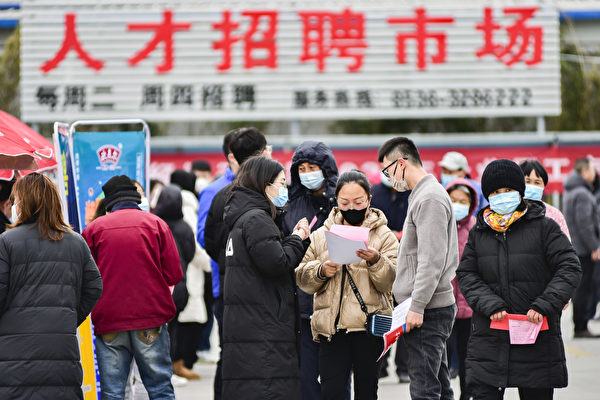
The official first-quarter employment data released by the Chinese Communist Party (CCP) shows a worsening trend, despite suspicions of embellishment. The industry believes this is due to the rampant use of artificial intelligence (AI) replacing employment, as well as external impacts such as the war in Iran.
On Tuesday (April 21), the CCP’s National Bureau of Statistics announced the latest data, indicating that the labor market is facing increasingly severe challenges. The overall unemployment rate unexpectedly rose in March, and wage growth slowed to its lowest level since the end of 2022.
Specifically, the unemployment rate for 16-24-year-old labor force in urban areas, excluding students, rose to 16.9%, reaching the highest level in nearly 4 months.
At the same time, the unemployment rate for the 25-29 age group also climbed to 7.7%, setting a record high since the data for this subgroup was released. These individuals are mainly young people transitioning from school to the workforce, who were previously favored as new labor force by enterprises.
The data shows that in March, the unemployment rate for the 30-59 age group in urban areas in China, excluding students, reached 4.3%, also hitting the highest point in over a year.
Overall, the survey unemployment rate in urban areas across China in March was 5.4%, an increase of 0.1 percentage points from February, hitting a new high in 13 months. China is known as the world’s largest labor market, with a working-age population of over 700 million.
For those entering their careers, the bleak job prospects may be the result of the accumulating pressure faced by young Chinese workers since the COVID-19 pandemic in 2020, and AI is exacerbating these pressures, especially in entry-level positions.
AI is being widely used in China, mostly to replace entry-level jobs. According to research by Citibank, AI transformation may lead to around 70 million job losses in China, especially impacting the demand for low-skilled occupations.
Official data shows that in the first quarter, China’s industrial robot production surged by 33.2%, indicating the acceleration of AI manufacturing and a turning point towards technological unemployment in the manufacturing sector.
The structural issues long existing in the Chinese economy are exacerbating employment pressures. The manufacturing industry, accounting for about 30% of GDP but only providing around 20% of the employment, has high levels of automation with limited labor absorption capacity.
If the situation is not reversed, China may struggle to escape the dilemma of “jobless growth.” Even in economic powerhouses like Guangdong in southern China, many factory workers are facing challenges as export growth in labor-intensive industries lags behind that of high-tech enterprises.
Additionally, the employment pressure typically increases seasonally around the Chinese New Year. Due to the later timing of the New Year in 2026 compared to previous years, it may have also intensified the employment situation in March.
The ongoing Iran war that started at the end of February has lasted for 8 weeks, severely impacting energy and trade, raising costs while squeezing business profits and restraining recruitment intentions.
Bloomberg reported that Ernan Cui, a consumer analyst at the research firm Gavekal Dragonomics, stated that the cost uncertainty brought by the Iran war may have disrupted recruitment plans, leading to the deterioration of labor market indicators in March.
Wang Guochen, deputy researcher at the First Research Institute of the China Economic Research Institute, mentioned that the overall rise in unemployment in mainland China is due to the economic downturn in general.
He pointed out that weak investment coupled with enterprises being more self-sufficient have led to a limited need for employees, causing a comprehensive unemployment problem in mainland China, not just reflected in the youth employment issues.
Wang emphasized that when observing the unemployment rate in China, one should not only look at absolute values but should also estimate the severity of the entire problem from the trend.
From official data, even after the uniform standards in the past few months, the unemployment rate has consistently hovered in the double digits, and the current trend is steadily rising, indicating that the employment issue is “worsening.”
It is widely believed that the CCP’s official unemployment data underestimates the real situation — it does not cover situations such as rural migrant workers returning home, the gig economy, etc., so the actual labor market pressures may be even greater. The gig economy almost accounts for half of urban employment.
The sluggish labor market, in turn, has become a major obstacle to household spending and the recovery of the real estate market. Retail sales in mainland China in March were weaker than expected, leading to an increased reliance on exports, causing growth imbalances and exacerbating overseas trade tensions.
At the same time, the household savings rate in China rose to 38% in the first quarter, reaching a new high for the same period in three years, indicating a weakening consumer confidence.