
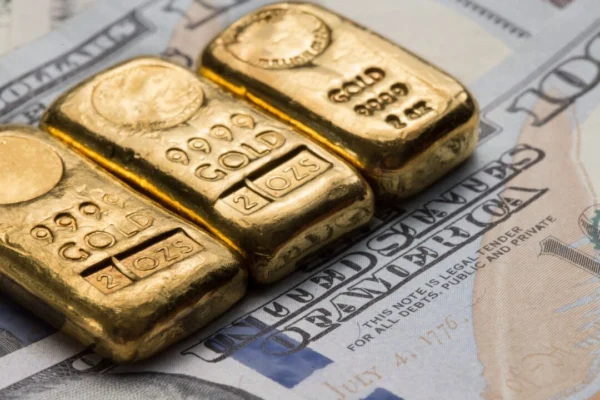
The unrest in the Middle East has once again led investors to seek safe havens, sparking discussions on which assets truly provide protection during times of market pressure.
With the unpredictability of traditional safe-haven assets, the choice has become increasingly complex. Gold prices have been volatile, and the US dollar, which has been out of favor for the past year, is now seeing a rebound.
Here is a summary of the performance of some popular safe-haven assets as compiled by Reuters:
This week, the US dollar can be said to be the best-performing among all safe-haven assets.
The US dollar index, which measures the dollar against six other currencies, rose by 1.5%. The dollar also strengthened against the Swiss franc and the Japanese yen, both of which typically perform well under market pressure.
Of note is that after the stock market decline following the tariff disputes in April last year, the weakened US dollar faced questioning regarding its safe-haven status.
Flow of funds data shows that there is currently strong demand for short-term US dollar cash, rather than other US dollar assets.
Although the United States is a net energy exporter, crises in the Middle East that push Brent crude oil prices above $80 per barrel are advantageous for the US.
James Lord, Foreign Exchange Strategist at Morgan Stanley, stated that “the dollar does have some safe-haven attributes, but it depends on the specific situation.”
He pointed out that this situation will not last forever, as the uncertainty of US policies has weakened the dollar’s safe-haven qualities.
Government bonds have struggled to attract the usual influx of safe-haven funds that arise during geopolitical crises, as investors now primarily trade these bonds based on inflation prospects rather than as defensive assets.
Factors such as Germany relaxing its debt brake and broader market concerns about increased government borrowing have also diminished the attractiveness of government bonds as safe-haven assets.
The yield on the German 10-year government bond, the benchmark for the Eurozone, has risen by 14 basis points this week.
With gold prices rising by 240% this decade, gold has a strong reputation as a safe-haven asset. However, gold also exhibits volatility, as evidenced by a significant price drop on Tuesday, March 3.
Analysts attribute part of the Tuesday gold drop to investors selling off the best-performing assets to offset losses elsewhere. Market concerns arising from the Middle East conflict have affected investor sentiment.
Nevertheless, they note that this should not impact gold’s status as a safe-haven asset, as inflation, geopolitics, and high debt levels remain concerning.
The Swiss franc and the Japanese yen, long considered safe-haven currencies, have each declined by 1.2% and 0.8%, respectively, as of this week.
Justin Onuekwusi, Chief Investment Officer at St. James’s Place, remarked that “from a valuation perspective, the yen may still be relatively attractive. In my view, it can still offer some hedge protection in the current environment.”
However, political uncertainty surrounding Japanese Prime Minister Kashiwagi’s cautious approach to further rate hikes has added a layer of risk to the yen’s outlook.
Meanwhile, analysts cautiously point out that the Swiss National Bank’s warning of readiness to intervene to curb excessive Swiss franc appreciation may limit the franc’s upside.
Teresa Alves, a strategist at Goldman Sachs, stated that “the rising risk of Swiss National Bank intervention may weaken its safe-haven attributes under the current impact.”
Stocks typically perform poorly during periods of market pressure, although some so-called defensive stocks (such as utilities or consumer staples) usually experience smaller declines. However, this time the situation is different.
This week, S&P utilities and consumer staples stocks fell by 1% and 2.8%, respectively, while the S&P 500 index remained relatively flat. In Europe, utilities stocks dropped by 3% and consumer staples stocks fell by 4.5%. In comparison, the STOXX 600 index fell by 3%.
Part of the reason is that these stocks had previously performed well. At least before the outbreak of war, a major investment theme was purchasing “hard assets” such as infrastructure and industrial sectors.
More broadly, the performance of defensive value stocks has consistently surpassed growth stocks, with some showing particularly strong performance.
James Bristow, Portfolio Manager at Templeton Global Investments, emphasized the need to carefully consider relative prices when investing in traditional defensive stocks at current interest rate levels.
“For example, I hold shares of Pepsi Co… it’s not the highest quality company, but its initial price was very low… which differs in terms of safety margin compared to buying shares of companies like Nestle,” Bristow said.
(This article is for general informational purposes only and does not constitute any recommendations. Epoch Times does not provide investment, tax, legal, financial planning, or other personal financial advice. For specific investment matters, please consult your financial advisor. Epoch Times does not assume any investment responsibility.)