
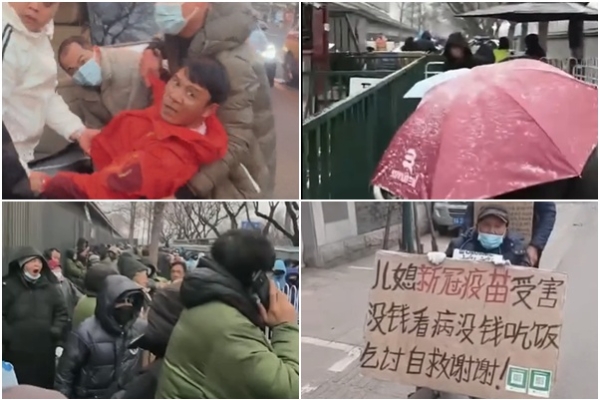
On the eve of the opening of the Chinese Communist Party’s “Two Sessions” on March 4th, the authorities have significantly escalated their crackdown on petitioners, yet the number of people lining up to lodge complaints in front of the National Bureau of Letters and Calls has visibly increased compared to previous years.
According to petitioners in Beijing, while stability maintenance personnel across various regions are arresting people on the streets, the Beijing police have also conducted a concentrated search in a settlement area of petitioners in Fangshan District, where over five hundred individuals were taken away one after another.
Petitioner Lin Liang told Epoch Times that there is a place in Beijing’s Fangshan District known as the “Petitioners’ Village,” where many out-of-town petitioners settle due to cheap rent and convenient transportation. In the lead-up to the Two Sessions, the atmosphere in the village was extremely tense, with a large number of police officers conducting searches and apprehending petitioners.
“This place has people who have been arrested for petitioning from all over the country. Many people I know have either been forcibly taken back by stability maintenance personnel from their hometowns or pressured to return on their own; the bottom line is they are not allowed to stay in Beijing.”
Liang mentioned that due to the heavy police presence, hundreds of individuals have been taken away and repatriated. Many people dare not go out during the day, some even turn off their phones to evade police surveillance. “There are approximately over a thousand petitioners living here. They are arresting petitioners everywhere, and about half of the petitioners have already been taken away and repatriated.”
Another source revealed that prior to the Two Sessions, a large number of petitioners in Shanghai were forcibly sent to Chongming Black Jail for detention.
Wang Yu told Epoch Times that since returning to work on February 24th (after the Chinese New Year holiday), street offices have dispatched people to monitor and stand guard at the doors of petitioners listed on their roster, while those who have already arrived in Beijing are forcibly escorted back to Shanghai.
To avoid arrest, petitioner Liu Dongbao from Shanghai fled to the wife’s hometown in Ankang County, Shaanxi Province. On February 27th, police from his registered residence in Shanghai tracked him down thousands of miles away and warned that he must not petition in Beijing during the Two Sessions, stationing people to watch downstairs, causing strong dissatisfaction among Liu and his family.
Wang Yu explained, “They hired eight security guards and brought two cars, guarding outside his (Liu Dongbao) wife’s house, leading to a dispute between both parties.”
Shanghai petitioner Cui Qun entered Beijing on February 28th, and after being located by stability maintenance personnel through mobile positioning, she was forcibly sent back to her original location. The functionality of her WeChat was restricted, rendering it unusable.
Petitioner Li Bei (pseudonym) was also forcibly taken away from Beijing by the police on March 4th. He stated that despite heavy snowfall in Beijing over the past two days, there are still a large number of petitioners queuing up. “The number of people queuing to lodge complaints at the Bureau of Letters and Calls this year is significantly higher than in previous years.”
He expressed, “Tens of thousands of people line up at the Bureau of Letters and Calls every day. Queuing does not solve problems, but not queuing doesn’t solve problems either. Going there is hopeless, not going is even more hopeless, thus creating a vicious cycle. The Communist Party system is shameless and acts like thugs.”
Mainland human rights activist Li Xin stated that under the current system, there is almost no way to seek justice through legal channels. He believes that the authorities’ intensified control in the name of stability maintenance has incited public anger, “The more severe the suppression, the stronger the resistance.”
(Interviewees are all pseudonyms)