
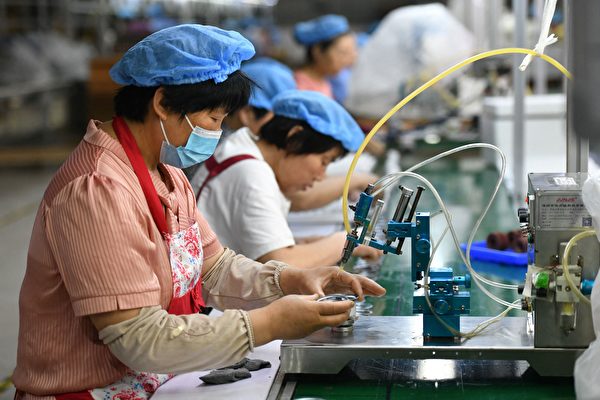
On March 4th, the National Bureau of Statistics of the People’s Republic of China released the Purchasing Managers’ Index (PMI) for the manufacturing industry in February. The index was 49.0%, a decrease of 0.3 percentage points from the previous month, indicating a decline in the manufacturing industry’s business conditions. At the same time, the non-manufacturing business activity index and the comprehensive PMI output index were both below the 50% mark, signaling contraction in the overall economic activity.
The official website of the National Bureau of Statistics of China published the report on the operation of the Purchasing Managers’ Index in February 2026. The PMI stood at 49.0%. Specifically, the PMI for large enterprises was 51.5%, increasing by 1.2 percentage points from the previous month. On the other hand, the PMI for medium and small-sized enterprises were 47.5% and 44.8% respectively, a decrease of 1.2 and 2.6 percentage points from the previous month, falling below the threshold of 50.
The sub-indices that make up the manufacturing PMI, including the production index, new orders index, raw materials inventory index, employment index, and supplier delivery time index, were all below 50.
The production index was 49.6%, down by 1.0 percentage point from the previous month, indicating a slowdown in manufacturing production activities. The new orders index was 48.6%, down by 0.6 percentage point from the previous month, reflecting a decline in market demand for manufacturing. The raw materials inventory index was 47.5%, up by 0.1 percentage point from the previous month. The employment index was 48.0%, down by 0.1 percentage point from the previous month, indicating a decline in the labor market for manufacturing. The supplier delivery time index was 49.1%, down by 1.0 percentage point from the previous month, showing a slowdown in the delivery time of raw materials for manufacturing.
In addition, the non-manufacturing business activity index in February was 49.5%, also below the 50 threshold. The business activity index for construction was 48.2%, the service industry was 49.7%, the new orders index was 45.2%, the sales price index was 48.8%, and the business activity index for industries such as capital market services and real estate were all below the 50 threshold.
The report on the operation of the Purchasing Managers’ Index in February 2026 also indicated that the comprehensive PMI output index for China was 49.5%, down by 0.3 percentage points from the previous month, showing a general slowdown in business operations compared to the previous month.
Chief Statistician Huo Lihui from the Service Industry Survey Center of the National Bureau of Statistics of China told mainland media that the overall market activity in the manufacturing industry had declined, with decreases in both production and demand.
Data shows that since April 2025, China’s manufacturing PMI has been continuously in the contraction zone below 50, except for December when it briefly expanded to 50.1%. However, as of January 2026, the manufacturing PMI once again dropped below the 50 threshold, standing at 49.3%.
Publicly available data indicates that the Purchasing Managers’ Index (PMI) is compiled from monthly surveys of enterprise purchasing managers, covering various aspects of procurement, production, and distribution in both the manufacturing and non-manufacturing sectors. PMI is a widely used leading indicator internationally to monitor macroeconomic trends, with a strong predictive and warning function. When PMI is above 50%, it indicates economic expansion compared to the previous month; when it is below 50%, it reflects economic contraction.