
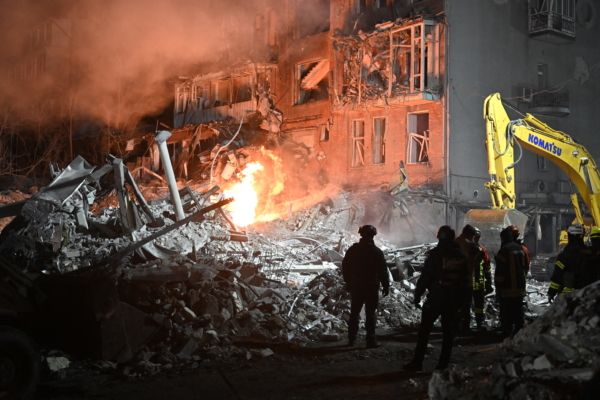
The Russia-Ukraine war has now been raging for a full four years, with the conflict still deadlocked and resulting in a total casualty count nearing 1.8 million. The international community’s debate over Beijing’s role continues to intensify, with the Chinese Communist Party (CCP) outwardly advocating for “urging peace and negotiations” in diplomacy, but being accused by multiple countries of effectively supporting the Russian war machine through component supplies, energy procurement, and financial channels. Experts point out that this “grey support” has become a crucial variable in prolonging the conflict, while Europe’s wavering between security and economic interests further exacerbates the international community’s difficulties in coordinating responses.
The Russia-Ukraine war erupted on February 24, 2022, and has now spanned four full years, with the conflict overall stuck in a grind of attrition.
According to a report released this month by the Washington-based Center for Strategic and International Studies (CSIS), since the full-scale Russian invasion, Russia has accumulated nearly 1.2 million battlefield casualties (including deaths, injuries, and missing), with estimated deaths ranging between 275,000 to 325,000.
In 2025 alone, Russian military casualties reached 415,000, averaging close to 35,000 per month, a scale of loss unprecedented for any major power since World War II. Ukrainian casualties are estimated at around 500,000 to 600,000, bringing the combined total close to 1.8 million. CSIS has warned that by spring 2026, the total number of casualties or missing persons on both sides could surpass 2 million.
In terms of advance speed, the performance of the Russian military is similarly dismal. The report indicates that in the direction of Pokrovsk, daily advancements are only about 70 meters, and in Chasiv Yar, just 15 meters – a speed even slower than the Somme Battle of World War I. Since 2024, the Russian military has gained control of less than 1.5% of Ukrainian territory.
Meanwhile, Russia’s wartime economy also shows signs of fatigue: the manufacturing sector contracted for several consecutive months in 2025, economic growth slowed to 0.6%, and labor shortages and high inflation continued to worsen. The Kremlin spokesperson, Dmitry Peskov, denied the “reliability” of this report.
On the occasion of the war’s fourth anniversary, Chinese Foreign Ministry spokesperson Mao Ning once again claimed that China “upholds an objective and fair position,” actively promoting peace talks, and stating that the “Ukrainian crisis” should not become a problem between China and Europe. Another spokesperson, Lin Jian, refuted the statement made by the US Ambassador to NATO, Hutch Tuck, about China’s “comprehensive support for the war.”
However, in interviews with the Epoch Times, both experts made different judgments on Beijing’s “neutrality.”
Cheng Zhengbing, a professor of Finance and Finance at Yunlin University of Technology in Taiwan, pointed out that China’s involvement is not simply a matter of diplomatic positioning but a part of the overall strategic layout: if Russia continues to hold NATO in Europe, Iran maintains a confrontational stance in the Middle East, and US global forces are dispersed, China’s strategic space in the Taiwan Strait and South China Sea will relatively expand.
Cheng described the coordination between China, Russia, and Iran as a “strategic containment chain,” with China being the most proactive key variable.
Senior military commentator Mark analyzed from the supply chain perspective, pointing out that China’s sustained support for Russia’s operational capability is manifested in three aspects:
Firstly, economic buffering – China-Russia trade provides important external support to Russia under Western sanctions; secondly, military imports – including electronic components, integrated circuits, infrared detection equipment, optical aiming components needed for missiles and drones, and high-nitrate cotton needed for manufacturing TNT explosives; thirdly, financial detours – partially bypassing the SWIFT system through promoting the settlement in local currencies and expanding the BRICS mechanism.
“If this external supply system is lacking, Russia’s weapons and ammunition production capacity will be difficult to maintain at the current intensity,” Mark said.
The two experts also pointed out that China has never condemned Russia’s invasion diplomatically, and their proposed “peace urging” plan is “essentially based on Russia’s position,” making it difficult to gain trust from Ukraine and Europe.
Hong Kong’s South China Morning Post reported in December last year, quoting testimonies from several senior European officials, that China’s material support to Russia is not decreasing but continuously increasing.
During Chinese Foreign Minister Wang Yi’s visit to Europe in July 2025, he openly informed the EU’s High Representative for Foreign Affairs and Security Policy, Kaja Kallas: Beijing cannot afford Russia’s defeat in Ukraine because it fears that the United States will shift all its strategic attention to China after Ukraine’s victory.
As the war enters its fifth year, international aid efforts for Ukraine still face multiple obstacles.
European Commission President von der Leyen visited Kyiv this week, stating that the EU will try to fulfill its promise of a 90 billion euro loan to Ukraine and will develop a new 920 million euro winter energy plan for 2026-2027. She also emphasized that Ukraine’s path to EU accession is “very clear.”
However, just the day before, Hungary vetoed a new round of sanctions against Russia and loan arrangements for Ukraine at an EU Foreign Ministers’ Summit, accusing Kyiv of attempting to increase energy prices ahead of Hungary’s April elections by disrupting the transit oil pipeline. Slovak Prime Minister Fico also requested the country’s power grid operator to stop emergency power supply to Ukraine.
On a technological level, the game surrounding the “Starlink” system has attracted widespread attention. According to The Wall Street Journal, the Russian military previously obtained Space X’s “Starlink” terminals through the black market, installed them on “Lightning” fixed-wing drones, and achieved remote control, posing a threat to Ukrainian supply lines. Earlier this month, the Ukrainian Ministry of Defense contacted SpaceX, which promptly shut down the unauthorized terminals. As a result, Russian drone attacks notably decreased, and some Russian military command centers that relied on “Starlink” were partially paralyzed.
Additionally, Ukrainian President Zelensky revealed in December last year that Russia may be using Chinese satellite image data to conduct precise strikes against energy targets within Ukraine, with the imaging records correlating highly with Russian attacks in terms of timing and location. The Ukrainian Deputy Foreign Minister immediately went to Beijing for negotiations, and Zelensky also signed a presidential order imposing sanctions on the relevant Chinese entities.
In conclusion, both experts agree that the Russia-Ukraine war has transcended the scope of a regional conflict and is deeply embedded in the framework of great power structural competition.
Mark likened the current situation to the later stages of the Korean War – a continuing exchange of fire alongside prolonged negotiations. He believes, “The key variable that will truly determine the timing of a ceasefire is whether Russia can endure sustained sanctions and high military expenditure, as well as whether the attrition of troops reaches an unsustainable level.”
Up to this point, both sides have found it difficult to make substantial concessions on territorial issues.
Cheng, on the other hand, analyzed the structural roots of Europe’s dilemma from a more macro perspective: core European countries like Germany and France, while supporting Ukraine on security grounds, continue to deepen economic cooperation with China, which is accused of supporting Russia, thus creating strategic self-contradictions. This structural division allows China to act on the Ukraine-Russia issue with “relative impunity” and makes it difficult for the EU to formulate a truly unified policy framework towards Russia or China.
Cheng emphasized that if Russia ultimately loses on the battlefield or the negotiating table, the United States will be able to shift more strategic resources from Europe to the Indo-Pacific region. At that time, with China facing economic downturn and external pressure, the geopolitical space will significantly shrink.
He concluded that, at the level of “strategic initiative and expansion intention,” Beijing has become a key variable in the current global turbulent situation, and the future trend will depend on the evolution of the Russia-Ukraine conflict, the stability of international alliances, and the direction of strategic interactions between China and the United States.