
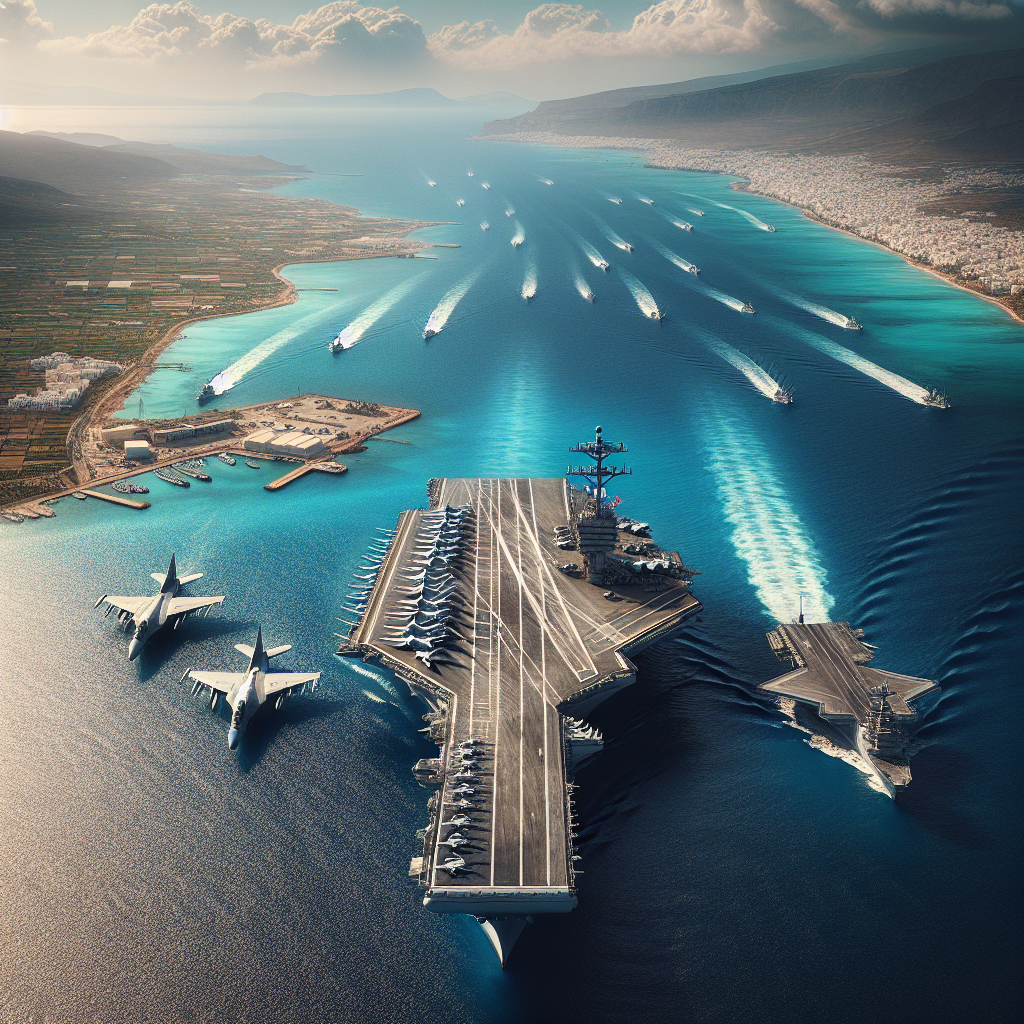
The Pentagon is assembling the largest US naval and air force in the Middle East in decades, including two carrier strike groups. According to Reuters, on Monday, the USS Gerald R. Ford aircraft carrier arrived at the Souda Bay port in Crete, Greece.
Crete is the location of a NATO military base, strategically significant for Greece, the US, and NATO in the Eastern Mediterranean region. It is only a few hours’ flight away from hotspots in the Middle East, with a straight-line distance of about 2350 kilometers/1460 miles.
The $13 billion USS Gerald R. Ford supercarrier, with a displacement of around 100,000 tons, will undergo a few days of resupply after crossing the Atlantic before continuing its eastward journey. It will then join the USS Abraham Lincoln carrier strike group already deployed in the region.
This deployment is part of the largest US military buildup since the invasion of Iraq in 2003.
With over 75 combat aircraft and advanced systems on board, the USS Gerald R. Ford can project power across the region within hours. By docking at Souda Bay, the US is sending a clear message to Iranian authorities and the world at large: America is prepared.
The visit to Souda Bay highlights Greece’s role as a steadfast NATO ally, allowing the US to use its airfields and ports.
The arrival of the USS Gerald R. Ford carrier strike group will bring the number of US Navy ships in the region to at least 16, surpassing the 11 ships previously stationed in the Caribbean.
In addition, a significant number of US combat and support aircraft have landed at bases in the Middle East and Europe.
More than 100 combat aircraft, including F-35s, F-22s, F-15s, and F-16s, have taken off from bases in the US and Europe heading to the Middle East, according to the Military Air Tracking Alliance (MATA), a team of about 30 open-source analysts who regularly analyze military and government flight activities.
The team also tracked over 100 tankers and over 200 cargo aircraft flying to bases in the region and Europe in mid-February.
Analysis of satellite images from the Muwaffaq Salti Air Base in Jordan by Planet Labs PBC showed over 50 aircraft, likely part of the US military buildup, with possibly more aircraft housed in hangars.
MATA member and researcher based in Canada, Steffan Watkins, noted the tracking of support aircraft like six E-3 AWACS aircraft flying to a base in Saudi Arabia.
These aircraft are crucial for coordinating the operational activities of a large number of aircraft.
Experts suggest President Trump may have various military options, including targeted strikes on Iranian air defense systems or direct strikes on top leader Ayatollah Ali Khamenei.
Last Thursday, Trump gave Iranian authorities a 10 to 15-day deadline to reach an agreement to resolve the long-standing nuclear dispute, warning of “really bad things” if they fail to comply.
On Friday, Trump mentioned considering limited strikes against Iran if negotiations on the nuclear program fail.
Negotiations between the US and Iran are ongoing, aiming to reach an agreement to prevent Iran from obtaining a nuclear weapon, a claim denied by Iranian officials. US envoys Steve Witkoff and Jared Kushner plan to hold new nuclear talks with Iranian officials in Geneva, Switzerland.
“Reports about a possible war with Iran are false and deliberately fabricated,” Trump added on Monday (February 23).
The President wrote, “I am the one who makes the final decisions, and I would rather make a deal than go to war. But if we can’t make a deal, it will be a very bad day for Iran, even worse for the Iranian people, who are great and kind, and such a thing should not happen to them.”