
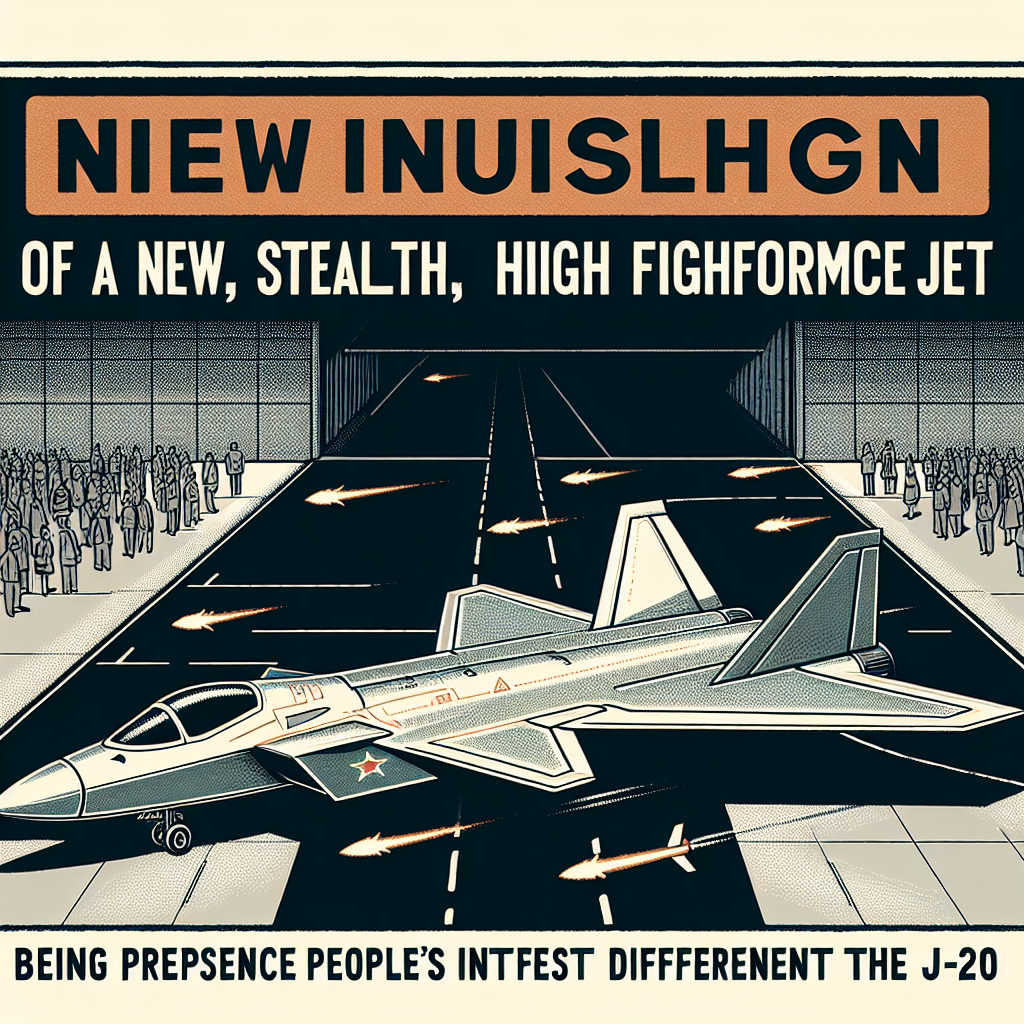
【Epoch Times News on December 29, 2024】The aviation department of the Chinese Communist Party (CCP) seems to have brought a new stealth, high-performance manned fighter jet into people’s view, different from the J-20. On December 26, within less than 24 hours, two previously unseen Chinese fighter jet designs were captured on camera, apparently undergoing flight tests. Both planes feature a tailless design, with many design elements that seem to align with the CCP’s desire to obtain sixth-generation airpower.
People’s attention was particularly focused on the first aircraft that appeared on December 26. It has a slightly larger size than the accompanying J-20 and adopts a broad triangular wing, a tailless design. From the images, the prominent cockpit canopy indicates that it is a manned aircraft. Each side of the fuselage has an engine air intake, and notably, there is also an intake at the rear of the cockpit, with what appears to be three exhaust nozzles at the tail. Based on this, some speculate that it may be equipped with three jet engines. Some analysts believe that the smaller intake at the back is to introduce cool air to cool the system and mask the infrared footprint of the engine exhaust. In short, this is a manned aircraft that pursues single-machine performance in the direction of fifth-generation fighters, possibly offering better stealth capabilities, sustained high-speed flight, larger payload capacity, and longer range than the J-20.
Strictly speaking, it cannot yet be called the “sixth-generation fighter jet” of China, as from just the appearance and flight attitude of this aircraft, it is far from sufficient to determine if it possesses many attributes of a sixth-generation fighter jet.
This aircraft may also be a type of tactical bomber under development, known in CCP terminology as a “strike bomber,” similar to Western “attack aircraft.” The CCP’s earliest such aircraft was the JH-5, modified from the Soviet MiG-19 fighter previously. Subsequently, the Xi’an Aircraft Manufacturing Company developed the JH-7 based on the J-8 fighter as a successor to the JH-5, although the CCP has not continued to develop this type of aircraft. If this newly exposed aircraft is understood as a stealth successor to the JH-7, it seems logical from a conceptual standpoint.
In fact, according to the Pentagon’s 2018 “China Military Power Report,” Beijing not only plans to build the supersonic H-20 strategic bomber but also a second stealth bomber aimed at developing a supersonic long-range combat bomber. This aircraft may be similar to the Cold War-era American F-111 and the Soviet Su-24 variable-geometry supersonic bomber, as well as the upgraded Su-34 and a stealth version of China’s JH-7 fighter bomber.
On the 26th, a second tailless aircraft appeared, which is smaller, and at least for now, it is challenging to make a judgment on it based on the lower-quality images available. It is purportedly from the Shenyang Aircraft Corporation (SAC). The J-16, J-15, and the recently unveiled J-35 are all products of this company.
The design of the first tailless aircraft reportedly comes from the Chengdu Aircraft Corporation (CAC). The J-10 and J-20 fighter jets are both products of Chenggu’s company. From the images, it can be seen that there is a “36” marking in front of the air intake on the right side of the fuselage, hence, the foreign media has labeled it as the “J-36.”
As early as September 2022, former US Air Combat Command leader Mark D. Kelly stated that the CCP is developing air combat systems similar to the US’s as part of their “Next Generation Air Superiority” plan, including a sixth-generation manned fighter jet.
At the time, Kelly pointed out that the sixth-generation airpower seen by the CCP, including future manned fighter jets, “very closely resembles what we see: radar features exponentially reduced, processing and sensing capabilities exponentially accelerated.” Another key factor is the improvement in capability through “iteration” with the help of open mission systems.
Kelly’s inference is based on his understanding of the US Next Generation Air Dominance fighter jet development plan, indicating that the CCP might make efforts in a similar direction. It is still unclear whether this new aircraft is a prototype of a sixth-generation fighter jet or a more general validation platform for testing new technologies that could eventually be applied across various platforms. The CCP has been conducting preliminary tests on various manned fighter configurations for a period of time. This development work may also include small and full-scale demonstration prototypes to test equipment and system functionality.
At least for now, evaluating the recently introduced new Chinese aircraft reliable is challenging, as many key “sixth-generation” characteristics are fundamentally hidden. For instance, artificial intelligence (AI)-driven complex flight computers and open architecture mission systems can reduce the pilot’s workload; high-quality and cost-effective stealth materials; the integration of AI-driven autonomy with human factors engineering, enabling perfect cooperation between pilots and cooperative unmanned combat aircraft/loyal wingmen; powerful and discrete long-range sensors; advanced propulsion systems (such as internally reconfigured variable cycle turbofan engines) to optimize high and low-speed performance for supersonic cruising and provide enough power for more potent radar, electronic warfare systems, next-generation computers, and even laser/microwave weapons, as well as better fuel efficiency for enhanced operational range.
The CCP intentionally “leaked” images of two prototype aircraft during significant Western holidays without releasing official statements to explain their relationship with Chinese military research projects, seemingly stirring people’s curiosity. In fact, from 2022 to 2023, there were numerous concept images on social media indicating similar plans.
However, the US Next Generation Air Dominance (NGAD) program’s sixth-generation fighter jet, which conducted a prototype test flight as early as 2020, has not been publicly revealed by the US military. The focus of the NGAD program is currently more on cooperative unmanned combat aircraft. The US Air Force has always viewed the sixth-generation fighter jet as part of a system rather than independent, high-performance airborne platforms, even though the capabilities of these aircraft are unprecedented and impressive.
The lack of public exposure of the US sixth-generation fighter jet also highlights the successful application of digital design tools and testing methods in project development. Traditionally, large-scale development projects require the construction of some prototype/demonstration aircraft to verify the integration of mission systems, and digital design and testing methods differ significantly from traditional methods in this regard, which may be the reason why the NGAD has not been seen by the public yet.
In contrast, the Chinese aviation industry has been catching up on high-performance turbofan engines for several decades. By 2025, its domestic turbofan engines seem to be finally getting close to or replacing imported Russian engines.
Currently, there is no existing supersonic stealth bomber, but in the 2000s, the US Air Force seriously considered procuring the FB-22 “Raptor Bomber” based on the F-22 stealth fighter, for tactical bomber use. If the CCP possesses a stealth tactical bomber that can be used in a limited range, it may pose a threat to US military bases in the Western Pacific (such as Okinawa, Guam) or the US forces defending Taiwan. High-speed aircraft are more suitable for specific missions compared to low-speed ones, despite both being stealthy, once detected, the subsonic H-20 would certainly be at a disadvantage when trying to flee.
This wave of publicity from the CCP, besides creating buzz, might further spark discussions in the US about the sixth-generation fighter jet, especially regarding the debate between manned and unmanned combat aircraft. Due to budgetary constraints, the US Air Force may not be able to afford all their “wish list” items. Therefore, they may need to consider how to further optimize and allocate resources and omit or simplify intermediate steps to achieve their goals.