
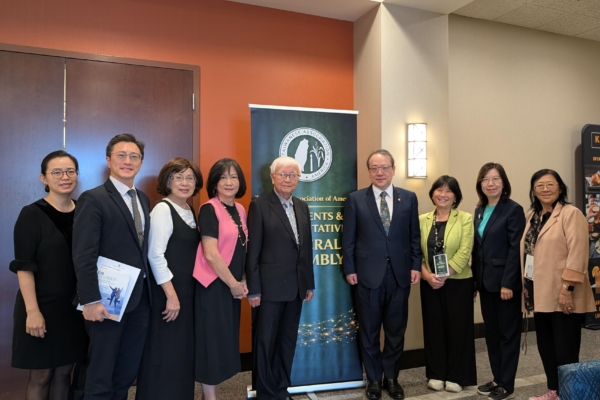
The All-American Taiwanese Association held its annual conference in Phoenix, Arizona on April 18th, emphasizing its important role in uniting overseas Taiwanese, supporting democratic development in Taiwan, and promoting Taiwan-U.S. exchanges over the past 50 years. As Taiwanese immigrants gradually integrate into mainstream American society, the organization is facing generational succession challenges and focusing on how to engage second-generation Taiwanese-Americans to ensure continuity.
Los Angeles Economic and Cultural Minister Ma Boyuan attended the conference. He recently led a delegation to the Arizona State Legislature, witnessing the passage of a pro-Taiwan resolution by both houses, reaffirming support for Taiwan’s international participation and emphasizing that UN Resolution 2758 does not authorize China to represent Taiwan. The resolution received bipartisan support and applause in the assembly.
Ma Boyuan stated that the deepening of Taiwan-U.S. relations is not incidental but the result of long-term efforts by the global Taiwanese community. Through interactions with local government officials, cultural activities, and public advocacy, the Taiwanese community has helped American society better understand Taiwan’s democratic values, including freedom, human rights, and diligence. He highlighted the importance of ongoing contacts and exchanges as a foundation for garnering international support for Taiwan.
Although Overseas Community Affairs Council Chairperson Xu Jiaqing could not attend in person, she sent a video message congratulating the representatives of the All-American Taiwanese Association and wishing the conference a successful outcome. Ma Boyuan presented letters of appreciation on her behalf to the President of the All-American Taiwanese Association, Song Mingli, and Phoenix Overseas Community Affairs Commissioner Wu Wenrui.
Chen Guiling, a consultant for the All-American Taiwanese Association from Washington, noted that since the early days of the “blacklist era,” many predecessors have been involved in community service and democratic advocacy within the Taiwanese community. She observed that about half of the attending representatives were from younger generations, indicating a stable generational succession structure within the community and emphasizing the enduring spirit of public engagement and emotional connection to Taiwan that has been accumulated over the long term.
Chen emphasized that unlike some organizations focused on economic interests, the Taiwanese Association places greater emphasis on public issue engagement and cultural identity. Members continue to contribute even without direct financial incentives, reflecting their long-standing support and identification with Taiwan.
Honorary President of the All-American Taiwanese Association Hong Maoze described the Taiwanese community in the U.S. as an “invisible ambassador” that interacts with local communities, legislators, and the public to help more Americans understand the mutual interests and security links between Taiwan and the U.S. His new book, “Stories Across the Pacific,” recounts the struggles and achievements of Taiwanese-Americans overseas, embodying their perseverance and determination.
Regarding the current state of Taiwan-U.S. relations, participants generally agreed that there is a solid foundation for further interaction between the two sides. Taiwan’s security and regional stability are closely linked, with increasing international attention towards the situation in the Taiwan Strait in recent years. Taiwanese-Americans have long played a role as information bridges, promoting peace and cooperation ideals. Hong emphasized the need for Taiwan to strike a balance between self-defense and international cooperation to garner broader support.
Chen also called for a consistent and transparent communication strategy from Taiwan to maintain trust and avoid misunderstandings that may undermine the international community’s enduring commitment to Taiwan.
Song Mingli stated that the focus of the conference was on organizational communication, charter review, and operational coordination, aiming to optimize institutional adjustments and enhance cooperation efficiency and consistency among branches nationwide. Through regular meetings and inter-area collaborations, the Taiwanese Association maintains stability in its operations and adjusts its institutional framework to accommodate the growth of the overseas community and generational changes.
During the conference, the President of the San Diego Taiwanese Association, Zeng Yingming, reported on the preparations for the 2028 Los Angeles Olympics, emphasizing the continued engagement of overseas Taiwanese in relevant activities to strengthen Taiwan-U.S. exchanges and community cohesion through resource integration.
This year marks the 55th anniversary of the East Coast Taiwanese Association, with New York Chapter President Liao Shidun announcing that New York will host the annual conference for a five-day event featuring lectures, workshops, and cultural exchanges involving representatives from the political, academic, and Taiwanese-American communities.
Liao emphasized that the conference would focus on “generational inheritance” and “connecting the second generation of Taiwanese-Americans,” aiming to strengthen the young generation’s sense of identity with Taiwan and their participation in the Taiwanese community.
Growing up in a Taiwanese community environment, Liao expressed that while the second generation has cultural ties, their involvement in the community still depends on family influences and personal identities. He pointed out the challenge of generational succession facing the community, with the first generation dedicating themselves to community service but not necessarily passing the torch to the second generation, leading to gaps in succession. However, he believed that the second generation has not detached from the community but continues to engage through various means such as cultural activities and community exchanges.
Liao stressed that the key to generational inheritance lies not in “requiring inclusion” but in allowing the second generation to naturally build an identity during their upbringing, which can then translate into action. ◇