
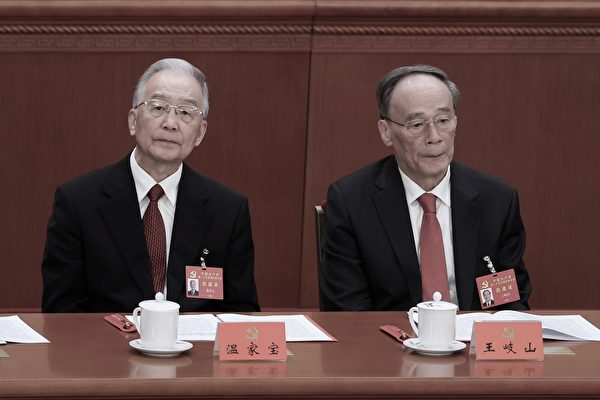
In China, many areas are strictly controlling retired senior cadres. In addition to tightening regulations on living in different places and traveling abroad for personal reasons, there is also a strong emphasis on closely monitoring ideological dynamics. Observers believe that this is largely because senior cadres are hoping for something to happen to the Communist Party leader Xi Jinping, who is increasingly becoming suspicious and has three major concerns about retired cadres traveling abroad.
According to a report from the “Hunan Daily” on April 16, the Communist Party’s Hunan Provincial Committee Organization Department, the Provincial Institutions Working Committee, the Provincial Committee’s Retired Cadres Bureau, and the Provincial Committee’s Retired Cadres Work Committee recently jointly issued a document, demanding further extension of the so-called “comprehensive strict governance of the Party” to include retired cadres.
Retired cadres bureaus in various Chinese provinces such as Hubei, Fujian, Guangdong, Shandong, Anhui, Guangxi, and Chongqing have also recently issued documents calling for enhanced control over retired cadres.
The Hubei Retired Cadres Bureau introduced a “comprehensive and full-coverage retired cadre education management system”, involving over ten provisions related to political treatment, traveling abroad for personal reasons, and more. Authorities have also established a pre-retirement conversation system, post-retirement dynamic management ledger, implemented “one-on-one” contact with party members who live in different places long-term or travel abroad, established a mechanism for monitoring ideological dynamics, and so on.
Huangshan City in Anhui Province mentioned the full implementation of “monthly routine contact and quarterly home visits” to achieve precise monitoring of the ideological dynamics of retired cadres. They also mentioned the establishment of a regular online contact mechanism for two retired cadres living abroad to have real-time insights into their lives and thoughts.
Fangchenggang in Guangxi requested strengthening management of retired cadres traveling abroad for personal reasons, conducting pre-travel reminder conversations, and filing reports upon their return. Hefei City in Anhui Province conducted a large-scale “heartwarming door knocking” and routine educational reminders.
The aforementioned official regulations all emphasize controlling the “ideological dynamics” of retired cadres.
Prominent political commentator Chen Pokong told Epoch Times that these documents appear to target lower-level senior cadres but are also aimed at higher-level senior cadres. This is mainly because senior cadres are currently in heated discussions. From top to bottom, senior cadres are dissatisfied with Xi Jinping. “Because they are all people who have come up from the era of Deng Xiaoping, Zhao Ziyang, and Hu Jintao. They do not agree with Xi Jinping’s lack of reform and his tactics resembling the Cultural Revolution. There is widespread anti-Xi sentiment among senior cadres from top to bottom.”
In May 2022, the General Office of the Communist Party Central Committee issued a document to strengthen Party building among retired cadres, prohibiting them from criticizing the central party’s major policies or spreading politically negative remarks. At that time, it was believed that the issuance of this document by the General Office of the Communist Party Central Committee indicated that many retired cadres were engaging in “unfounded criticism of the central party.”
The sudden downfall of Zhang Youxia, Vice Chairman of the Central Military Commission, and Liu Zhenli, a member of the Military Commission, on January 24 this year, caused a stir in official circles. There were previous rumors in official circles that Zhejiang Governor Liu Jie was questioned by his former retired subordinates whether “something big has happened in Beijing?” Liu Jie angrily retorted, “Are you all hoping for something to happen to the boss (referring to Xi Jinping) every day?”
Chen Pokong believes that despite Xi Jinping consolidating power through the 20th National Congress, he has not gained control but instead faces increasing opposition. “His performance is getting worse and worse, the internal economy is collapsing, and international relations are deteriorating. The dissatisfaction among senior cadres is universal. All senior cadres hope for Xi Jinping to have a mishap.”
The contents of the documents from various regions indicate that the behavior of retired cadres traveling abroad for personal reasons is a focal point of strict control by the Communist Party. Epoch Times reported exclusively in February this year that some regions have expanded the management targets from retired officials at the bureau level to retired personnel at the divisional and even departmental level of critical departments. After retirement, relevant personnel who need to leave the country no longer follow the original unit’s “filing” procedure but instead undergo “approval.”
Chen Pokong believes that the sudden publicization of what was previously done in secret by the Communist Party forces retired cadres to learn and adopt “Xi Jinping Thought,” aligning with the central authority, consuming a significant amount of manpower, materials, and financial resources. This primarily stems from the authorities’ three insecurities:
“First, retired cadres crossing the border can be a source of intelligence leaks; second, retired cadres can also become sources of anti-Xi sentiment because they are aware of the party’s internal situation; third, these retired cadres can also become sources of collaboration with overseas forces. Xi Jinping has an extreme sense of insecurity, and he is becoming increasingly suspicious. Regardless of whether these retired cadres have the courage to engage with external affairs, Xi Jinping is fearful.”
However, Chen Pokong believes that it is not easy for Xi Jinping to return to the closed-off era of Mao, so he can only use various regulations to restrain people, not only targeting retired cadres and current civil servants but also extending to the entire society. This will trigger significant backlash. “What will ultimately result from the combined forces of resentment and hatred? Xi Jinping himself can hardly predict. He is now taking a big risk.”