
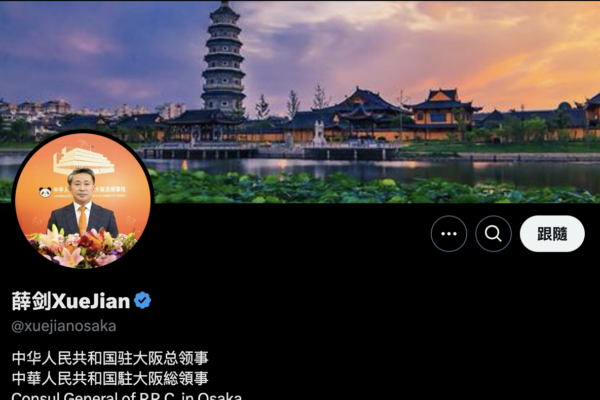
A Japanese netizen teaching at a Chinese university left a comment under a post by Xu Jian, the Consul-General of the Chinese Communist Party in Osaka, expressing that Chinese university students are extremely indifferent to “different cultures of their own country.” Xu Jian responded angrily by criticizing the interference in Chinese (CCP) internal affairs in a lengthy post, which even drew sarcastic remarks from pro-Beijing Hong Kong media.
On December 23, a Japanese netizen claiming to teach comparative culture at a university in Sichuan commented under Xu Jian’s post, stating that after living in China for 26 years, it feels like even university students from prestigious Chinese universities are extremely indifferent to “different cultures of their own country.”
Initially interacting with the Japanese individual in Japanese, Xu Jian later posted a lengthy Chinese article on the platform in great anger.
He criticized the Japanese intellectual, stating, “Always considering themselves superior ‘civilized people’ in front of Asians, especially Chinese, with a proud and arrogant attitude. They are accustomed to a superior and condescending mindset, criticizing China’s internal affairs based on their superficial understanding and speculation, as if discussing their own household affairs, readily commenting and criticizing, and even intervening casually…”
Xu Jian further remarked, “Only knowing how to chatter on about China, staring at trivial faults, and continuing to play the role of throwing rotten eggs from behind the scenes. Even if you stay in China for another 26 years and conduct so-called comparative cultural studies, you cannot truly understand the reality and future development trends of contemporary China. Only the Chinese people themselves can truly understand China.”
The Japanese netizen mocked Xu Jian, claiming that his mindset is no different from the late Qing dynasty Prime Minister of Foreign Affairs Bureau, looking down on foreigners.
Another netizen named “觀於冥冥” (observing in the dark) criticized Xu Jian in Chinese, saying, “Sir, your remarks precisely reflect that modern China has become a land of civilizational decay, long losing the vibrant appearance of the ancient Chinese civilization of etiquette. Instead, Japan has preserved more essence of traditional Chinese culture and integrated it well with modern civilization.”
“觀於冥冥” also mentioned that cultural revival is not just about having a say but truly reviving the essence sieved from the 5,000-year history of Chinese culture. How much of it does China still retain today?
Xu Jian engaged in further debates in Japanese with the aforementioned Japanese netizen on other content.
In one post, Xu Jian praised, “In the 40 years since reform and opening up, China has made great strides in development.” However, the Japanese netizen countered, “I think that saying ‘China has developed’ without paying attention to the widening wealth gap is too one-sided.”
Xu Jian responded, saying, “Where did you hear that? Even Chinese people don’t know.”
The Japanese netizen replied, “If I must comment on Mr. Xu Jian’s ‘even Chinese people don’t know,’ I believe this is a common honest recognition among many Chinese people. I truly don’t know, and I don’t want to know. I’m not blaming them for it, but I feel that China’s rich are too indifferent to the poverty and inequality issues in their own country.”
The netizen also mentioned that in China, the overall poverty rate remains high, with one-fifth of the population classified as poor. “China’s poverty problem is also quite severe. If the Communist Party government cannot properly address the wealth gap, I believe that one day the contradictions will erupt.”
Indeed, the Chinese Communist Party officially acknowledges the serious poverty issues among the Chinese people.
During the National People’s Congress press conference on May 28, 2020, then-Premier Li Keqiang stated that China has “600 million people with low to medium income, with an average monthly income of about 1000 yuan,” and “in a medium-sized city, it may be difficult to afford rent.”
Zhejiang University professor Li Shi mentioned in a recent media interview that around 65% of China’s population does not reach the standard of middle-income, with approximately 900 million people being in the low-income category.
Public records show that Xu Jian, a native of Lianshui, Huai’an, Jiangsu, aged 56, previously served as the Deputy Director of the Asia Department of the Chinese Ministry of Foreign Affairs. In November 2021, he was appointed as the Consul-General of the Chinese Communist Party in Osaka holding an ambassadorial title.
While the Communist Party prohibits the people from bypassing the Great Firewall to access foreign websites and use platforms like X, Chinese diplomats enjoy privileges. Xu Jian has 85,000 followers on X platform, where he often posts aggressive “Wolf Warrior” rhetoric, many of which praise Mao Zedong and Xi Jinping.
Pro-Beijing Hong Kong newspaper “Sing Tao Daily” published a signed editorial today, pointing out that regardless of the correctness of the Japanese netizen’s opinion about Chinese people’s “cultural indifference,” sharing personal observations is acceptable. Additionally, since the netizen is not a political figure and did not involve any “insult to China,” there seems no need for such emotional rebuttals.
Political commentator Li Linyi told Epoch Times that since the establishment of the CCP, it has been destroying traditional Chinese culture, especially evident after the Cultural Revolution. The so-called excellent traditional Chinese culture promoted by the CCP in recent years has actually removed the essence of the transmitted culture, so what is now prevailing in China is not genuine traditional Chinese culture but the CCP’s party culture. Therefore, the Japanese scholar’s description of China’s cultural desert may not be entirely wrong.
The well-known historian Yu Ying-shih has a widely circulated saying: “Where I am, there is China.” He believed that true Chinese culture is not in China today because the genuine Chinese culture and values have been distorted and destroyed by the Communist Party. Yu Ying-shih did not believe that returning to China would bring back Chinese culture.
Yu Ying-shih, originally from Qianshan County, Anhui, moved to Hong Kong in 1949 and later pursued studies in the United States.
The commentary in “Sing Tao Daily” also mentioned that while political figures should refrain from meddling in other countries’ internal affairs, ordinary people and scholars have the freedom to express such opinions.
Xu Jian’s criticism of the Japanese netizen for meddling in the CCP’s internal affairs did not go unnoticed, even by pro-Beijing Hong Kong media. However, Xu Jian himself previously posted on social media platform X, campaigning for a candidate in the Japanese House of Representatives election in October, violating the duty of diplomats not to interfere in the host country’s internal affairs, sparking a diplomatic dispute.
According to the Vienna Convention on Diplomatic Relations, diplomatic personnel have an obligation not to interfere in the internal affairs of the host country. Central News Agency reported on November 23 that the Japanese government deemed Xu Jian’s actions “extremely inappropriate” during a Cabinet meeting on November 22, requesting removal through diplomatic channels, and Xu Jian’s posts have since been deleted.
Xu Jian had also sent letters to Japanese parliament members in the Kansai region, stating that the visit of Japanese parliament members to President Lai Ching-teh’s inauguration in May was supporting “Taiwan independence” forces, sending extremely wrong political messages. He warned these lawmakers not to have any contact or dealings with Taiwan.