
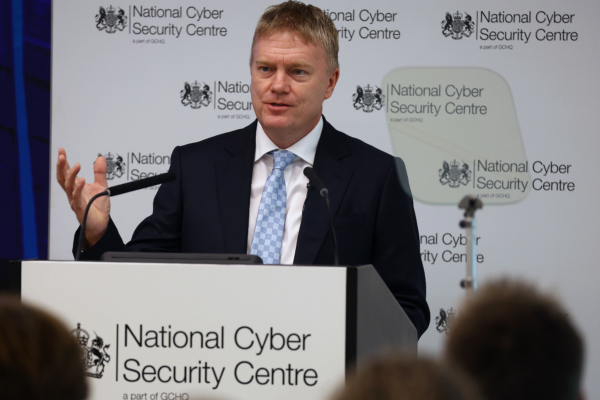
The head of the UK’s National Cyber Security Centre (NCSC), Richard Horne, warned at the annual CyberUK conference in Glasgow, Scotland on Wednesday (April 22) that the UK is facing “the most severe geopolitical shift in modern history”. He pointed out that national-level cyber attacks against the UK are rapidly increasing, with China, Russia, and Iran identified as the primary drivers of these threats.
According to data, the UK currently faces an average of 4 significant cyber security incidents per week. In the latest annual review, NCSC reported a total of 204 nationally significant cyber attacks between September 2024 and August 2025, more than double the previous year.
Horne highlighted the technological evolution of Chinese hackers, emphasizing the sophisticated nature of their cyber operations and their whole-of-state approach, making them formidable adversaries in cyberspace.
Regarding Russia, Horne noted that Moscow is transferring cyber tactics honed on the Ukrainian battlefield to target assets in the UK and Europe with sustained hybrid attacks.
He also mentioned Iran likely using cyber activities to suppress dissidents in the UK perceived as threats by Tehran.
Horne described the rapid advancement of artificial intelligence (AI) driving technological change, coupled with geopolitical tensions, leading to a period of turbulent uncertainty.
He stressed that as technology evolves, the definition of cyber security expands beyond traditional information systems to include protecting technologies like control robots and autonomous systems. This signifies that the scope of cyber security has far exceeded understanding from a decade ago, requiring organizations to continually rethink their approaches to cyber security.
Horne warned that cutting-edge AI models are being utilized to exploit vulnerabilities in existing systems at a large scale, accelerating attackers’ ability to identify and exploit weaknesses. This exposes inadequacies in the foundational cyber security infrastructure that need to be addressed promptly.
In response, UK Minister for Security, Dan Jarvis, urged collaboration between AI companies and the government to establish AI-driven cyber defense measures. Jarvis stated that such partnerships can autonomously identify and patch vulnerabilities at speeds and scales beyond human capabilities.
Amid the threats, Horne urged businesses not to rely on paying ransoms to resolve issues, especially in international conflict scenarios where ransom payments may no longer be an option. He called for a “cultural shift” within organizations.
“Whether serving on the board or working on the IT help desk, cyber security is everyone’s responsibility…it’s part of their mission,” Horne expressed.
Horne echoed the sentiments of the head of the UK intelligence agency MI6 from December last year, emphasizing that the world today is more confrontational than any time in decades.
“We are in between peace and war,” he warned, “and it’s crucial to recognize that cyberspace is a part of this competition.”