
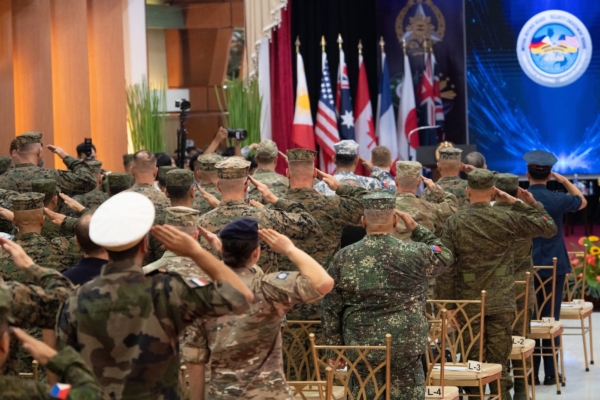
On April 20th, more than 17,000 military personnel embarked on the annual “Shoulder-to-Shoulder” joint military exercise between the United States and the Philippines, with the participation of the highest number of countries ever. For the first time, Japan’s Self-Defense Forces officially participated. Experts believe that this exercise highlights the United States’ use of strength to ensure peace and the global trend of containment against China, while Japan’s military rise serves as a warning against Chinese military expansion.
The 2026 Philippines-US “Shoulder-to-Shoulder” joint military exercise, held from April 20th to May 8th in the Philippines, saw the highest number of participating countries in history. First-time participants included Japan, Canada, France, New Zealand, and Australia continued to participate.
Additionally, around 17 countries participated as international observers, including Brunei, Germany, involving over twenty countries and partners.
Approximately 17,000 military personnel took part in this exercise, with around 10,000 from the US and 1,400 from the Japanese Self-Defense Forces. The U.S. stated that the “Shoulder-to-Shoulder” military exercise showcased the “rock-solid” alliance between the U.S. and the Philippines, demonstrating the U.S.’ commitment to a “free and open Indo-Pacific region.” The forces participating in this exercise were among the “largest scale in recent years,” and deployments would not be adjusted due to conflicts in the Middle East.
This joint military exercise will take place in multiple locations in the northern Philippines facing the Taiwan Strait and South China Sea regions, including live-fire exercises.
General Romeo Brawner, Chief of Staff of the Armed Forces of the Philippines, stated that this multinational joint military exercise aims to establish deterrence and resilience against aggressive actions in the region.
China has been increasingly assertive in the disputed South China Sea, targeting the Philippine navy and coast guard, with Beijing claiming sovereignty over almost the entire South China Sea.
Regarding the US-Philippines joint military exercise, Chinese Foreign Ministry spokesperson Guo Jiakun claimed on the 20th that military security cooperation between countries should not target third parties or harm the interests of third parties, stating that “blind containment of each other in security will only backfire.”
On February 23, the Philippine military, Japanese Maritime Self-Defense Force, and U.S. military held joint exercises in the Bashi Strait (located between Taiwan and the Batanes Islands of northern Philippines) airspace for the first time, with Japan deploying Self-Defense Force aircraft for the first time. China expressed displeasure on February 27 regarding the exercise.
Su Ziyun, Director of the National Defense Strategy and Resources Research Institute at the Taiwan Institute of National Defense and Security Studies, told Dajiyuan that China’s self-immolation rhetoric was a concept switch. “Others are taking fire prevention actions, China is systemically retaliating.”
Su Ziyun stated that the participation of the most countries in this exercise illustrated that strategically encircling China had become a global trend, debunking rumors of insufficient US military forces. Despite the ongoing conflict between the US and Iran, the “Shoulder-to-Shoulder” military exercise remained primarily led by the US. Additionally, the participation of seven countries, including Canada, suggests that despite differing stances and disputes on tariff issues within democratic nations, there is unity on security matters, particularly with regards to defense against China surpassing minor disputes within democratic countries.
“As China is an authoritarian state, its expansion naturally threatens other democratic countries. Therefore, China is playing with fire, while democratic countries are fireproofing themselves,” he said.
Former Dean of the Political Warfare College at National Defense University, General Yu Zongji, analyzed that the largest number of participating countries in this exercise reiterated the importance of peace in the South China Sea. The content of the exercise directly targets China, aiming to demonstrate the capability and determination to counter China’s military expansion.
He believed that the United States fundamentally uses its strength to ensure peace, strengthening mutual military confidence through exercises among various countries.
“Any country within the first island chain is no longer dealing with China alone. By using concepts of collective defense and single theater of operations, there is a comprehensive containment of China’s military expansion ambitions. The most important lesson that the US gained from its containment strategy against the Soviet Union during the Cold War was that reasoning with authoritarian states yields no results; displaying strength is the only way to achieve peace,” he said.
The Japan Self-Defense Forces have participated as observers in the “Shoulder-to-Shoulder” joint military exercises since 2012. However, the Simplified Customs Procedures Agreement (RAA) between Japan and the Philippines that came into effect in September streamlined the entry and exit permits for military equipment, allowing Japan to officially deploy 1,400 troops for practical exercises for the first time this year.
In addition to dispatching escort vessels such as the “Ise” and “Rai” and large transport ships like the “Shimokita,” the Japanese forces will be using the “Type 88 Land-Based Anti-Ship Missile System” on the northern coast of Luzon Island, Philippines, to participate in the “sea strike training” and carry out tasks to sink target ships.
The Japanese Maritime Self-Defense Force destroyer “Rai” sailed through the Taiwan Strait on the 17th.
Prime Minister Takamichi Hayashi, in office for only six months, swiftly took action to increase defense spending, making Japan an important player in the global defense market and enhancing Japan’s military image.
Yu Zongji believed that Japan’s current military actions are unprecedented, such as raising the defense spending goal to 2 percent of GDP, deploying new anti-ship missiles in the southwestern islands, and participating in the US-Philippines military exercises, highlighting Japan’s active role in regional security.
“For Japan, this is significant because it is restricted by the peace constitution and was unable to participate in such multinational military exercises. This participation demonstrates that the Japan Self-Defense Forces have evolved into a formal national defense force role, which is a major breakthrough and a significant warning to China. As for Japanese warships traversing the Taiwan Strait, it is a clear message to China, rejecting China’s claim of turning the Taiwan Strait into an inland sea.”
Su Ziyun interpreted that Japan’s first direct military participation reflects Japan’s increased focus on the maritime lifelines of the first island chain, as it pertains to Japan’s “life-threatening crisis.” This means that while Japan’s mainland is not under attack, changes in the surrounding environment could endanger Japan’s maritime supply lines, including oil transportation.
Ahead of Japan’s first troop deployment in the US-Philippines “Shoulder-to-Shoulder” multinational joint exercise, the Eastern Theater Command of China conducted joint combat readiness patrols in the East China Sea airspace and related sea areas on the 18th, and on the 19th announced additional deployments. The Eastern Theater Command organized a fleet of 133 warships to sail near Okinawa, passing through the critical international waterway of the Yokoate Waterway, en route to the western Pacific Ocean. The Yokoate Waterway is closer to Japan’s mainland than the Miyako Strait.
From March 27 to May 6, China issued aviation task notices in large airspace areas near the Yellow Sea and East China Sea, establishing an “SFC-UNL” (from ground to unlimited height) reserved area without publicly explaining the reason or announcing exercises.
Yu Zongji believed that China is currently feeling the pressure from the military containment led by the US with other countries, prompting counteractions. “China was already struggling with the US, and now with the rise of Japan’s military power, the combination of these two major military forces poses a significant suppression on China.”
Yu Zongji believed that Japan could soon become the world’s fourth strongest military power, which would deal a severe blow to China’s ambitions to share the Pacific military sphere with the US.