
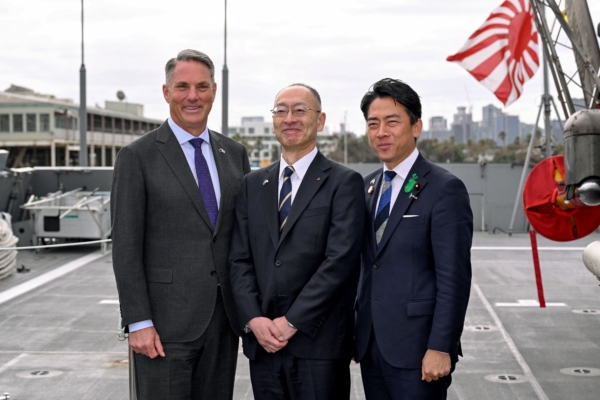
On Monday, April 19th, Japan’s largest defense company, Mitsubishi Heavy Industries, announced the official signing of an agreement with the Australian government to deliver three new multipurpose escort ships to the Australian Navy after 2029.
This deal marks Japan’s first military ship export project. Some media outlets suggest that this Japanese arms export could pave the way for the formal export of lethal weapons by the Japanese government.
In August 2025, the Australian government selected Mitsubishi Heavy Industries’ 4800-ton new-generation top-class escort ship as the preferred platform for Australia’s next generation of multipurpose escort ships. The construction will take place at Mitsubishi Heavy Industries’ shipyard in Nagasaki, in collaboration with the Australian government, the Japanese government, and the companies involved in the construction. The first completed escort ship is expected to be delivered by December 2029.
At the same time, the Australian government has pledged to invest up to 20 billion Australian dollars (14.3 billion US dollars) in building a fleet of 11 general-purpose escort ships. The first three will be constructed by Mitsubishi Heavy Industries, and the remaining eight are expected to be built by Australian shipbuilder Austal.
These new warships will replace the ANZAC-class escort ships that have been in service with the Australian Navy since the 1980s, with an age exceeding 40 years. Australian Defense Minister Richard Marles stated in August 2025 that the selection of the new Japanese escort ships was to fill the gap in Australia’s ability to acquire new-generation surface combat ships before 2034.
According to the Australian Broadcasting Corporation (ABC), Mitsubishi Heavy Industries beat Germany’s ThyssenKrupp Marine Systems to win the 10 billion Australian dollar (7.15 billion US dollar) contract, mainly because Japan promised that the Australian Navy would receive the first upgraded warship earlier than the Japanese Navy.
Australia’s recent urgent upgrade of its navy may be related to the frequent actions of the CCP in the South China Sea. The 2026 Defense Strategic Report released by Australia on April 16th highlighted the “increasing national power and military capabilities of the CCP” as a significant factor affecting security dynamics in the Indo-Pacific region.
The report mentioned that the CCP will continue to use the People’s Liberation Army and coast guard ships to advance its maritime and territorial claims in the South China Sea and East China Sea. The report also noted that the PLA frequently intercepts foreign warships and aircraft operating in international waters and airspace based on international law, with methods that are unsafe and unprofessional.
The companies involved in building the warships include Japanese companies such as NEC, Mitsubishi Electric Corp, and Hitachi, which will provide radars, antennas, and other critical core systems for the ships.
This transaction led to a 4% increase in Mitsubishi Heavy Industries’ stock price on Monday, with the company’s stock price having risen by about 75% over the past year. Mitsubishi Electric’s stock price also rose by 4%, while Hitachi increased by 0.8%, but NEC fell by 0.6%.
Aside from exporting to Australia, Mitsubishi Heavy Industries previously secured a contract from the Japanese Acquisition, Technology, and Logistics Agency (ATLA) to build three upgraded versions of the same multipurpose escort ships (FFM) for the Japan Maritime Self-Defense Force (JMSDF), with a total contract value of 128.6 billion yen (approximately 8.06 billion US dollars).
In Japan, these three new ships are referred to as “new FFM” or “06FFM.” They are positioned as the core platform for the next generation of surface vessels of the Japan Maritime Self-Defense Force, significantly enhancing anti-mine capabilities and improving integration with unmanned systems on existing ships.
The new FFM will significantly enhance air defense and radar capabilities, bringing its role at sea closer to a missile escort ship (FFG). NavalNews predicts that the new FFM will be equipped with upgraded Type 12 ship-to-ship missiles, new ship-to-air missiles (NSAM), Type 23 anti-aircraft missiles (A-SAM), and Type 17 anti-ship missiles (SSM).
Additionally, the number of units in the Mk 41 vertical launch system (VLS) on the new FFM ships will increase from 16 tubes to 32 tubes to enhance its air defense capabilities. Other upgrades include improvements in multifunction radar systems and enhanced sonar systems to further enhance the ship’s anti-submarine warfare (ASW) capabilities.