
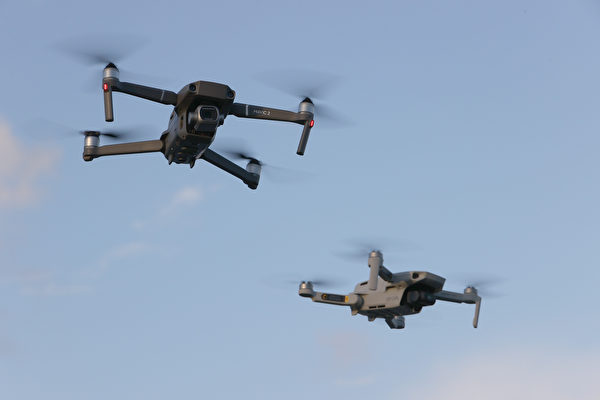
China’s drone industry is facing the strictest regulation in history this year. Officials have rolled out a series of new regulations, particularly in Beijing, where the entire city will be designated as a controlled airspace for drones starting next month. All outdoor flights will require approval, and the sale and rental of drones and core components will be banned in Beijing. The drone market is experiencing a downturn, with industry insiders expressing concerns. Experts believe that the Chinese Communist Party is caught in a dilemma between security and development, which may limit the future prospects of China’s so-called low-altitude economy.
Since January 1, 2026, the CCP’s “Administrative Punishment Law on Public Security” has made “black flights” (violations of airspace regulations) explicitly listed as illegal acts that endanger public safety. Penalties for “black flights” have been escalated to include administrative detention and even criminal detention, in addition to fines. Flight activities in most controlled areas now require at least 1-day prior permit application.
Subsequently, two mandatory standards, “Real-name Registration and Activation Requirements for Civilian Drones” and “Operational Identification Norms for Civilian Drone Systems,” will officially take effect on May 1. Starting from May 1, all drones in China must be registered with real names and their flight activities tracked in real-time.
On March 27, Beijing authorities issued the “Beijing Civilian Drone Management Regulations,” enforcing strict control over the production, sale, flight, transportation, and storage of drones. The entire Beijing administrative region has been designated as a controlled airspace, where all outdoor drone flight activities must be applied for, with specialized drone flight sites designated as needed.
China expert Wang He pointed out that Beijing has implemented the strictest control policies due to being where the top echelons of the CCP work and live. Recent incidents such as the capture of Venezuelan President Maduro, and the killing of Iran’s top leader, Ayatollah Khamenei, indicate that the U.S. may have obtained their information through various means. This has greatly intimidated the CCP, leading to the strict ban on drones flying over all of Beijing.
In Shanghai on April 17, a man who flew a drone had applied in advance through the Civil Aviation Administration of China’s Civil Unmanned Aircraft Operator Management Platform (UOM). However, just 30 seconds after the drone took off, the police called him. The man was asked to bring the drone to the police station for inspection.
The man stated that even if you successfully apply through UOM to fly a drone in Shanghai, you are likely to receive a phone call from the police after flying for about a minute. There is a high probability that you will have to go to the police station for investigation, as the police need to verify the information you reported on UOM.
Wang Xiaowen, an assistant researcher at the Institute for CCP Military and Operational Concepts at the Taiwan Institute for National Defense Security Studies, told Epoch Times that the CCP’s fear of drones has heightened since the U.S. carried out precise targeting of Iran’s leadership in the Middle East. If foreign drones must be strictly guarded against, there is no reason to allow domestic drones to fly freely, as it is difficult to distinguish between those for security purposes and potential attacks. Therefore, strict control measures are implemented, possibly impacting the industry, but this may not be a consideration for the CCP’s top echelons.
The series of measures implemented at the beginning of 2026 are considered by the public as the “strictest new regulations on drone supervision,” shaking up the market.
According to reports by mainland media Caixin, the traditional peak season for drone sales around the Chinese New Year in 2026 has seen a significant cooling of the market. Some drone dealers reported a 50% decline in sales recently; meanwhile, the resale of drones on second-hand platforms has notably increased, with prices dropping significantly.
The latest official statistics indicate that by 2025, the total number of drones registered with real names in China had exceeded 3.28 million. However, recently there has been a wave of drone enthusiasts declaring they will “abandon their drones,” with many netizens saying they intend to sell their drones. Some industry insiders frankly stated that many aerial photography practitioners are now too scared to fly, fearing flying inadvertently into unreported airspace and concerned about public security visits.
Due to the new regulations escalating penalties for “black flights” to criminal detention, some drone enthusiasts and users are worried about inadvertently crossing red lines and are reluctant to fly. At the same time, the cumbersome approval process, slow processing, and high rejection rate of flight applications in controlled areas have made compliance flights difficult. Some applicants have complained that response times to flight applications are slow, and the approval rate is as high as 90%.
Furthermore, the new regulations require enterprises to install various functions such as “operational identification” on equipment to achieve real-name registration and real-time monitoring. The rising hardware costs have caused some small and medium-sized manufacturers to panic, as they lack the capacity to comply.
Some industry professionals have stated that the new national standard mandates manufacturers to provide module-installation services for existing drones but does not clearly define who is responsible for the cost of this service. If manufacturers bear the entire cost, it will be a significant expense. If consumers pay for it, it may be challenging for them to accept paying several hundred yuan for installing a module on a device worth only a few thousand yuan, likely leading to users abandoning or turning to the black market.
The CCP authorities have emphasized the importance of balancing development and security.
On April 17, Zheng Jiansheng, the head of the Low-Altitude Economic Development Division of the National Development and Reform Commission of the CCP, stated that during the “15th Five-Year Plan” period, low-altitude economic development aims to achieve a balance between effective management, stability in operation, and utility. He also stressed that without safety, there is no low-altitude economy, promising to strengthen the full-cycle management of aircraft and implement strict safety supervision measures.
Wang He commented that the CCP views low-altitude economy as a new point of economic growth domestically, which is why a specialized department has been established for low-altitude economic development within the National Development and Reform Commission. However, the CCP also needs to meet its so-called political security requirements, creating a self-conflict. “It cannot completely strangle this industry and needs to leave some room. However, the problem is that many things are approached in a one-size-fits-all manner by the CCP, causing significant troubles for itself and falling into a dilemma between security and development.”
In recent years, the top echelons of the CCP have emphasized political security, requiring officials to think with extreme caution, with state media explaining it as “What to do in extreme situations?”
Wang Xiaowen remarked that the CCP’s extreme caution resembles paranoia. Due to the leaders’ lack of understanding of the economy and industry, they have restricted industrial development in the name of security through a single command. However, this has led to wastage and misplacement of various resources within society, likely limiting the future development of China’s low-altitude economy.
While China leads in drone scale, supply chain integrity, and cost, it is also starting to face regulatory restrictions in some Western markets.
The new model of Chinese DJI drones cannot be launched in the U.S. market due to lack of certification by the Federal Communications Commission (FCC). In Europe, there are calls suggesting that Chinese-made drones pose potential national security risks, urging for a gradual reduction in dependence on them.
Wang He stated that drones involve many sensitive technologies such as AI and communication. Due to a lack of mutual trust, the divergence of paths between the West and China in the drone field is inevitable.