
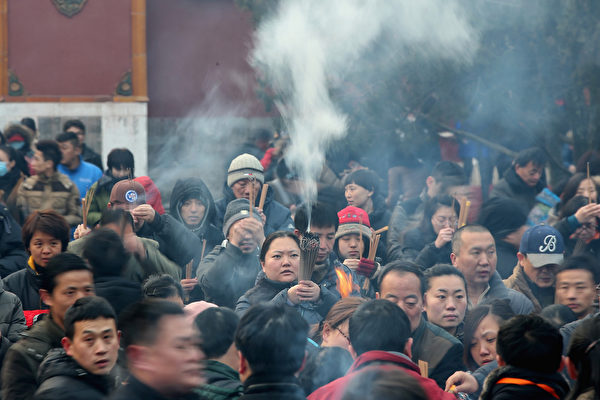
Recently, an informed source within the Chinese Communist Party’s tax system revealed that religious sites in Zhejiang, Fujian, and other areas are being required to submit financial account books, close the circulation of religious artifacts, and provide details on the charges for each religious event and overall income. The local national tax system has already notified internally that they will significantly increase tax inspections on temples. Once tax issues are detected, strict measures will be taken to recover the taxes and impose penalties.
Zhejiang’s Hangzhou, Ningbo, and Zhoushan are among the regions in China with the most intensive Buddhist activities and largest financial scale. The incense money, donations, and ticket revenues of a single temple can reach tens of millions of yuan, with some even reaching hundreds of millions of yuan.
An informed source in the Zhejiang national tax system, using the alias Yan Qin, revealed to a media outlet that, “From the central government to local finances, there is great tension. The tax authority needs to maintain the operation of the massive system. Notifications have been issued to all regions, instructing them to include temples and enterprises that have been previously overlooked in the inspection scope. Temples have long operated in a gray area, where donations, fees for religious events, and offerings have not been fully declared in the reporting system. Now, everything needs to be thoroughly investigated.”
Zhejiang, Fujian, and Jiangxi have a high concentration of temples with a large financial scale. Zhejiang has over 4,000 temples, leading the nation, followed by Fujian and Jiangxi with 3,396 and 3,260 temples respectively. Among the most profitable temples, Lingyin Temple in Hangzhou stands out, with an estimated annual income of up to 670 to 680 million yuan from 2023 to 2025, while Putuoshan’s Pujisi Temple in Zhoushan also has an income exceeding 60 million yuan per year.
Yan Qin stated that according to the tax department’s internal assessments, the actual income of temples is far higher than publicly disclosed: “We are aware that the actual income of some temples is 20% to 30% higher than reported. The current approach is a comprehensive investigation. If any concealment or underreporting is found, direct recovery and penalties will be imposed. In simple terms, the government is short of money and has to collect from these places.”
In recent years, the economic activities of temples in China have rapidly expanded. Some large temples have established stable cash flow through religious events, offerings, and cultural products. This income mainly comes from offerings by believers to ancestral tablets and requesting high monks to chant scriptures.
A person close to the temple management in the southeastern coastal region, Mr. Lin, informed reporters that the authorities have begun implementing stricter financial controls on high-income temples, including introducing a third-party auditing mechanism. He said, “Fuzhou’s Yongquan Temple, Wanfo Temple, Xiamen’s Nanputuo Temple, and Quanzhou’s Kaiyuan Temple have all received tax inspection notices. The tax system has categorized temples with annual incomes of about 5 million yuan as ‘high-income temples,’ focusing on them.”
According to internal documents of the Chinese Communist Party, issues such as “digital fundraising” and “opaque income from merit boxes” have been listed as key areas for rectification. Mr. Lin stated that the core of this operation is not just reorganization, but comprehensive takeover of the financial system: “This time it’s not about projects but about accounting. The income structure of temples was complex in the past, with some public, some temporary, and long-term offerings, and much of this money was not included in a unified account. Now everything has to be clarified, including explaining the sources of past accounts. Many temples are suddenly under pressure because they didn’t operate according to the corporate model in the past.”
He also mentioned that supervision is rapidly escalating: “I understand that some local governments have already required high-income temples to undergo similar enterprise audit management. Although the standards are not public, internally it is clear that temples with ‘large income and high cash’ are being closely monitored.”
Media practitioner Zhou Zhou from Zhejiang believes that this operation directly exposes a deep crisis in the Chinese Communist Party’s financial system. He told reporters, “With domestic demand weakening and infrastructure projects halting, the government can only maintain operations through exports and increased taxes. The funds from temples, which have not been fully incorporated into the tax system, may seem like a windfall. However, facing the massive debts left by the real estate collapse, this money can’t even begin to fill the gap.”
Earlier reports have exposed that governments in cities like Shanghai and Tianjin have turned to temples for financial support during tight financial periods. Zhou added, “Temples have become the ATM of the Chinese Communist Party, meaning that these assets have effectively been brought into its control system. This unscrupulous harvesting of divine funds is pushing the Chinese Communist Party towards the abyss of public opinion.”
—
This translated and expanded article provides an in-depth look at the recent scrutiny and increased tax inspections on temples in China, shedding light on the financial operations and challenges faced by these religious institutions in the face of growing government oversight and control.