
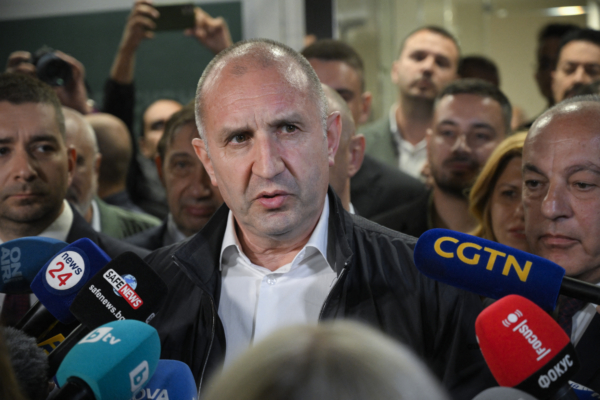
On Sunday, April 19, Bulgaria held parliamentary elections, with preliminary exit polls indicating that pro-Russian former President Rumen Radev and his party, “Progressive Bulgaria Alliance,” are likely to emerge victorious.
This parliamentary election is the country’s 8th major election in the past five years. Radev’s potential victory is expected to break the long-standing political deadlock in the country but may also lead to significant changes in the foreign policy direction of this European Union and NATO member state.
According to the latest exit polls released by the polling agency “Alpha Research” based in the capital Sofia, the “Progressive Bulgaria Alliance” garnered an impressive 44% of the votes, far surpassing former Prime Minister Boyko Borissov’s leading party, the long-ruling “GERB,” with only 12.5%.
While there are slight differences in data from various exit polls, all indicate Radev’s significant lead. If these results are confirmed, it will mark one of the best performances by a single party in decades, putting an end to the long-standing political instability.
Since the fall of communism in 1989, Bulgaria has witnessed rapid development and joined the EU in 2007. The average life expectancy has notably increased, and the country boasts one of the lowest unemployment rates in the EU. Economic security has also improved since joining the Eurozone in January this year.
However, in many aspects, Bulgaria still lags behind other EU countries, with corruption remaining prevalent and issues such as vote-buying during elections being rampant.
The cost of living has become a pressing issue since Bulgaria adopted the euro. The previous government collapsed amid protests against a new budget plan that aimed to increase taxes and social security contributions.
Riding on the wave of discontent, Radev emerged as a prominent figure.
“Alpha Research” stated that with one hour left before the polls closed, the voter turnout stood at 47%, higher than the overall turnout of 39% in the last election in October 2024.
Addressing supporters at a press conference, Radev declared, “The ‘Progressive Bulgaria Alliance’ has achieved a decisive victory. This is a triumph over suspicion, freedom over fear, and if you say so, it is also a moral victory.”
As a former fighter jet pilot, Radev’s political stance exhibits a distinct skepticism towards the EU and pro-Russian sentiments. He openly opposed providing military assistance to Ukraine and advocated during the campaign for restoring relations with Moscow to ensure the flow of Russian oil and gas resources back into Europe.
Despite Bulgaria’s current membership in the EU and NATO, as well as its status in the Eurozone, some analysts express concerns that Bulgaria may become a more pro-Kremlin force within the EU.
While Radev is poised for victory, forming a stable government in the 240-seat parliament will pose challenges that lie ahead in tough negotiations.
His pro-Russian position clashes with the pro-European reformist alliance “We Continue to Change – Democratic Bulgaria” (PP-DB), and his anti-corruption stance has distanced traditional parties like GERB.
GERB party leader Borissov seems to have acknowledged defeat in a Facebook post but also cautioned, “Winning an election is one thing; governing is entirely different. Elections determine who comes first, but negotiations will determine who governs.”
The final election results are expected to be announced on Monday.
Radev expressed his willingness to work with “PP-DB” on judicial reform and cooperation. The alliance secured the third position with an 11.3% vote share in Alpha Research’s exit poll. Radev also mentioned that a minority government is also an option.
” Bulgaria will strive to continue its European path,” he said. “But for a strong Bulgaria and a strong Europe… pragmatism is needed because in a world without rules, Europe has become a sacrifice for the ambition to become a moral leader.”