
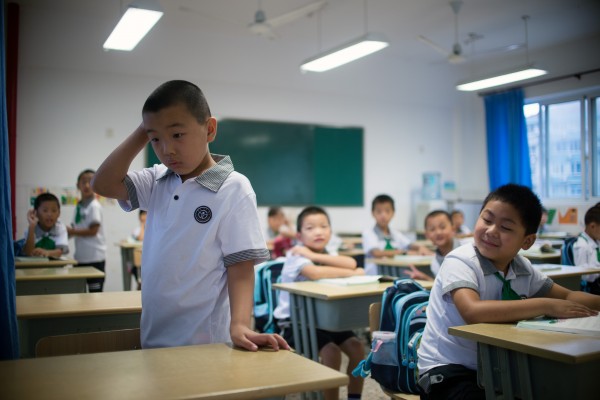
Recently, the Chinese Communist Party’s education system has mandated nationwide schools to uniformly use the “National Security Education Reader for Primary and Secondary School Students”, incorporating content such as “Party leadership” and “national interests first” into basic educational curriculum. This extension of political education to children has sparked criticism from the public.
According to a report by China’s state media CCTV News on April 14th, the reader, compiled by the CCP’s “National Textbook Committee Office” and “relevant central departments”, has been published and distributed. The reader consists of 4 volumes, covering stages from elementary to high school.
The content of the reader shows that the first volume for elementary school states that “the country’s security and stability are the result of the joint efforts of all walks of life under the leadership of the Party”; the middle school section emphasizes “national interests first”; and the high school materials revolve around the “Ten Adherences”, including principles like “adhere to the Party’s leadership in national security work” and “adhere to the overall national security concept”, integrating these relevant principles as the core of the curriculum.
Mr. Wu, a bookseller at a bookstore in Beijing, told Epoch Times in an interview that this reader will serve as the “authoritative textbook” for (CCP) national security education, to be used in conjunction with the “Xi Jinping Thought on Socialism with Chinese Characteristics for a New Era Student Reader” and ideology textbooks.
He stated, “This promotional material is not fundamentally different from the indoctrination materials of the Cultural Revolution era. This is also a significant reason why many parents choose to immigrate to foreign countries, as many parents exhibit clear aversion to this kind of brainwashing education.”
An opinion writer in Shenyang, going by the pseudonym Xiao Mu, told the reporter, “The core of what the CCP calls ‘national security’ will always be ‘political security’, ultimately referring to ‘regime security’ or ‘Party security’. By demanding elementary school students to understand ‘Party leadership’, it is clearly forcibly binding the Party and the nation together, redefining the meaning of ‘security’. Teaching children from a young age to believe that ‘without the Party, there is no safety’ is an extremely insidious political deception.”
He continued, “The objective of this reader is not for students to understand security, but for them to accept power structures and learn to obey authority. Shaping this kind of cognition during the educational stage is a reinforcement of political control. Can parents agree to this? Anyway, I have already sent my child abroad.”
Ms. Xue, a retired teacher from a middle school in Hunan, said, “Recently, Xinhua News Agency and media have been promoting these materials. Doing so will weaken the independence of teenagers in their thinking, making them more prone to obey authority, cultivating political lackeys who absolutely obey authority.”
Ms. Xue expressed, “The CCP’s reader plants seeds of fear and absolute obedience in the hearts of children, turning students into ‘components’ that uphold its rule, rather than individuals with modern civic awareness.”
In recent years, the CCP has been intensifying ideological arrangements in schools. From requiring university teachers to avoid discussing “universal values” to universally introducing national security readers in primary and secondary schools, and advancing through the administrative system from top to bottom. In minority areas such as Xinjiang, Tibet, and Inner Mongolia, authorities have scrapped ethnic language teaching and fully implemented Mandarin as the medium of instruction, sparking ongoing controversy.
Scholar Mr. Du believes that the education method implemented by the CCP authorities, “starts from kindergartens. My friend’s child is only 5 years old and says ‘Grandpa Xi’ at the dinner table. I think he’s been influenced in a negative way. When a system needs continuous indoctrination to maintain identification, it indicates that its stability has issues.”
Mr. Du stated that as social contradictions increase in Chinese society, the official attention to the younger demographic continues to rise, presenting a clear trend of making education arrangements more youth-oriented, with educational content and political requirements becoming more tightly bundled. Such practices are not unprecedented in history and are often associated with ideological management under highly centralized systems, indicating that the education system is being used to shape the political stance of the next generation in advance.