
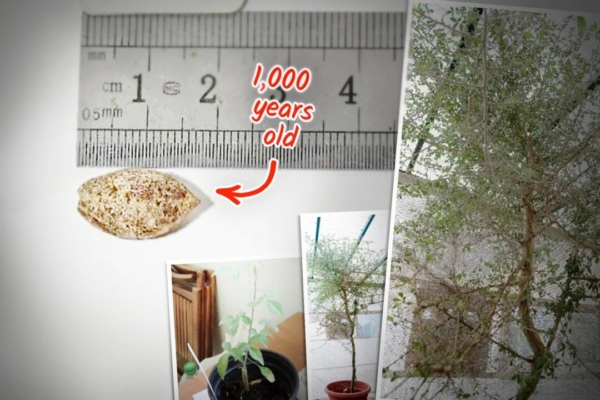
A thousand years ago, a wild bird or small animal carried a seed smaller than a fingernail, dropping it into a cave in Israel. Modern archaeologists have uncovered it. After careful cultivation, it sprouted and grew into a tree. A mystery lies within: a passage in the Bible mentions a tree whose fragrant sap was once used for medicinal purposes and highly valued. Could this tree be the revered Jewish balm tree mentioned in ancient texts?
According to the Bible, the Three Magi brought gold, frankincense, and myrrh for baby Jesus. The latter two resins have long been esteemed for their fragrances, known to exude from the pierced bark of trees belonging to the Commiphora genus. While some species of Commiphora still exist, others are believed to have become extinct long ago, disappearing since biblical times. However, a late 1980s archaeological excavation may have unearthed a lost secret of the Bible: the aforementioned seed preserved in a cave in a desert valley.
Archaeologists from the Hebrew University of Jerusalem discovered this tiny seed while excavating the cliff-ridden limestone caves in the Northern Judean Desert of the Dead Sea-Jordan Rift Valley. Many of these caves were once solitary cells for monks and shelters during Jewish and Roman wars. Among man-made artifacts like beads, pieces of cloth, woven ropes, and 35 sets of adult and child skeletons, a seemingly intact seed was found. The seed, measuring only 1.8 centimeters in length and weighing 0.565 grams, is believed to have been carried in by an animal.
The seed, along with other artifacts, is stored at the Hebrew University. Decades later, Dr. Sarah Sallon, head of the Hadassah Medical Center, selected the seed for testing from collected archaeological botanical materials. A new hypothesis subtly referencing the Bible emerged.
“We wanted to know if it might be the ancient precious balm of Gilead tree or represent an extinct (or at least locally extinct) species of the Commiphora genus implied by early biblical texts,” the authors of a study published in the journal Communications Biology in September 2024 wrote.
Scientists used radiocarbon dating on the woody outer shell of the seed, determining its age to be between 993 and 1202 AD. It could be over 1,000 years old.
In 2010, researchers soaked the seed and planted it for germination in a greenhouse at an Israeli sustainable agriculture center. Five weeks later, a sapling emerged, named “Sheba.”
Today, Sheba is a 14-year-old deciduous tree standing at 10 feet tall, with light green bark shedding into papery flakes, typical of the Commiphora genus. Chemical and DNA analysis of its leaves led to several conclusions. According to the authors, Sheba does not produce myrrh, the precious resin offered by the Three Wise Men to baby Jesus. But could it be the Jewish balm tree mentioned in the Bible?
“Our initial hypothesis was that ‘Sheba’ might be a candidate for the historical ‘balm of Judaea’ tree,” the authors wrote. However, tests revealed that Sheba’s resin lacked the aromatic qualities of an extract called “tsori,” found in Jewish aromatic compounds. Thus, scientists ultimately debunked the earlier notion.
However, after Sheba exhibited therapeutic properties present in tree species historically native to the region, researchers formulated a second hypothesis. They observed the presence of triterpenoids, compounds with anti-inflammatory and anti-cancer properties. The existence of these compounds proves that Sheba is a previously unknown Commiphora species with “distinct characteristics.” This intriguing prospect opens doors to enticing new possibilities for identification.
The authors remain hopeful in their quest to find the esteemed Jewish balm tree (revered tree in the Bible) and conclude: “If the Jewish balm tree were able to survive as a living Commiphora species today, scientists may not yet be familiar with it.”