
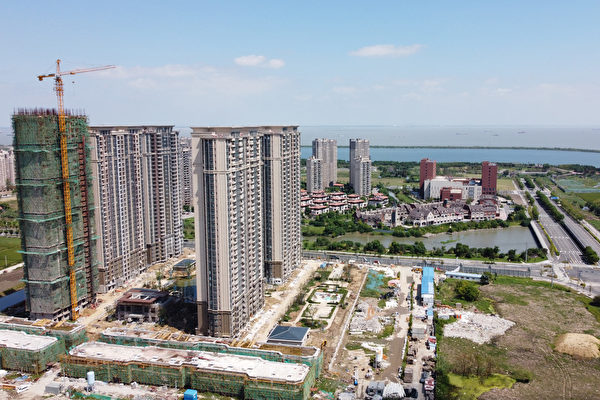
Recent days in Suzhou, one of the leading economic cities in China, residents have revealed a significant downturn in the local economy, with numerous factories shutting down, stores closing, workers losing their jobs, and foreign investment withdrawing, leading to a widespread economic collapse.
Experts point out that the current economic situation in Suzhou reflects a deep-rooted structural dilemma, where the growth model built on foreign investment exports and cost advantages is no longer sustainable. The new growth drivers have yet to fully mature, while China’s economic slowdown, industrial restructuring, and employment pressures are expected to become the norm for the foreseeable future.
On April 17th, Zhang Ailing (pseudonym), a female owner of a noodle shop in Suzhou, told Epoch Times, “This year is not as good as before, just trying to sustain. Several shops around me have closed down, and everyone is struggling. With elderly and children to support, I’m just trying to make ends meet. Opening a store now is not about making money but about survival.”
She expressed, “There are noticeably fewer people eating out on the streets. Many factories in the area have closed down or relocated, resulting in significantly fewer people dining out.”
Zheng Pengfei (pseudonym), an intermediary working at a job placement agency in Suzhou, interacts with numerous job seekers daily. He told reporters, “Many people have come to Suzhou to find work this year, but many have returned home unable to find a job. It’s very tough to find work this year. Either the wages are low, or factories don’t want women, or they don’t want men, or they don’t want those with low education levels, or they don’t want older individuals. Many have been out for a month without finding a job, having no money on them, and even no place to stay, almost starving outside.”
He said, “You can’t be too picky when looking for a job now; you just have to find something to transition.”
Lin Zhigang (pseudonym), a semiconductor engineer from Anhui who has gone through divorce and unemployment, recently arrived in Suzhou in search of job opportunities.
He told Epoch Times, “In Suzhou these days, the average salary for ordinary people is only about seven to eight thousand, and even a monthly salary of over three thousand is not common. Parking costs me 50 yuan for one night, a shared room without a private bathroom costs 1500 yuan, and with a bathroom, it costs 2500 yuan. Eating casually costs at least thirty or more, and the prices of groceries are about twice as high as in my hometown Anhui. The average income in Suzhou seems unable to support such high expenses.”
Financial training instructor Wei Ming (pseudonym), who has been involved in enterprise planning for seven years and assisted over five hundred business owners in obtaining loans, revealed to reporters, “The economic situation here is not as good as before, doing business in Suzhou is quite brutal. Many business owners lose sleep because of a month’s rent. Mainly the tourists are visible, filming videos for social media, very few local actual consumers, tourists come into shops, ask for prices, and then leave.”
He also mentioned, “The city management here is strict, penalties are imposed frequently, the current environment is very poor, doing business in Suzhou is very difficult.”
A video shot by a netizen on April 12th has been widely circulated online. The video shows that although the registered population in Suzhou reaches as high as 12.98 million, the streets are empty, tourist attractions are deserted, malls are vacant, hotels have no guests, office buildings are deserted, factories are abandoned, and even the rural areas have no one around, with rental notices posted everywhere.
The video narration stated, “In the manufacturing sector of the Yangtze River Delta, Suzhou and Kunshan were once the most prominent star cities, as they attracted numerous Taiwanese enterprises, electronics manufacturers, and export-oriented industries… However, in recent years, a visible change is taking place: foreign companies pulling out, factories shutting down, workers losing jobs, and the streets deserted.”
Another segment of the video gathered testimonials from multiple local residents, reflecting the sentiments of more people. Several residents expressed, “Suzhou used to be known as the most powerful prefecture-level city in the universe, but now, due to the massive exodus of foreign enterprises to Southeast Asia, the entire situation has undergone a tremendous change…”
A woman in the video listed the “Eight Oddities of Suzhou”: a trend of office workers bringing packed meals collectively to save money, stagnant property sales despite the sliding prices, college graduates facing immediate unemployment, prime commercial spaces plastered with rental signs, a surplus of ride-hailing drivers compared to passengers, malls experiencing downturns, vacant office buildings turning into ‘ghost buildings,’ and an increasing number of food delivery riders with decreasing order volumes. She questioned, “What has happened to this city?”
While ordinary people in Suzhou are facing real hardships, official figures present a different narrative. According to data released by the Suzhou Statistics Bureau in February 2026, Suzhou achieved a 5.4% growth in regional GDP in 2025. The official report stated that industrial production in Suzhou had “steadily increased,” total imports and exports hit a “historic high,” and per capita disposable income of residents rose by 4.2%.
The official media described this report card as “making progress amidst stability and enhancing quality in progress,” claiming that Suzhou successfully concluded the “14th Five-Year Plan.”
However, within the same official data, several details have garnered external attention: a 6.5% decline in fixed asset investment, a 0.3% decrease in overall consumer prices, and a mere 2% growth in total retail sales of consumer goods. These discrepancies clearly contradict the pronounced economic prosperity claimed by the authorities.
In reality, Suzhou’s economic downturn in recent years is closely linked to the massive exodus of foreign investments.
As early as 2018, a report from the Yangtze Industry and Economy Research Institute indicated that 20 well-known foreign companies had closed operations in Suzhou, including Nike, Adidas, Philips, Nokia, Seagate, and Nippon Electric Corporation, among others, relocating their businesses.
In 2024, mainland media NetEase reported that widespread news of numerous foreign companies withdrawing from Suzhou and over twenty thousand foreign enterprises closing down had circulated online. Suzhou officials promptly refuted these rumors, stating that the number of foreign companies in Suzhou had not decreased but had increased compared to the previous year. However, the report highlighted that despite the unchanged number of foreign enterprises on record, actual foreign capital utilization in Suzhou had decreased by nearly a quarter in the first ten months.
The report also pointed out an anomaly: regardless of the increasing number of domestic and foreign companies in Suzhou reported by official statistics, office supplies consumption had decreased by forty percent, a trend that could not be explained by normal business operations.
Concerning the various chaotic aspects of Suzhou’s economy, Professor Sun Guoxiang from the Department of International Affairs and Business at Nanhua University in Taiwan provided a systematic analysis during an interview with Epoch Times.
Professor Sun stated that describing Suzhou as experiencing a “collapse overnight” may not be entirely accurate. Still, he pointed out that a more realistic description would be that Suzhou is in a period of structural deceleration due to external shocks and internal transformations intertwining.
He emphasized that this is not just an issue for one city but a reflection of China’s export-oriented economic model facing challenges amid current international and domestic environment changes.
Regarding external pressures, Professor Sun indicated that with the escalation of US-China strategic competition and the increasing trend of global supply chain diversification, many multinational corporations that heavily relied on China as a manufacturing base are gradually shifting their production capacity to Southeast Asia and India.
He explained, “Suzhou has long depended on foreign investment and export-oriented manufacturing, making its economic structure highly sensitive to external demand. When orders shift and investment slows down, it directly impacts industrial output and the employment market.”
Concerning internal pressures, he pointed out that the continuing slump in China’s real estate market has led to a decrease in local government fiscal revenues, squeezing their capacity for infrastructure and public spending. The accumulation of debts in local financial platforms and enterprises has made both government and businesses more conservative in their investment decisions.
“Even though Suzhou has industrial foundations, it is challenging to drive economic growth through traditional investments,” Professor Sun emphasized.
Professor Sun concluded, “The current state of Suzhou’s economy reflects a deep-seated structural dilemma, where the growth model built on foreign investments, exports, and cost advantages is no longer sustainable, and the new growth drivers are yet to fully mature. The slowdown of China’s economy, industrial restructuring, and employment pressures are expected to become the norm for the foreseeable future.”