
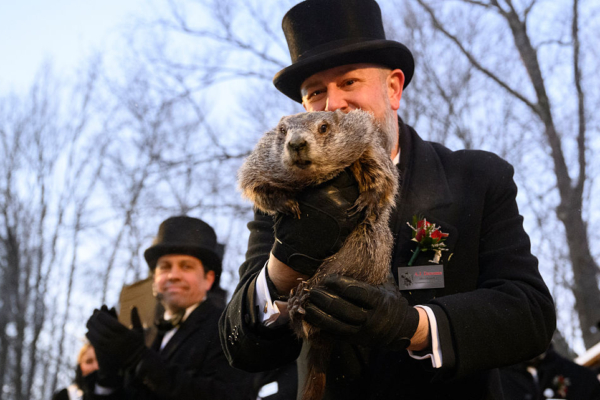
On February 2, 2026, in the midst of extreme cold weather in the eastern part of the United States, the famous groundhog Phil made his winter prediction.
In the morning of February 2nd, the annual Groundhog Day ceremony was held in the town of Gobbler’s Knob, Pennsylvania. Thousands of spectators gathered to watch as Phil was pulled out of his warm burrow. Upon seeing his shadow, it was predicted that there would be six more weeks of winter weather.
Groundhog Day is not a federal holiday. According to tradition, if Phil sees his shadow, it means six more weeks of winter, while the absence of a shadow signifies an early spring.
Every year on February 2nd, groundhogs across the U.S. predict the weather, with Phil from Punxsutawney, Pennsylvania, being the most renowned. Since the tradition began, Phil has seen his shadow a total of 110 times, indicating that his predictions of a prolonged winter are quite common.
Groundhog Day coincides with the Christian holiday Candlemas. Some of the traditions associated with Groundhog Day are said to have originated from Candlemas. This holiday was initially observed by Europeans to predict the best time for planting crops. The Old Farmer’s Almanac notes that the observation of bears or badgers in Europe was later replaced with groundhogs by German immigrants in Pennsylvania.
Regardless of Phil’s prediction, astronomical winter officially ends with the spring equinox on March 20th at 10:46 am (Eastern Time). However, weather conditions, much like Phil’s forecasts, are always unpredictable. Phil has been predicting the weather since the late 19th century, with claims that it has been the same groundhog, though whether it truly is remains a mystery.
While Phil is considered the most experienced weather forecaster in the world, analysis from the National Oceanic and Atmospheric Administration (NOAA) shows that his accuracy in predictions over the past two decades is only around 35%. Last year, Phil predicted another six weeks of winter, but the outcome proved otherwise.
The National Weather Service’s Climate Prediction Center forecasts that for the month of February, temperatures in most eastern regions of the U.S. are expected to be lower than normal, while the western and southern plains may experience higher temperatures, possibly leading to an early spring.
This winter in the United States has been a tale of two extremes. Regions east of the Rockies have faced repeated waves of bitter cold, while areas from the Rockies to the West Coast, including cities like Phoenix and Las Vegas, have enjoyed the warmest winter in recent memory.