
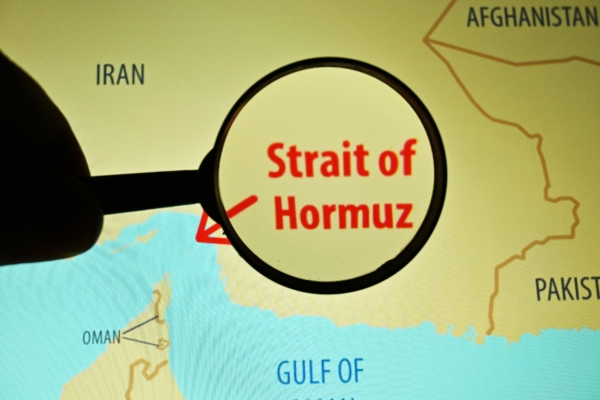
As the United States enforces a naval blockade against Iran, the Chinese Communist Party, in addition to no longer being able to obtain Iranian oil through the Strait of Hormuz, has also seen its Middle East agency business through freight forwarding (freight agency) companies at least halved, with shipping costs soaring threefold due to detours through UAE land-sea combined transportation routes.
According to a report by “First Financial” on April 16, Li Hao (alias), the sales manager of an international freight forwarding agency based in Guangdong, stated that due to the closure of the Strait of Hormuz, the volume of the company’s Middle East agency business has been cut by at least half, something the company has never experienced in the past decade.
The shipping companies that Li Hao’s company connects with come from all over the world. Currently, these shipping companies have adjusted their routes for Chinese exports to the Middle East to ports in the UAE such as Khalifa Port and Fujairah, to avoid conflict areas and ensure smooth transportation of goods.
Many freight forwarding industry insiders interviewed have introduced that the detour through land-sea combined transportation in UAE has become one of the important alternative channels for Chinese goods to enter the Middle East, but this emergency route comes with high costs, weak timeliness, and long-term challenges such as port congestion.
On April 14, Mr. Chen, a route manager at a large international freight forwarding agency in China, told “First Financial” that under normal circumstances, the freight cost for a standard container shipped from Shanghai to the Middle East was only three to four thousand US dollars. Now, the basic shipping cost has risen to five to six thousand US dollars, plus various additional fees such as war risk surcharges imposed by shipping companies, the additional cost per container has increased by three to five thousand US dollars.
After comprehensive calculations, the transport cost for a single container from Shanghai to the Middle East has skyrocketed to as high as 11,000 US dollars, equivalent to 75,000 Chinese yuan, nearly three times higher than the highest freight cost during normal times.
At the same time, the transportation efficiency has also significantly decreased. Due to factors such as route detours, port congestion, and land transportation transfers, the delivery period for goods has been extended by more than a week compared to before, further increasing the operational risks for businesses.
The report stated that what puts additional pressure on manufacturing enterprises is that almost all of the additional transportation costs are borne by the sellers. According to announcements released by shipping companies, additional costs incurred from route adjustments, port delays, transfers, as well as related risks are all to be borne by the cargo owner or shipper.
Interviewed industry practitioners generally believe that relying solely on existing route layouts and contract agreements is no longer effective in coping with the current shipping risks for freight forwarding agents and foreign trade enterprises. There is an urgent need to anticipate and assess in advance the potential chain reactions that may arise from changing ports, detours, transfers, and the increase in various additional fees.
The report mentioned that Li Hao observed from the frontline of the market that the demand in the Middle East market is showing significant differentiation: essential consumer goods like daily necessities and basic building materials still have strong demand, while the demand for non-essential consumer goods such as leisure and entertainment has significantly contracted. This change directly leads to many factories in Yiwu facing a shortage of orders in related categories.
On April 12, according to a report by “Daily Economic News”, Xu Yan, the president of the Yiwu Cross-border E-commerce Association, revealed that the situation in the Middle East has brought significant impact to some businesses in Yiwu operating in the Middle East market, “in the past month, orders from the Middle East market for some businesses have decreased by 50% compared to the same period last year.”
Ding Yandong, a Ningbo foreign trade merchant, told “Daily Economic News” that 40% of his customers are from Middle Eastern countries. Now he not only has to deal with the situation where Middle Eastern customers are not placing orders, but also faces the triple pressure of rising shipping costs, raw material costs, and exchange rate fluctuations.