
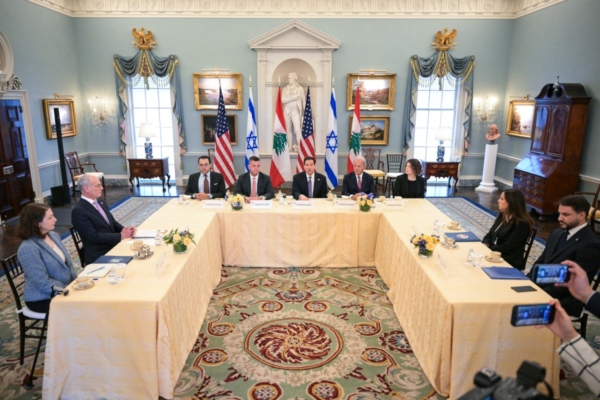
Israel and Lebanon held a historic meeting at the US State Department on Tuesday, April 14. The initial round of negotiations lasted about two hours, with Israel stating that they found themselves “on the same side” after the talks. The US State Department also described the negotiations as “productive”.
The negotiations were chaired by US Secretary of State Rubio, with the main representatives being Israeli Ambassador to the US Yechiel Leiter and Lebanese Ambassador to the US Nada Hamadeh Moawad.
After the talks, Israeli Ambassador Leiter praised the Lebanese government for not succumbing to pressure from Hezbollah. Hezbollah had demanded that the Lebanese government cancel the negotiations with Israel before the talks began.
“We discovered today that we are actually on the same front. This is the most positive outcome of our meeting,” Leiter said. “We are both committed to freeing Lebanon from an occupying force named ‘Hezbollah’ led by Iran.”
The Israeli ambassador also stated that Hezbollah has been “weakened to an unprecedented level” and that Israel will never allow Hezbollah to launch missiles at Israeli civilians.
Leiter mentioned that the meeting proposed “several suggestions and recommendations,” and after submitting these to their respective governments, they may “meet again in Washington in the coming weeks to continue discussions”.
Lebanese Ambassador Moawad stated that the “date and location” for the next direct negotiations between Israel and Lebanon will be announced in due course, noting that Tuesday’s “preliminary talks were constructive.”
The US State Department issued a statement, saying that this meeting marked the first significant high-level contact between Israel and the Lebanese government since 1993. The participants had “productive” discussions on the steps to promote direct negotiations between Israel and Lebanon.
The statement introduced the negotiation circumstances, indicating that all parties agreed to “initiate direct negotiations at the agreed time and place.” Israel expressed support for disarming all terrorist organizations within Lebanon and dismantling all terrorism infrastructure, promising to work with the Lebanese government to achieve this goal and ensure the safety of both nations’ people. Israel also committed to participate in direct negotiations to address all unresolved issues and achieve lasting peace, thereby enhancing the security, stability, and prosperity of the region.
The statement also mentioned that Lebanon reiterated the urgent need to fully implement the ceasefire agreement announced in November 2024, emphasizing territorial integrity and the principle of national sovereignty. Lebanon called for a ceasefire and concrete measures to address and alleviate the serious humanitarian crisis caused by the ongoing conflicts.
Following the outbreak of the Iran war, Hezbollah began firing at Israel in support of Iran, dragging Lebanon into the broader conflict. Israel subsequently conducted ground military operations and airstrikes in Lebanon to eliminate the threat Hezbollah posed to Israel. Israel’s military operations in Lebanon are ongoing.
Prior to the negotiations between Israel and Lebanon on Tuesday, Israeli Foreign Minister Gideon Saar had expressed at a press conference, “We hope to achieve peace and normalization of relations with Lebanon. There are no major disputes between Israel and Lebanon, but the issue lies with Hezbollah.”
Saar noted that the focus of the negotiations would be on disarming Hezbollah. He added that Hezbollah poses a threat to Israel’s security and Lebanon’s sovereignty, stating that “this issue must be addressed before moving to the next stage.”