
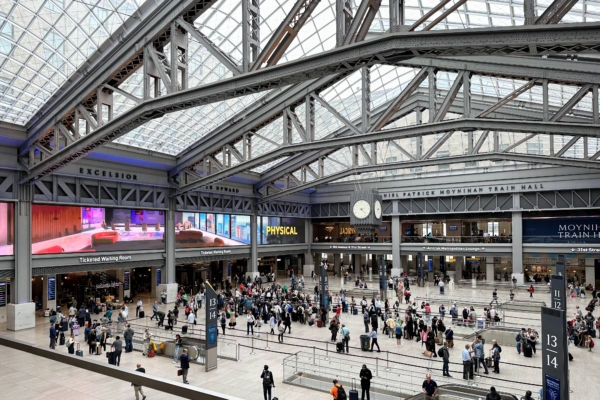
The start of January 4th this year marked a crucial turning point for commuters on the Long Island Rail Road (LIRR) and Metro-North Railroad. The Metropolitan Transportation Authority (MTA) of New York announced the introduction of the new “CityTicket Day Pass,” officially replacing the longstanding round-trip ticket system. The goal is to bring some “stress relief” to the upcoming fare adjustments through a more simplified and flexible approach.
Since the implementation of the new unlimited CityTicket Day Pass, passengers can ride specific routes within designated areas an unlimited number of times within the validity period of the pass. Whether dinner runs late, missing the planned train, or sudden changes in plans, there’s no need to worry about ticket expiration. The unlimited pass becomes effective upon purchase and is valid until 4 a.m. the following day.
The appeal of the one-day unlimited CityTicket for specific commuting goals is particularly evident. For instance, on one of the busiest city routes of the Long Island Rail Road, between Flushing Main St Station and Penn Station in Manhattan, many individuals travel multiple times between Manhattan and Flushing in a day for work, business, appointments, or last-minute meetings. With the one-day pass, these passengers who engage in frequent back and forth trips on the same day no longer need to calculate whether single tickets are cost-effective, nor do they have to worry about delays affecting their return journey. For the price of two regular tickets, they gain the flexibility of unlimited travel for the entire day.
The peak-hour one-day unlimited CityTicket is priced at $14.50, while the off-peak cost is $10.50. On weekends, the one-day pass is the same as two off-peak single tickets, providing a day of unlimited travel for the original cost of two tickets.
This adaptation in commuter fare can also be seen as a result of changes in commuting patterns post-pandemic. With remote and hybrid work becoming the norm, the traditional “daily back and forth” round-trip tickets are gradually losing their previous necessity. In response, MTA is introducing more flexible ticket options, reflecting the railway service’s attempt to adapt to changing passenger behaviors.
With the introduction of the new system, the Long Island Rail Road and Metro-North Railroad will also undergo comprehensive fare adjustments:
– Peak-hour single CityTicket prices will increase from $7 to $7.25, while off-peak single ticket prices will rise from $5 to $5.25, including for Far Rockaway tickets.
– City Zone single trip fares will align with CityTicket prices, ensuring that passengers within Brooklyn, Queens, Manhattan (LIRR), the Bronx, and Manhattan (Metro-North) will not pay more than the specified limit.
Monthly and weekly ticket prices will increase by up to 4.5%, but they will still remain below pre-pandemic levels and will not exceed $500.
Mobile App Promotion: Ride 10 times in two weeks, get 1 ride free
MTA has also introduced a new incentive for mobile users: after completing 10 peak or off-peak single trip journeys within 14 days, customers will receive the 11th ride free within the same period, exclusively for mobile ticket purchasers.
With the introduction of the “unlimited daily ride pass,” round-trip tickets will soon become a thing of the past. The validity period for all single trip tickets (paper or mobile) has been extended uniformly until 4 a.m. the day after purchase, further simplifying the rules. However, MTA emphasizes that passengers must still activate their tickets before boarding.
To streamline ticketing processes and speed up ticket inspections, based on the new regulations released by the Long Island Rail Road and Metro-North Railroad, passengers who repeatedly purchase tickets from ticket inspectors (or via the TrainTime App) after the train has departed, or activate e-tickets after boarding, may face an additional fine of $2, increasing the total penalty from the current $6 to $8. The practice of activating tickets on board will no longer be applicable.
The $8 fine must be paid upfront before purchasing a new e-ticket. In case passengers violate the regulations, the TrainTime App will display a warning message stating, “According to the electronic ticket policy, tickets must be purchased and activated before boarding. Our records show that your most recent ticket usage did not comply with this policy.”
However, for the elderly who are unfamiliar with smartphones or occasional passengers, the new rule that forgetting to activate e-tickets may result in penalties is viewed as another invisible barrier, causing concerns for many passengers.
The new policy also retains the social welfare program: senior citizens, individuals with disabilities, and Medicare beneficiaries (holders of the red, white, and blue Medicare card) can enjoy discounted fares at all times, including during peak hours. In terms of family outings, children aged 5 to 17 can travel for $1 with an accompanying paying adult, even during peak hours.
The attention drawn to this wave of fare adjustments is closely linked to the critical role of the Long Island Rail Road in the transportation and economic structure of the Greater New York metropolitan area. As one of the busiest commuter rail systems in North America, the Long Island Rail Road carries over 350,000 passengers daily on weekdays, connecting Manhattan, Brooklyn, Queens, Nassau County, and Suffolk County through high-frequency services, serving as a core option for hundreds of thousands of commuters to avoid traffic congestion and reduce commuting costs.
The strength of the Long Island Rail Road lies not only in its capacity but also in its “directness.” With the completion of the East Side Access project, trains can now directly reach the new station at Grand Central Madison below the existing Penn Station, forming a dual-core layout of “one east and one west,” serving both sides of Midtown Manhattan. For commuters, this means not just another terminal but a reduction in transfers and commuting time.
On a regional development level, Long Island’s economy and housing market heavily rely on the railway system. Several studies indicate that the current lifestyle of “living in the suburbs and working in Manhattan” on Long Island is nearly unsustainable without the Long Island Rail Road. The railway not only broadens the accessibility of the labor market but also stimulates “transit-oriented development” along the route, leading to downtown revitalization and mixed-use residential and commercial developments.
In local Long Island areas, most stations are located near main streets or commercial corridors, allowing passengers to walk or transfer to buses to shopping centers, dining districts, and local downtowns upon disembarking. This spatial arrangement makes the railway an essential engine driving local consumption, foot traffic, and commercial activities, rather than just being “commute-specific.”
Overall, this is not a year of “freezing fare hikes.” While ticket prices are increasing, MTA is attempting to exchange passengers’ understanding with simpler rules and more flexibility.
From this perspective, MTA’s introduction of the unlimited daily pass, aiming to replace the round-trip tickets with a more flexible fare system, is also to some extent responding to the evolution of the Long Island Rail Road’s function – no longer solely serving “fixed-time, fixed-route” commuters but catering to diverse needs such as work, leisure, shopping, and family travel.