
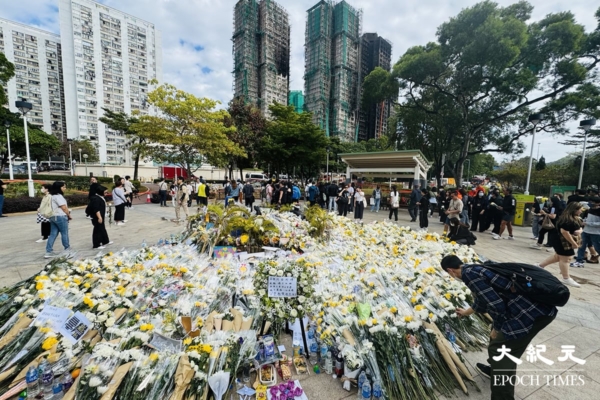
Last Wednesday, the most serious fire in recent years in Hong Kong occurred at the Hung Fuk Court in Tai Po, resulting in over a hundred casualties. Today marks the “seventh day” memorial for the victims, with the entire city shrouded in mourning atmosphere as survivors recount their escape experiences. Family members of the victims in Hung Fuk Court began the ritual of “seventh day” mourning at 2:00 p.m. in Yuen Chau Tsai Lane, where many citizens rushed to the funeral home and near the site of the fire to mourn.
One survivor, Mr. Wong, 77 years old and residing on the 7th floor of Hung Sun House, recalled to a journalist that at the moment the fire broke out, he and his 71-year-old wife and disabled son managed to escape, though they lost all their belongings. Mr. Wong mentioned that when his wife went out to buy food, she noticed another building on fire, thinking it was a minor incident. As the fire alarm in Hung Sun House continued ringing incessantly, upon opening the door, Mr. Wong was greeted with thick smoke. Due to the window being covered with foam insulation outside, he couldn’t see out and hastily left with his wife and son wearing only shorts and t-shirts.
Anna, 69 years old, was among the last residents to escape from Hung Sun House. She recounted to a journalist that in the afternoon of November 26th, when friends and relatives called to inform her about the nearby fire, she felt weak in the knees. She recalled, “Someone supported me, urged me to walk, pulled me along, and as I turned back, I saw the second building burning. I took a few steps, looked back again, and the building next to mine was also on fire.”
Mr. Zhao, 80 years old, living in Hung Tai House for over 40 years, fortunately survived with his wife. He mentioned that they did not hear any fire alarms during the evacuation process. Nearly halfway through the fire, it was a neighbor’s wife who informed them about the fire incident.
The Hong Kong SAR government stated today (Tuesday) that the death toll from the Hung Fuk Court fire has increased to 156, with 30 people still missing.
The Disaster Victim Identification Unit (DVIU) of the Hong Kong Police continued searching for the missing individuals in Hung Fuk Court today. As of approximately 5:00 p.m., the center’s director, Chief Superintendent Tsang Suk Yin, announced that more bodies were found today, raising the death toll to 156, with 127 bodies identified and 29 yet to be recognized.
In the Hung Fuk Court Memorial Park on Kwong Fuk Road in Tai Po, citizens continued to arrive to lay flowers and pay their respects. The area was adorned with white fresh flowers, while the pavilion was covered with memorial notes, with some folding origami cranes as a tribute to the victims.
Hung Fuk Court’s eight buildings commenced a major renovation project since July last year, lasting over a year and costing HK$330 million. Anna lamented that she had already paid HK$156,000 for repairs, but with no results, all of her 40 years of hard work in her home went up in flames.
“Facts showed that we spent over a hundred thousand Hong Kong dollars, only to see it burn down. Tears welled up in my eyes instantly,” Anna expressed angrily.
“The government mandated that this building must undergo major repairs. If not repaired, it’s not allowed. If anything happens, compensation is necessary. It has to be done because it’s the government. But since many residents are elderly or incapable, the government provided two forms of subsidies… the HK$50,000 has started distribution, some may have received it, but I haven’t yet. I don’t know if I will receive it; however, the HK$80,000 can only be received upon completion,” she added.
Mr. Wong criticized the government for negligence in supervision, allowing corruption and using substandard materials during construction. He questioned why the entire external wall made of stone tiles had to be demolished rather than repaired in sections and suspected that paint was deliberately chosen to match the old wall color, facilitating cutting corners in materials, making it difficult for residents in high-rise units to discern if replacements were done properly.
He pointed out that during the renovation period, lasting over a year and a half to two years, residents couldn’t open windows or use air conditioning. They had to rely on fans during summer as the air circulation was severely limited, leading to extremely challenging living conditions.
Mr. Zhao also mentioned that sealing the windows with foam insulation not only prevented visibility during the fire but also provided a year of living in darkness at home. “All the windows were sealed shut, you couldn’t see anything, everything sealed off. You had to turn on the lights, and it was pitch black inside. They sealed us to death; they even removed the air conditioning.”
Anna believed that, “This is not a natural disaster; it’s a man-made one! Of course, I have no evidence, but during the entire major renovation, I was at the scene. How could a natural disaster spontaneously ignite a fire? A natural disaster is an earthquake; it won’t set itself on fire. It’s not a volcano, is it? This is human error. From sorrow to anger…”
The chairman of the Hong Kong non-profit organization “China Watcher” told a journalist that these issues point to a larger systemic problem: “The biggest problem lies in the loose enforcement system, non-compliance with the law, lax law enforcement, and then the bamboo scaffolding and foam insulation. Absolutely not related to the bamboo scaffolding.”