
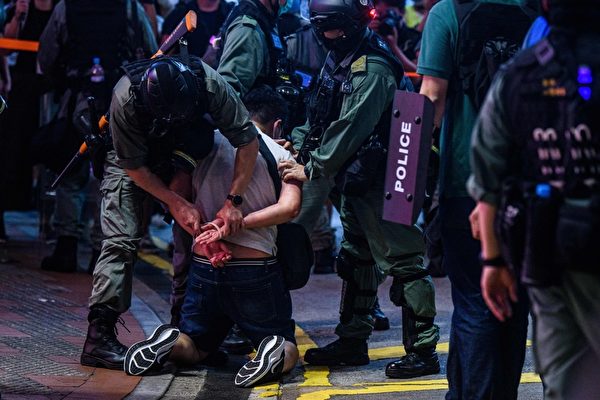
Approximately 7,000 individuals in Hong Kong who were arrested during the anti-extradition bill protests have yet to be charged. The Hong Kong government recently announced plans to introduce a “special program” to assist these individuals in their so-called “rehabilitation,” which includes taking them to mainland China to “understand the country.” This move has sparked debate and criticism.
In 2019, the Hong Kong government proposed amendments to the Fugitive Offenders Ordinance, triggering the prolonged anti-extradition bill protests. The police arrested over 10,000 people, prosecuted nearly 3,000, and have not yet made processing decisions for the remaining approximately 7,000 individuals.
Hong Kong’s Secretary for Security, John Lee, stated in a recent interview with Hong Kong Cable TV that the police have introduced a “special program” to offer these individuals the opportunity for so-called “rehabilitation.”
He revealed that this “special program” has been ongoing for 1 to 2 years, involving taking these individuals to the mainland for “exchanges,” “understanding the country,” learning about “national security,” among other activities. They will then evaluate the individuals’ expressions of remorse through reports submitted or sharing of experiences, and handle the cases in a “non-judicial process.”
Lee also mentioned that in Hong Kong, these individuals can undergo internships within government departments and may potentially become civil servants if they meet the criteria.
He claimed that a considerable number of individuals have been granted the opportunity for “rehabilitation” through participating in the “special program,” but did not disclose specific figures. He also mentioned that some have subsequently assisted in promoting “national security.”
Renowned Hong Kong singer Jason Zhang, who publicly supported the anti-extradition bill protests, recently announced his intention to participate as a mentor in the related “special program.” However, he unexpectedly unfollowed over a thousand friends and followers on his Instagram, including artists such as Mani, Joey Yung, Twins, William Chan, and Sammi Cheng, causing concern among fans.
Wu Shaoping, head of the Overseas Human Rights Lawyers Alliance, expressed to The Epoch Times that the Chinese Communist Party aims to strengthen Hong Kong citizens’ identification with the CCP regime, while the Hong Kong government seeks to handle cases through “flexible means” of non-prosecution to reduce international pressure. However, this to some extent constitutes widespread human rights abuse and is a very serious matter. Controlling the thinking of Hong Kong residents through the so-called “rehabilitation program” is essentially political indoctrination and brainwashing by the CCP.
“Individuals detained in CCP prisons or detention centers are made to watch the news broadcast and study central government documents. Their so-called rehabilitation program is simply implementing the CCP’s tactics,” he stated.
Lai Jianping, a former lawyer in Beijing and independent scholar, told The Epoch Times that the Hong Kong government treating people as political slaves can arbitrarily conduct political, spiritual, and character molding. “It uses politics to replace the law, reshaping these so-called suspects’ hearts to make them submit to the authoritarian rule of the Communist Party.”
According to PulseHK News, a volunteer named Tom expressed astonishment at the authorities exchanging non-prosecution for participation in the “special program,” stating, “It’s difficult to imagine such a political transaction being openly and directly stated.”
Current affairs commentator Sampson believes this approach stems from practices in mainland China, such as administrative detention and surveillance, which involve punishment before trial, similar to the methods used during Mao Zedong’s era for “reforming the Five Black Categories.”
Several posts on social media directly question if this is a “Hong Kong version of re-education camps.”