
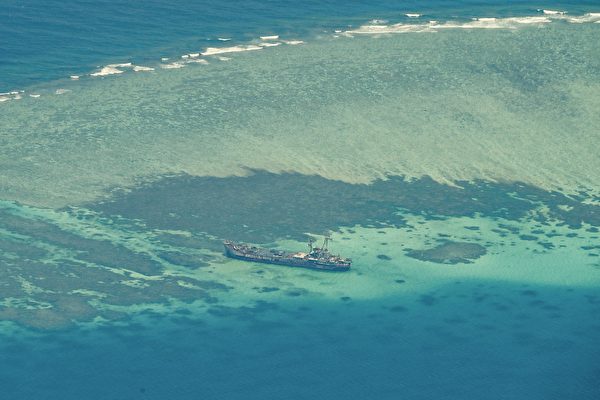
Philippine security officials said on Monday (April 13) that they found highly toxic cyanide on Chinese vessels operating near disputed islands and reefs in the South China Sea, accusing it of being a “destructive act” targeting Filipino troops.
According to Reuters, Philippine authorities stated that laboratory tests confirmed the presence of the toxic chemical in bottles seized by the Philippine Navy during an operation at Second Thomas Shoal last year.
Officials in the Philippines warned that cyanide not only poses a catastrophic threat to marine ecology but also erodes and weakens the coral reef foundation supporting the BRP Sierra Madre, the old World War II-era naval ship deliberately grounded at Second Thomas Shoal in 1999 to serve as a military outpost symbolizing Manila’s assertion of territorial claims against Beijing’s expansion in the region.
Cornelio Valencia, a spokesman for the National Security Council, emphasized in a press conference, “We want to emphasize that the use of cyanide at Ayungin Shoal (Philippine name for Second Thomas Shoal) is a destructive act aimed at killing local fish stocks, depriving Navy troops of vital food sources.” He stressed that damage to the reef would “ultimately compromise” the structural stability of the grounded vessel.
In response to the Philippines’ accusations, a spokesperson for the Chinese Foreign Ministry, Guo Jiakun, dismissed them as a “political show.” China countered by accusing the Philippines of illegally harassing Chinese fishing vessels engaged in normal operations and seizing supplies from fishermen.
Second Thomas Shoal lies within the Philippines’ 200-nautical-mile exclusive economic zone, about 1,300 kilometers from the mainland China. This maritime region is fiercely disputed, being a crucial strategic waterway where over $3 trillion worth of global shipping trade passes through annually.
Second Thomas Shoal has long been a frontline of maritime confrontation between China and the Philippines. The Philippines has accused China of interfering with resupply missions to troops stationed aboard the BRP Sierra Madre.
In a clash on June 17, 2024, a Chinese coast guard vessel attempted to block a Philippine resupply operation, leading to a violent collision and boarding confrontation resulting in a Philippine sailor losing a finger in the violent clash. However, China denied aggression claims and accused the Philippines of “intrusion.”
To ease tensions, the two countries reached a “temporary agreement” on resupply missions in July of the same year. Nonetheless, the discovery of cyanide now casts a new shadow over this fragile consensus.
Despite the tense situation, high-level talks were held last month between China and the Philippines to discuss preliminary cooperation in areas such as oil and gas development and establishing maritime confidence-building measures (such as coast guard communication mechanisms).
However, the Philippine Department of Foreign Affairs emphasized in a statement on Monday that cooperation in coast guard operations is limited and “not considering collaborative efforts in sensitive operational areas,” clarifying that discussions on “joint patrols” have not reached any agreements.
Beijing asserts nearly all sovereignty over the South China Sea, covering the claimed areas of Brunei, Malaysia, the Philippines, Taiwan, and Vietnam. Despite a 2016 ruling by the Permanent Court of Arbitration in The Hague, which found China’s “nine-dash line” claim lacked legal basis under international law, China refuses to accept the ruling.