
Recently, Fujian rights activist Wang Xiuying posted a series of photos online, reflecting her personal experiences in advocating for rights over the years. She expressed that these images often haunt her thoughts, evoking a sense of sadness, heartache, and helplessness that makes it hard for her to find peace of mind. She asked fellow advocates: “What kind of life will these images mold us into?”
Having been involved in rights advocacy for over 20 years, Wang Xiuying made her first visit to Beijing during this year’s National People’s Congress session. Upon her return, she penned three articles expressing her multitude of reflections, feeling the need to speak out. Her articles garnered significant attention and resonance among the advocacy community.
During the National People’s Congress session this year, Wang Xiuying’s experience in Beijing left her with swollen eyes from crying.
On February 28th, she was brought to tears at the National Discipline Inspection Commission, with those tears representing the helplessness she has faced over the past two decades with no one to rely on.
As a village representative tasked with safeguarding collective village land rights, Wang Xiuying faced the unauthorized conversion of village collective land into state-owned land. Despite pursuing legal and petitioning avenues, the government kept passing the buck, from high courts to procuratorates, back to the Discipline Inspection Commission, and then back to procuratorates…The bitterness and helplessness of over 20 years could only be seen in her tears.
Following her return from Beijing, Wang Xiuying wrote an article titled “Insights from Visiting Beijing Personally: Petitioners Living in the Shadows Unreachable by ‘Legal Rays'”, detailing what she witnessed at the National Petition Bureau regarding the plight of petitioners.
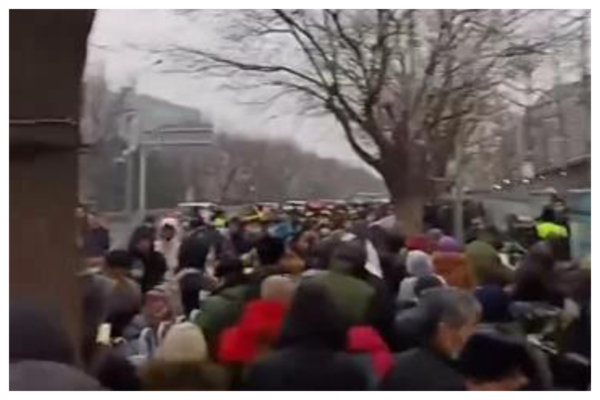
While waiting in line at the National Petition Bureau, she saw petitioners enduring hunger and cold, braving long queues with tattered blankets because leaving temporarily meant having to start over. Petitioners in line were at risk of being abducted by local stability maintenance personnel at any moment, with even the security inside the National Petition Bureau possibly colluding with local authorities to sell out petitioners. Petitioners faced beatings, abductions, and illegal detentions with no avenue for recourse!
She remarked, “Petitioners are both victims and drivers of social progress, yet our country’s leadership improperly views them.”
On February 27th and 28th, while queuing at the National Petition Bureau, Wang Xiuying received videos from three petitioners capturing an incident where a petitioner killed an intercepting official, observed by indifferent onlookers.
The video showed the petitioner wielding a large hammer and striking repeatedly while uttering profanities and expressing sentiments like “I’d rather die” and “Don’t fool me”. Onlookers watched as the intercepting official was beaten to death. Petitioners who watched the video commented that the intercepting official deserved to die as they obstructed petitioners’ paths.
Wang Xiuying said, “When petitioners are driven to the point of not wanting to live, it reflects they have been cornered with no way out. Is the intercepting official to blame? I believe the real culprits are the leaders behind him, the decision-makers who let those employed to carry out evil deeds. Both sides of this tragedy are victims, with the mastermind being the decision-makers behind the scenes.”
On February 23rd, outside the National Petition Bureau in Beijing, a large number of petitioners queued. One petitioner at the scene shouted aloud, “The current leaders are blind and deaf, destroying this country, ruining the youth of so many. Can you see matters of foreigners but turn a blind eye to those of Chinese?” They advised fellow queueing petitioners that queuing was futile, urging them to seek a different approach, like emulating student and worker strikes for human rights.
On March 4th, Zhang Nijun from Jinshan Street, Huli District, Xiamen, intercepted at the National Petition Bureau by personnel from her hometown, was lured to a hotel for discussions regarding her petition, only to be pulled into a black car. She was held without food or water for two days, denied restroom breaks. Due to prolonged dehydration, she experienced limb numbness and eventually collapsed by the roadside when she managed to escape unnoticed.
Wang Xiuying stated, “I want to emphasize that I document facts, highlighting the current situation, in hopes that those in power would listen to the people and make the country better. I don’t want my voice to be used as an excuse for suppression.”
On March 4th, Deng Zhichun from Jin’an District, Fuzhou, was forcibly handed over to black security personnel by police from Beijing Xiannong Forum Police Station at the National Petition Bureau, then returned to Fuzhou by local government. During the journey through the service area, Deng Zhichun was denied restroom access, leading to a physical altercation with local stability maintenance personnel. Subsequently, Deng Zhichun is now facing criminal detention for alleged intentional harm.
Wang Xiuying stressed, “The tragic experiences of petitioners are numerous, and while we understand how these tragedies occur, the leaders of our country should have a better understanding.”
Citing a personal example from her experiences, Wang Xiuying mentioned a case in Fuan City, Fujian Province, where 371 acres of land belonging to farmers was illicitly awarded to colluding parties by the government in secret. Five years later, the affected farmers were only informed that the colluding parties had used the unlawfully issued land certificates to secure billions in loans from banks and bribe high-ranking officials in Fujian, ensuring reelection as Fujian People’s Congress representatives twice.
When the displaced farmers sued, the Fujian High People’s Court ruled that “the land issued belonged to the state and was not legally related to the plaintiffs.” With just one sentence, the court completely stripped the farmers of land they had used for over a hundred years, without requiring any justification, effectively turning the land into state property.
Ms. Yan, a petitioner from Fujian, expressed to a reporter, “After reading Wang Xiuying’s articles, I feel sorrowful because these incidents keep happening. Petitioners from Fuzhou like Ye Zhong and Lin Tianming have died because of petitioning. They fought for their own rights and spoke up for petitioners, wishing to lessen the tragedies of petitioning in our country. But in the end, they succumbed within this system.”
“For years, I have been advocating for rights following the law, but there is no one to rely on in this country, so petitioning is the only option. I have witnessed so many tragedies firsthand because of petitioning. Wang Xiuying uses her words to record the humiliation experienced by our generation, a history that will be passed down to the next generation.”
“Many petitioners say that the petitioning system is essentially a disguised killing system, a glaring reality. Petitioners queue day and night in front of the National Petition Bureau, how many of their issues get resolved? This country does not see petitioners as human beings; they don’t even assign a queue number. If you can’t make it today, you come back tomorrow to start over. The attitude of the National Discipline Inspection Commission and the National People’s Congress towards petitioners is consistently: ‘This is not under my department’s purview,’ is this not a system designed to deceive petitioners?”
“This country established the petitioning system, then disallowed intercepting, yet simultaneously allowed the expansion of black security companies. Once petitioners step into Beijing, the Beijing police would contact black security, who in turn contact local government, creating a system of robbery, isn’t it?”