
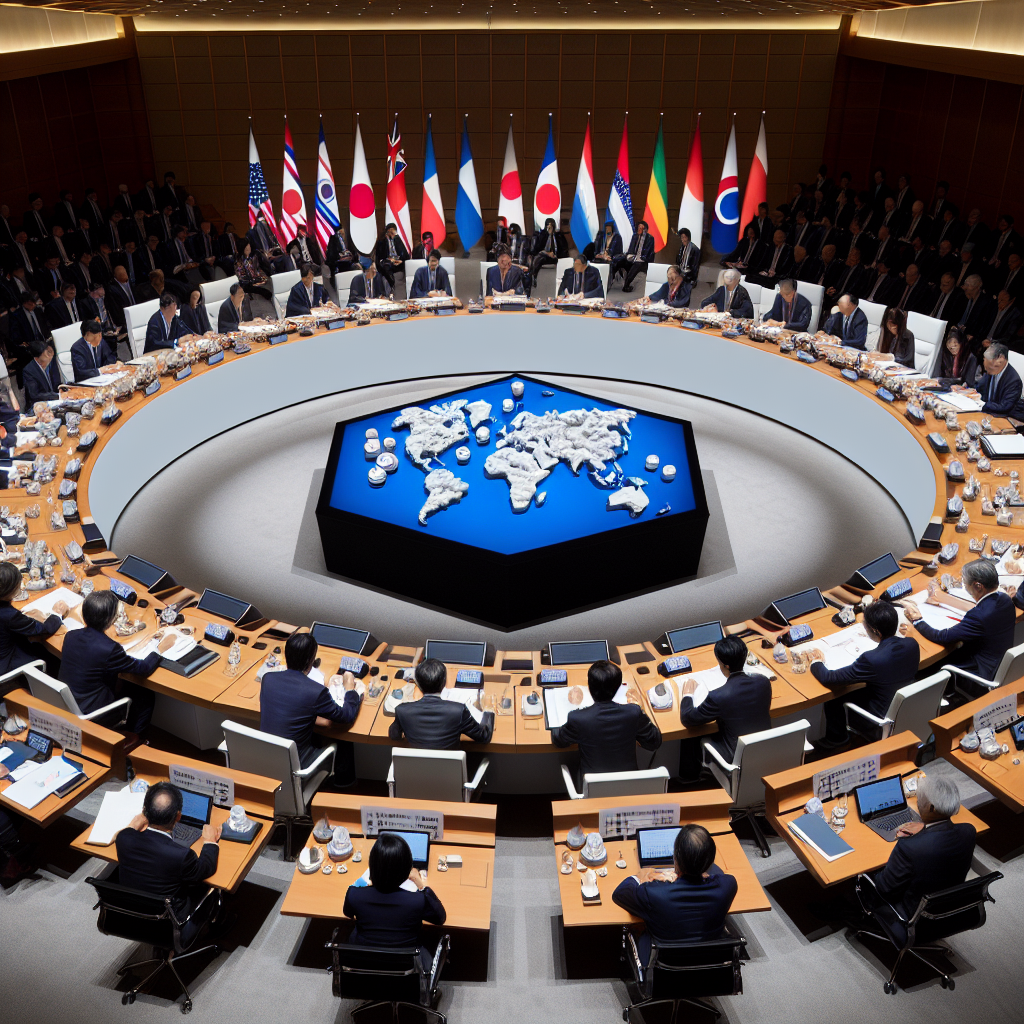
Amidst the heightened tension in the Middle East, the United States and Japan co-hosted the “Indo-Pacific Energy Security Ministerial Conference” on March 14 and 15, where they discussed the stable supply of energy resources such as oil. In conjunction with the ministerial meeting attended by 18 countries, a Japan-U.S. ministerial meeting was also held, announcing the establishment of a “Rapid Response Team” composed of senior officials from both countries’ ministries to prevent supply chain disruptions of critical minerals like rare earths. They also deepened strategic cooperation on diversifying crude oil procurement and enhancing energy security.
Leaders and energy ministers from 18 countries participated in this conference, engaging in two days of in-depth discussions on the implications of the closure of the Hormuz Strait by Iran. On March 15, they issued a joint statement committing to jointly strive to ensure the stability of energy supply in the region.
On March 14, Japanese Minister of Economy, Trade and Industry Akasawa Ryo held talks with U.S. Interior Secretary Doug Burgum and Environmental Protection Agency (EPA) Administrator Lee Zeldin regarding supply chain issues of critical minerals like rare earths and energy resources such as crude oil.
Additionally, Akasawa separately met with ministers from Indonesia and Singapore, signing memorandums of understanding (MOUs) covering multiple areas including nuclear energy, critical minerals, and hydrogen energy.
On March 15, Akasawa stated at a press conference, “Leaders from various Indo-Pacific countries gathering together in response to the tense situation in the Middle East, showcasing a unified front to enhance energy security in the region, holds significant importance in the international community.”
Furthermore, Akasawa announced the outcomes of bilateral cooperation between the U.S. and Japan. He pointed out that given China’s significant supply advantage in strategic resources like rare earths, Japan and the U.S. have agreed to establish a “Rapid Response Team for Critical Minerals Supply Chain Disruptions” to enhance information sharing and ensure stable access to vital resources.
Akasawa emphasized that Japan heavily relies on imports from the Middle East for most of its crude oil and natural gas. “Overreliance on a single region poses significant risks.” Therefore, Japan and the U.S. agreed to further deepen cooperation in diversifying the sources of crude oil procurement, liquefied natural gas (LNG), and nuclear energy fields.
In conclusion, Akasawa stated, “We have laid a solid foundation for the upcoming bilateral leaders’ meeting.” Japanese Prime Minister Sanae Takichi is expected to fly to Washington on March 19 for a summit with U.S. President Trump, with energy and economic security anticipated to be the main core issues on the agenda.