
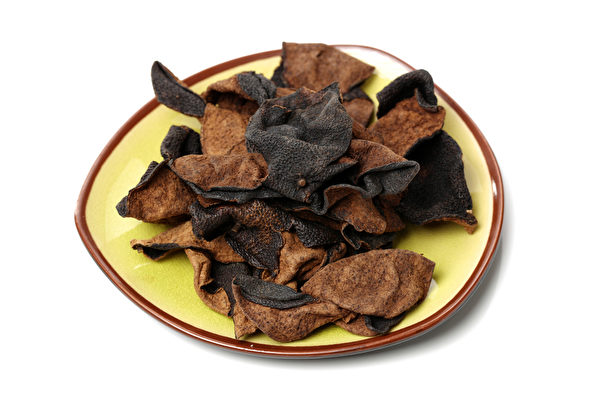
In recent days, the fake industry chain of Chenpi in Xinhui, Guangdong has been exposed. Investigations show that some Chenpi production companies process only one month of tea-branch tangerine peels and pass them off as 3 to 10-year naturally aged Chenpi through a so-called “quick processing” method before flooding the market.
Xinhui Chenpi, renowned for becoming more fragrant with age, is a Chinese geographical indication product. However, a recent report by the mainland media “Financial Investigation” revealed irregularities in the local Chenpi market, including false labeling of production years, origin falsification, and lack of transparency in processing. An industry insider disclosed that up to 80% of the so-called “Xinhui Chenpi” circulating in the market are actually from other regions, with a significant portion being labeled as “Guangxi Chenpi.”
Investigations indicate that Pubei County in Qinzhou City, Guangxi has emerged as a crucial cultivation base for tea-branch tangerines. The tangerine peels produced there are considered essential raw materials for creating the aroma of Chenpi and form the core foundation of the Chenpi industry in Pubei. Data indicates that in 2024, the Chenpi industry’s output value in Pubei County exceeded 6 billion RMB. During the harvesting season each year, a large quantity of fresh fruits is processed and dried into tangerine peels before being distributed to the market through various channels.
However, during the inter-provincial circulation process, some tangerine peels are re-packaged and transformed into “Xinhui Chenpi,” and even labeled as “aged Chenpi” or “ten-year-old Chen,” commanding high prices in the market.
The head of the Guangxi Pubei Jinpu Long Chenpi Technology Industry Co., Ltd. revealed that according to industry consensus and group standards, tangerine peels must age for over three years to be considered Chenpi, with higher value attributed to longer aging periods. However, the natural aging process takes time and substantial resources, making it challenging for most companies to afford. In this context, a processing method known as “light processing” has become popular within the industry. Through this method, new tea-branch tangerine peels can be processed to mimic the appearance of three to five year naturally aged Chenpi within just one month, significantly reducing the aging cycle.
Industry experts note that wholesale prices for naturally aged five-year Chenpi range from 300 to 400 RMB per kilogram, while the counterfeit “processed peels” cost only about 140 RMB per kilogram, highlighting a significant cost advantage, leading some merchants to forgo natural aging and take risks.
These processed Chenpi vary in color due to differences in the heat treatment during processing, and are then labeled with different “years” ranging from 3, 5, to 10 years based on their appearance. For instance, those labeled as “aged five years” can fetch prices of up to 1000 RMB per kilogram, while “ten-year-old” ones can be sold for up to 2000 RMB per kilogram, indicating that pricing can be increased multiple times based solely on visual differences, offering profits exceeding over ten times the production cost.
As “Guangdong Xinhui Chenpi” is currently the only Chenpi variety granted geographical indication protection in China, its characteristic of becoming more fragrant and valuable with age has made it a significant cultural and economic symbol in the Lingnan region, with a promising market outlook and continuously high selling prices.
Driven by substantial profits, some merchants resell or use certificates from Guangxi to label the “processed peels” as “Xinhui Chenpi” along with the geographical indication mark, packaging them as “genuine Xinhui aged Chenpi” for external sales.
Some merchants openly admit that the “processed peels” simulate the effects of aging for several years through modern technology, making it difficult for average consumers to differentiate. Despite the inaccurate aging years, they possess a trademark authorization certificate for “Xinhui Chenpi,” allowing products processed from any source to be labeled as “Xinhui Chenpi.” Such violations are gradually becoming an under-the-table industry practice.