
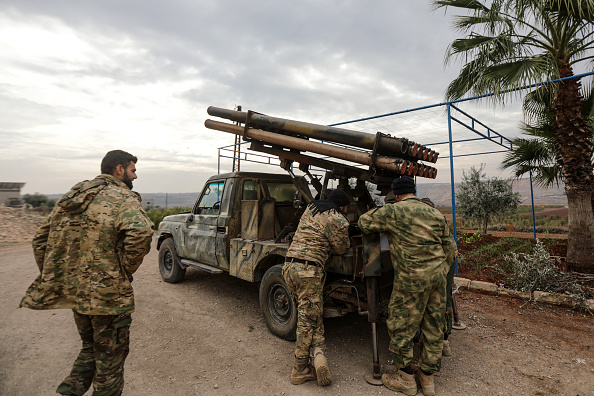
On Thursday, Syrian anti-government forces expelled pro-government troops from the country’s fourth-largest city of Hama, marking another significant victory following their lightning-fast advance in northern Syria. This move serves as a new blow to President Bashar al-Assad and his Russian and Iranian allies.
The Syrian military admitted to withdrawing from Hama and redeploying outside the city to “protect civilian lives and prevent urban combat.”
The anti-government forces stated that they have taken control of several areas in the northeast of the city and seized the central prison, releasing detainees.
Footage aired by Al Jazeera showed anti-government forces inside Hama, with some individuals meeting civilians at intersections while others were seen driving military vehicles and motorcycles.
Last week, the anti-government forces captured Aleppo, Syria’s largest city in the north, and then swiftly began advancing southwards from northwest Syria.
Hama had been under government control during the civil war against Assad in 2011. The occupation of Hama by the anti-government forces is expected to send shockwaves in Damascus and raise concerns about their further advance south.
Located one-third of the way between Aleppo and Damascus, the capture of Hama will open the path for the anti-government forces to advance towards Homs, Syria’s third-largest city. Homs is a crucial crossroads city connecting the most populous regions of Syria and lies approximately 40 kilometers (25 miles) from Hama.
The UK-based opposition war monitoring group, the Syrian Observatory for Human Rights, stated, “If Hama falls, it means the beginning of the collapse of the regime.”
During the most intense years of the civil war, Assad relied on support from Russia and Iran, which helped him regain much of the territory and the country’s major cities until 2020 when the frontlines remained largely stagnant.
However, his main supporters are currently facing troubles and seem preoccupied, with Russia focusing on the war in Ukraine since 2022. The Lebanese Hezbollah, supported by Iran behind the scenes, was once a formidable support force for Syria, but the terrorist group suffered significant losses in the war against Israel.
The most powerful anti-government faction is the radical Sunni Islamic organization known as the Hayat Tahrir al-Sham (HTS). It was formerly an affiliate of Al-Qaeda in Syria. Its leader, Abu Mohammed al-Golani, has promised to protect Syria’s religious minority groups and has urged them to abandon Assad. However, many remain fearful of the rebel fighters.
HTS and other rebel groups are working to consolidate their rule in Aleppo and integrate it under the administration of the so-called rescue government they have established in the northwest.
On Wednesday, al-Golani visited Aleppo’s historic castle.
Residents of Aleppo have reported shortages of bread, fuel, and disruptions in telecommunication services.
Among the anti-government forces is a Turkish-backed alliance called the Syrian National Army. Sources within this alliance have stated that they control a stretch of territory along the Syrian-Turkish border.
Turkey considers HTS a terrorist organization, but it has long been the most significant external supporter of other anti-government factions in Syria.
The Turkish government has denied involvement in the sudden incursion by anti-government forces into Aleppo last week.
_This article is based on reports from Reuters and the Associated Press._