
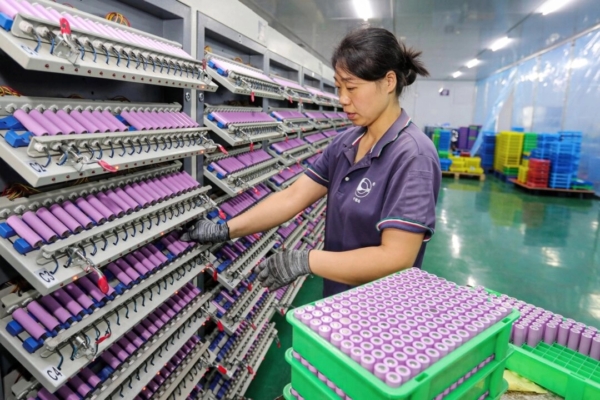
Recently, Chinese state media claimed that they will counter arguments that criticize China’s economy, such as the “China’s economic collapse theory” and “China’s overcapacity”. However, the Chinese industry has refuted these claims with facts, exposing the severe internal collapse within the energy storage sector. Over the past four years, 50,000 energy storage enterprises have collapsed, with the outlook for 2026 remaining uncertain.
From 2022 to 2025, within just four years, the cumulative installed capacity of new energy storage in China has surged from 3.3GW to 144.7GW, a staggering 43.9-fold increase. The rapid growth in energy storage installation is accompanied by severe internal competition within the industry.
In recent years, the Chinese authorities have emphasized the vigorous development of new energy storage, hydrogen energy, and energy storage, categorizing them as the so-called “new quality production forces” in the energy sector. New energy storage refers to various storage forms including lithium-ion battery energy storage, compressed air energy storage, and liquid flow battery energy storage, in addition to pumped hydro storage. Among these, lithium batteries are the dominant technology and one of the “new three” (new energy vehicles, lithium batteries, and photovoltaic products) advocated by the Chinese government.
According to a recent report from Huaxia Energy Network, the number of energy storage companies established in China has exceeded 436,000, with over 108,000 new companies established in 2025 alone. In 2024, the number was 93,000, in 2023 it was 79,000, in 2022 it was 46,000, and as early as 2021, there were only 16,000 new energy storage companies being established per year, whereas before 2019, the number was only a few thousand annually.
In January 2026, more than 9,300 energy storage companies were newly established. It is estimated that the total number of new energy storage companies established in 2026 may exceed 110,000, setting a new record.
Among the newly established companies are not only those from the solar and wind power sectors, which have industry synergy, but also companies from diverse sectors such as real estate, clothing, and consumer goods, indicating a broad spectrum of entrants.
Over the past four years, energy storage cell/system prices have repeatedly hit new lows, leading to severe overcapacity and widespread losses among industry chain enterprises.
At the beginning of 2022, mainstream energy storage cell prices were above 1.08 yuan/Wh; by the second half of 2022, prices started to trend downwards, dropping below 1 yuan/Wh; by 2023, the average price plummeted to 0.45 yuan/Wh, a drastic drop. By the end of 2024, prices fell to 0.3 yuan/Wh, and in 2025, the lowest winning bid price reached the rock bottom of 0.26 yuan/Wh.
Amid the price war, the entire lithium battery industry chain, including energy storage, has plunged into a loss-making quagmire. Enterprises without profits can only bleed slowly until they ultimately collapse.
Reportedly, a total of 63,000 energy storage companies are now abnormal (including deregistration and revocation). Among them, 4,800 companies closed down in 2025, 15,000 in 2024, 19,000 in 2023, 11,500 in 2022, and 2,500 in 2021. This means that from 2022 to 2025, during the four years of the energy storage industry’s price war, a total of 50,000 companies have been deregistered or revoked.
Among these collapsed companies are many former star enterprises. For example, Hua Fu Energy, a New Third Board star established for 14 years, saw a 66.21% and 102.4% year-on-year profit growth in 2022 but experienced a 43.66% revenue decline in the first half of 2023, with losses exceeding 9.65 million yuan, an 8,396.43% increase in losses. The losses continued in the second half of 2023, and the company failed to disclose its 2023 annual report, eventually delisted from the New Third Board in November 2024.
Founded in 2019, Fu Neng Bao Energy began bankruptcy asset auctions in August 2024. Additionally, Sungton New Energy, founded in 2011 with a registered capital of 3.2 billion yuan, filed for bankruptcy reorganization twice starting in December 2023. By the end of 2023, the company’s debts had surged to 3.793 billion yuan. The company’s revenue in 2023 was 262 million yuan, with a net loss of 524 million yuan.
In September 2024, Sungton New Energy, whose funding chain collapsed, proceeded with bankruptcy liquidation.
Even state-owned enterprises are not immune to closures. In October 2025, China National Chemical announced that its holding subsidiary, Ningxia China Lithium Electricity, continued to incur losses, leading to a situation where assets do not cover debts and cannot repay maturing debts. The company’s board agreed to file for bankruptcy reorganization with the court.
Established in October 2018, Ningxia China Lithium Electricity recorded revenue of 155 million yuan in 2024 but suffered a net loss of 525 million yuan. By the first half of 2025, its total assets stood at 244 million yuan, while liabilities soared to 288 million yuan.
Jiangsu Beiren, a smart manufacturing company that entered the energy storage industry in 2023, decided to strategically shut down its energy storage business in January 2026 after three consecutive years of losses.
Industry warnings have been sounded throughout the past year.
In August 2025, the Shanghai Securities News reported that despite the rapid growth of the energy storage industry in recent years, lithium energy storage system prices had plummeted by nearly 80% in the last three years, plunging companies into a situation of “increasing revenue without increasing profits.”
In September 2025, the chairman of CATL, Zeng Yuqun, criticized the five systemic risks within the Chinese energy storage industry:
1. Uncontrolled brutal price wars, with nearly one-third of system integrators bidding below cost, leading to industry-wide losses and rapid decline in gross profit margins due to the proliferation of brutal low-price wars spreading overseas.
2. Increasing safety hazards, particularly for continuously operating standalone energy storage stations, exacerbating safety pressures.
3. Proliferation of fictitious parameters and false advertising, with many companies focusing more on parameter manipulation than actual research and development, resulting in actual operational lifespans far below promised performance, severely damaging user trust and project economics.
4. Severe homogenization of technology, with many companies opting for shortcut methods of “plagiarism and replication instead of independent innovation,” stifling the industry’s original impetus for innovation.
5. Unregulated expansion fraught with risks, where numerous small and medium-sized enterprises may collapse, rendering the power stations they built as orphaned facilities requiring maintenance, shifting risks onto society.
On January 7, 2026, the Chinese Ministry of Industry and Information Technology conducted a symposium in collaboration with multiple departments on the power and energy storage battery industries, urging the energy storage industry to “counter internal competition.” Sixteen companies, including CATL and BYD, participated.
However, industry insiders pointed out that the effects of countering internal competition in the energy storage sector have been minimal.
According to “Tava Energy,” the profit pressure on the energy storage industry is expected to intensify further in 2026. Amid rising raw material costs and declining system prices, top enterprises in 2026 are predicted to experience significant profit declines, with some second-tier manufacturers facing difficulties continuing operations.
As the year 2026 unfolds, more than 9,300 new players have entered the market in January. Will they become the next sacrificial lambs?
In fact, the internal strife and wave of closures in the energy storage industry are a microcosm of China’s economic trajectory.
A recent commentary on the Chinese Communist Party’s “Seeking Truth” website called for propaganda departments to counter both domestic and foreign criticisms of China’s economic prospects, including the “collapse theory” and “overcapacity” narratives, and instead promote the “bright side of China’s economy.”
Lin Song, a political science PhD from the University of New South Wales in Australia, stated to Epoch Times that the shift from promoting a positive economic narrative to countering collapse theories indicates the urgency felt by the Chinese Communist Party. As the years of the pandemic have passed, the Chinese mainland’s economy is deteriorating. How it intends to counter this reality poses a significant question.