
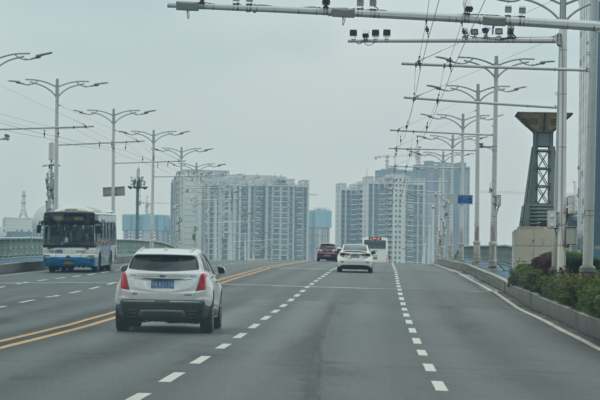
Amid the continued deterioration of local finances in the Chinese Communist Party (CCP), the long-silent collection of tolls on ordinary national highways is experiencing a resurgence in various parts of China. The government of Shanxi Province recently announced the establishment of toll stations on the Xuinzhou section of National Highway 108, with toll collection set to last nearly 30 years. This announcement has sparked discontent among many drivers and netizens, with many pointing out that this is the local government’s way of reintroducing “road tolls” to the society in times of financial hardship.
On March 11, the CCP Shanxi Provincial Government issued a notice approving the establishment of three toll stations on the section from Shahe to Shilingguan along National Highway 108 within Xuinzhou. The toll rates range from 10 yuan to 70 yuan per vehicle trip, depending on the vehicle type from small cars under 2.5 tons to large trucks over 30 tons.
He Pengfei, a media person from Taiyuan (pseudonym), told reporters that since 2009, road maintenance costs have been included in the fuel tax system. Now, reintroducing toll collection on ordinary national highways essentially means double billing and further exploitation. He Pengfei bluntly stated, “This is akin to shearing a sheep twice, and it’s an extremely ugly sight.”
The notice shows that within this short 120-kilometer stretch of road, three toll stations are densely placed, with a toll collection period lasting for 29 years and 10 months. This news has garnered strong backlash from local drivers, with complaints flooding social media platforms. Some netizens expressed anger, saying, “Having three toll stations in a span of 120 kilometers is simply outrageous.” Others pointed out the crux of the matter, stating, “Taxes are already included in fuel prices, and now they are demanding additional road tolls, the CCP is blatantly robbing money from the people.”
In 2009, the CCP eliminated administrative fees such as road maintenance fees and replaced them with fuel surcharges, incorporating road maintenance costs into fuel prices. However, after more than a decade, this system is being forcibly rewritten by administrative forces. Public records show that since 2024, many places including Shanxi have been intensifying the installation of toll facilities on provincial and national highways. For instance, in February of this year, a toll station was set up at the Hanhuling Tunnel on the Dongyu Line provincial road, with a toll collection period lasting 20 years.
Economic analyst Mr. Li from Hubei analyzed that the proliferation of toll stations on national highways is far from a simple adjustment in transportation policy but rather a chain reaction to the drastic deterioration of local finances. With the bursting of the real estate bubble and sharp declines in land transfer revenues, the old model of “selling land to survive” has collapsed.
He stated, “With no way out, local governments are forced to resort to ‘monetizing road rights,’ reaching into the tires of the public.”
Car owners vehemently oppose the government’s measures, with angry netizens bluntly stating, “They impose taxes under the guise of road maintenance, then shamelessly admit to using tolls to repay debts. The CCP’s promises are worth less than waste paper.”
According to reporters’ investigations, this trend is rapidly spreading to various parts of China. According to mainland media statistics, since the second quarter of 2025, seven provinces including Anhui, Gansu, Hubei, Jilin, Shanxi, Jiangsu, and Shandong have taken the lead in initiating so-called “national highway toll pilot projects.” As of now, the number of new toll stations nationwide has exceeded one hundred, initiating a new round of toll collection across the national road network.
Economic analyst Mr. Li stated that against the backdrop of a stagnant real estate market and ballooning local debts, reopening the old path of “toll roads” has become an important means for local governments to fill their fiscal gaps. This model fundamentally shifts the burden of government debt onto the society, constituting a transfer of pressure from administrative power to people’s livelihoods.
Mr. Li warned that the government’s desperate actions could further increase logistics costs, creating new challenges for the already weakened domestic demand.
On social platforms such as WeChat and Douyin, the sweeping “national highway toll wave” that has engulfed many areas has sparked widespread grievances. Netizens generally believe that this not only mirrors the financial plight of local governments but also reflects new pressures on China’s economic structure. One netizen commented, “Now officials are in dire straits, they impose tolls wherever they can and seek money in any way possible.”
Meanwhile, the CCP’s National Development and Reform Commission previously released an “Opinion on Improving the Transport Price Mechanism,” proposing to study the establishment of a mechanism for sharing the costs of using lanes by new energy vehicles. Analysts believe that this indicates that even new energy vehicles currently enjoying policy support may gradually be incorporated into the road toll system.
Some commentators believe that the resurgence of toll collection on ordinary national highways reflects new pressures facing the CCP’s financial system. Local governments that previously relied on land finances to operate are now seeking new toll channels after the downturn in the real estate market, with road tolls becoming the most direct tool available.