
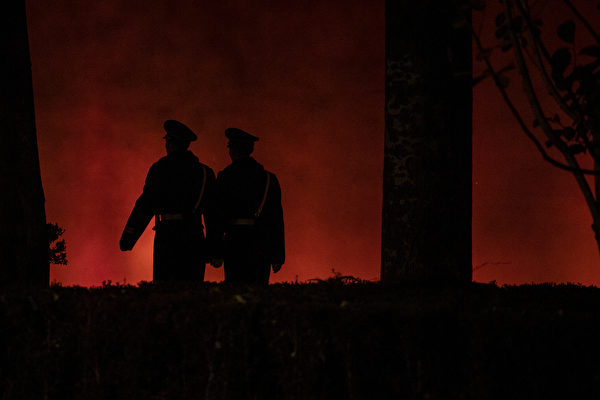
After the fall of Zhang Youxia, Vice Chairman of the Central Military Commission of the Chinese Communist Party, almost all high-ranking officials in the current Military Commission have been eliminated. Observers have noticed that the position of Vice Chairman of the Central Military Commission has become a high-risk position, as a total of nine individuals holding or previously holding this position have been purged since the establishment of the CCP. Experts believe that the Communist Party’s system is a ruthless meat grinder, where anyone inside will be ground to pieces, including top CCP leaders.
During the Mao era, several individuals who served as Vice Chairmen of the Central Military Commission, such as Liu Shaoqi, Peng Dehuai, Lin Biao, and He Long, were purged. Deng Xiaoping purged Zhao Ziyang, and Xi Jinping ousted former Vice Chairmen of the Military Commission, Xu Caihou and Guo Boxiong, and later targeted Vice Chairmen He Weidong and Zhang Youxia.
Public records indicate that Peng Dehuai made significant contributions to the CCP’s seizure of power. In 1966, during the Cultural Revolution, Peng suffered broken ribs from attacks by Mao Zedong’s Red Guards. He was accused of plotting against the military, party, and country, as well as engaging in foreign collusion. On November 29, 1974, the 76-year-old Peng Dehuai passed away after enduring physical and mental torment.
Following the outbreak of the Cultural Revolution in 1966, Kang Sheng, an adviser to the Central Cultural Revolution Group, reported to Mao Zedong that He Long was planning a military rebellion known as the “February Incident.” In January 1967, Mao decided to isolate and investigate He Long. He Long, suffering from diabetes, experienced great physical and mental distress during his detainment. On June 9, 1969, He Long passed away at the Beijing 301 Hospital.
Lin Biao was renowned for his military prowess. After the establishment of the CCP, Mao Zedong selected Lin Biao as his second successor, even enshrining it in the Ninth Party Congress. At the Lushan Conference in 1970, public disagreements arose between Mao and Lin. On September 13, 1971, Lin Biao, along with his family, fled by plane from Shanhaiguan and officially declared dead after an alleged crash near Ulan Bator, Mongolia. Following his death, the CCP labeled Lin as a “capitalist roader, conspirator, two-faced individual, traitor, and enemy of the state.”
Prior to the establishment of the CCP, from 1943 onwards, Liu Shaoqi had served as Secretary of the Central Committee and Vice Chairman of the Central Military Commission. After the establishment of the CCP, Liu Shaoqi went on to become a member of the Politburo Standing Committee, Vice Chairman of the Central Committee, Chairman of the National People’s Congress, and President of the CCP. During the Cultural Revolution, Liu Shaoqi clashed with Mao Zedong, leading to his expulsion from the party on charges of being a “traitor, spy, and capitalist roader.” In 1969, he was detained in Kaifeng, Henan, where a lack of adequate medical care led to a fatal lung infection. Officially identified under a pseudonym, Liu Wei Huang was secretly cremated.
In 1987, Zhao Ziyang was “elected” General Secretary of the Central Committee and First Vice Chairman of the Central Military Commission at the Thirteenth National Congress of the CCP. In 1989, the student democratic movement erupted in Beijing and spread nationwide. Deng Xiaoping advocated for military suppression, while Zhao opposed the use of military force.
After the Tiananmen Square massacre in June Fourth, Zhao Ziyang was removed from office. From then on, Zhao was under soft detention for 16 years. On January 17, 2005, Zhao passed away at home at the age of 86.
Guo Boxiong and Xu Caihou were promoted by Jiang Zemin to members of the Politburo and Vice Chairmen of the Central Military Commission. They acted as Jiang’s proxies on the Central Military Commission after his retirement, overshadowing the Chairman of the Central Military Commission, Hu Jintao. Guo and Xu wielded power over the Central Military Commission for ten years, engaging in unscrupulous corruption practices.
On April 15, 2014, Xu Caihou, who had been retired for over a year, was investigated. On March 15, 2015, while undergoing a military court trial, Xu passed away at the age of 71. On April 9, 2015, Guo Boxiong, who had been retired for over two years, was investigated. On July 25, 2016, Guo Boxiong was sentenced to life imprisonment by a military court for corruption.
He Weidong, who was officially removed from office last year, was personally promoted by Xi Jinping from the Fujian faction. Similarly, Zhang Youxia, who fell from grace last month, was initially seen as a stalwart supporter of Xi Jinping.
Yuan Hongbing, a scholar based in Australia, shared with Epoch Times that from the era of Stalin’s Soviet Communist Party to the Kim dynasty’s Communist Party regime in North Korea, to the current CCP regime, they all share a common feature: maintaining power through state terrorism, violence, and lies. The CCP’s military guard represents the manifestation of the Chinese state’s terrorism and violence.
He stated that the current Chinese Communist Party has turned the military into a group of servants and lackeys of Xi Jinping. Anyone who raises his suspicion will face brutal purges. This type of political gangster-style absolute dictatorship represents the fundamental reason behind the continuous purging of senior military officials within the CCP.
Yuan Hongbing remarked, “The entire regime of the Communist Party is a meat grinder, with an increasing number of officials being fed into this machine. Xi Jinping is constantly seeking to consolidate his personal authority through extensive purges, ultimately pushing the foundation of the CCP’s tyranny closer to the brink of collapse.”
Political commentator Chen Pokong, based in the United States, shared with the Epoch Times that the toppled CCP officials were both maintainers and beneficiaries of the system, only to be eventually consumed by it. While in power, they did not seek to change the system. Some, like Zhao Ziyang, may have considered it, but it was too late.
Chen pointed out that in democratic and normal countries, the military gets nationalized; however, under the CCP regime, the military serves as a party army, with the party guard even transforming into the personal army of the top leader, whether it’s Mao Zedong or Xi Jinping.
He added, “The Communist Party’s system is a meat grinder, where anyone inside is ground to pieces. This system not only poses a threat to the people and deprives them of their rights but eventually strips the high-ranking CCP officials of their own rights. Xi Jinping is racing along this path, and the Red Dynasty will be wiped out.”