
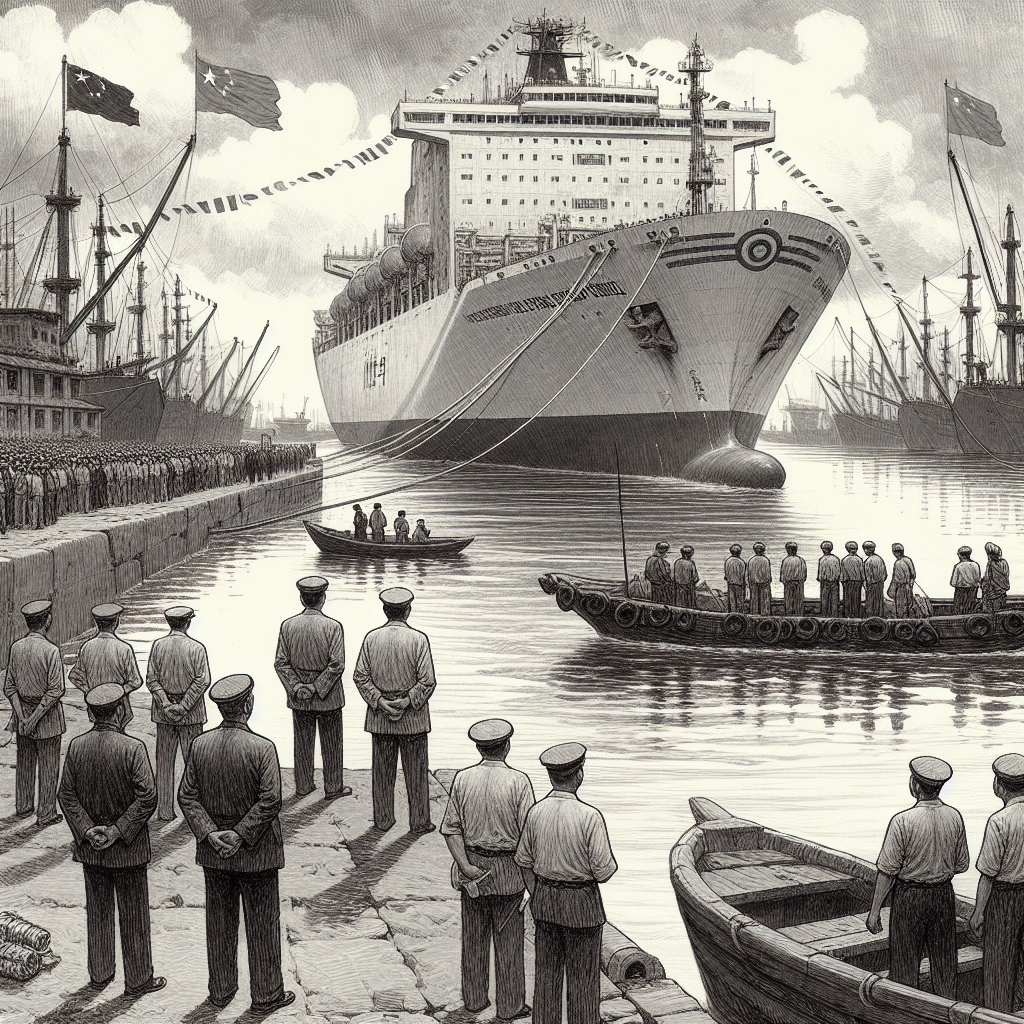
A Chinese giant vessel is currently conducting visits to several Latin American countries, reported as a medical service mission by Chinese official sources.
During its recent stop in Brazil, the Brazilian authorities were unable to inspect the giant vessel, sparking concerns and questioning whether the mission of this medical ship named “Silk Road Ark” is solely humanitarian.
The “Silk Road Ark” arrived in Brazil’s second largest city, Rio de Janeiro, in early January. Concerns were raised by Brazilian authorities regarding the provision of medical services by the vessel without local authorization. Some worry that the unauthorized medical services could be a cover for intelligence gathering or espionage activities.
The presence of the medical ship in Latin America has raised concerns amidst increased attention from the United States to the region, particularly as President Donald Trump revives the Monroe Doctrine and aims to capture the Venezuelan dictator Nicolás Maduro. The U.S. seeks to enhance its influence in the region to counter Beijing and other rivals. Concurrently, China’s Central Television broadcasted simulated military exercises by the Chinese military near Cuba, the Gulf of Mexico, and the Caribbean Sea in December 2025.
Experts interviewed by the Epoch Times and Brazilian authorities suggest that this visit may be related to China’s military buildup in Latin America to prepare for potential direct conflicts with the United States.
Evan Ellis, Latin American Studies professor at the U.S. Army War College, noted, “Clearly, this medical ship known as the ‘Silk Road Ark’ is part of the Chinese Navy. In other words, despite being a medical ship, it is essentially a military vessel.”
The journey of the “Silk Road Ark” began in the South Pacific Islands in September 2025. In November 2025, it traveled to Latin America for a technical stop, then continued to Jamaica (recently hit by Hurricane Melissa), followed by Barbados, and arrived in Brazil on January 8.
The vessel left Brazil on January 15, made a four-day stop in Uruguay, planned visits to Chile, Peru, and Mexico, and is scheduled to return to China.
According to Chinese officials, the mission, named “Mission Harmony 2025,” aims to “carry out medical services and cultural exchange activities” with other countries.
However, the presence of this military ship, belonging to the PLA Navy with a displacement of over 10,000 tons, during its stop in Brazil has prompted widespread attention. Brazilian officials received reports that Chinese crew members provided medical services to local residents without authorization. Additionally, photos and reports indicate the vessel bears military characteristics.
Authorities in Jamaica and Barbados welcomed the medical services provided by the Chinese vessel to their citizens. However, some Brazilian government agencies are more cautious.
Dr. Francisco Cardoso, São Paulo State Medical Board chief, stated, “Without authorization from the Federal Medical Council, foreign doctors are not allowed to provide any medical services within Brazilian territory, including foreign vessels in Brazilian waters.”
The Federal Council of Medicine in Brazil is responsible for issuing medical licenses to physicians and enforcing medical laws.
The vessel had permission from the Brazilian Navy to dock in Brazilian waters. However, neither Cardoso nor the Federal Medical Council granted authorization for the personnel on the vessel to conduct medical procedures within Brazil.
Alleging unauthorized medical consultations or treatments, Cardoso and other government officials faced accusations that the vessel provided unauthorized medical services to Brazilian citizens.
In response to these allegations, Dr. Raphael Câmara, a consultant for the Rio de Janeiro State Medical Board, was dispatched to inspect the vessel as it was docked in Rio de Janeiro.
The purpose of the inspection, he explained, was to gather information about the medical services on board. “Is there a problem with drug abuse?… What are those people doing there? Have they collected biometric samples? Blood samples, for example? Whatever it may be, we don’t know,” Câmara told the Epoch Times.
“We don’t know what they are doing there, and from our perspective, this poses a security risk to the public.”
Dr. Câmara’s concern stemmed from the possibility that unauthorized medical consultations or treatments would not leave behind any treatment records, complicating follow-up medical care.
“Rio de Janeiro does not need any humanitarian aid. We have enough doctors in Rio de Janeiro. And we understand that there are other places that need this vessel more than Brazil,” Câmara said.
After reaching the docking point of the vessel, Câmara and his team had to wait for the Chinese Consul responsible for the operation to arrive. The Consul arrived in a van, accompanied by several Chinese military personnel.
However, Câmara was barred by the Chinese Consul from boarding the ship.
“He also said that if we decided to send an official letter, he would not respond,” Câmara said.
“To me, that statement seems hostile. Why say if we send him a letter, he won’t respond? I think this is not the appropriate way to deal with a federal entity authorized to supervise this matter.”
Cardoso noted that it is abnormal to refuse inspection requests from government agencies. “They usually allow inspections, even to prove that everything is normal,” he said.
Câmara stated that he contacted the State Health Secretariat, responsible for managing and coordinating the state-level public health system. While there is cooperation between the Rio de Janeiro State Regional Medical Board and the State Health Secretariat, both operate independently.
He mentioned that officials from the State Health Secretariat initially promoted the services on the vessel and even held a reception for the vessel’s personnel. However, when Câmara tried to discuss this matter with them, they denied providing any medical services. The Chinese authorities also denied it.
The Rio de Janeiro State Health Secretariat was contacted by the Epoch Times to clarify whether the vessel provided medical services, who received these services, and whether they had obtained authorization from the Federal Medical Council.
“There is no mention in any communication record from the Chinese authorities of the ‘Silk Road Ark’ offering any type of medical service.” the State Health Secretariat responded. “The visit of the vessel to Brazil was at the request of the Chinese Navy to the Brazilian Navy.”
Câmara mentioned that the highest health authority in Brazil – the Brazilian Health Regulatory Agency – informed him that they were also unable to inspect the vessel.
“They were unable to inspect because this is, in fact, a military operation authorized by the Brazilian Ministry of Defense. Therefore, in practice, the vessel providing medical services is nominally a Chinese military medical ship and is not subject to inspection by the Health Department,” Câmara said.
Ernesto Araújo, former Brazilian Foreign Minister, expressed concern about China’s motives.
“Anything China does is not without reason or routine, especially in this unprecedented situation,” he said.
“I think this is first and foremost transmitting a message to President Luiz Inácio Lula da Silva, indicating dissatisfaction from China with Lula’s reconciliation with [President] Trump and that China will not easily give up the enormous influence it has gained in Brazil.”
The relaxation of tensions between Brazil and the United States occurred during the UN conference in 2025, shortly before Trump’s formal speech, where Lula met with Trump and agreed to hold a formal meeting between the two leaders.
In the preceding months, tensions between Brazil and the United States had escalated, nearly stagnating diplomatic relations.
In July 2025, the U.S. State Department announced sanctions against Brazilian Supreme Court Justice Alexandre de Moraes, citing his “serious violation of human rights,” especially regarding the trial of former Brazilian President Jair Bolsonaro. President Trump labeled the trial as “political persecution” on social media. Bolsonaro was ultimately sentenced to over 27 years in prison.
On July 30, 2025, President Trump signed an executive order imposing tariffs on Brazil in response to the “political persecution” of Bolsonaro. The President stated that the actions of the Brazilian government posed an “unusual threat to the national security, foreign policy, and economy of the United States.”
However, in recent years, Brazil’s relations with China have grown closer, with China overtaking the U.S. as Brazil’s primary trading partner in 2009.
In 2024, during the G20 summit in Brazil, Lula met with Chinese leader Xi Jinping. During the meeting, 37 bilateral agreements were signed, elevating relations between Brazil and China to a “community with a shared future.”
On January 23, a few days after the departure of the Chinese giant vessel from Brazil, Xi Jinping had a telephone call with Lula, expressing China’s willingness to “promote greater development in China-Brazil bilateral relations.”
Meanwhile, the United States has been endeavoring to strengthen its ties with the Brazilian government.
At the end of 2025, the U.S. announced the lifting of sanctions against de Moraes.
The removal of sanctions by the United States was seen as an attempt to rebuild relations with the current Brazilian government. Brazil holds the world’s second-largest rare earth mineral deposits, a strategic asset amid the U.S.-China dispute.
On January 26, three days after meeting with Xi Jinping, Lula spoke with President Trump, announcing his visit to the United States in February for a meeting with the U.S. President.
Apart from Brazil, the U.S. government has sought to strengthen its relations with several other countries in the region.
The U.S. State Department recently approved the sale of equipment and services worth $1.5 billion to Peru to upgrade its main naval base, enhancing Peru’s port infrastructure in competition with a giant port supported by China about 50 miles away.
In its 2025 National Security Strategy, the Trump administration revived the Monroe Doctrine to enhance U.S. influence in Latin America, deepen partnerships with Latin American countries, “realign U.S. global military presence in the region,” and counter the growing expansion of U.S. adversaries such as China, Russia, and Iran.
“This is our hemisphere,” the U.S. State Department posted on social media two days after U.S. forces captured Maduro.
“This is where we live – we will not allow the Western Hemisphere to become a base of action for hostile powers, competitors, and adversaries of America,” said U.S. Secretary of State Marco Rubio on January 4.
Days later, China published its policy white paper on Latin America and the Caribbean, indicating a desire to strengthen “all-round” cooperation with Latin American countries and added that “China will actively engage in military exchanges and cooperation with Latin American countries.”
Ellis noted that the Chinese document also “emphasizes security cooperation in areas such as organized crime, cybersecurity, and money laundering.” He stated that this cooperation opens the door for Chinese interaction with local law enforcement agencies, highlighting that “China intends to expand activities that raise concerns about espionage.”
On December 19, 2025, during its journey from Jamaica to Barbados, the “Silk Road Ark” engaged in simulated warfare exercises between Chinese military units and opposition armed forces in areas near the Gulf of Mexico, Cuba, and the Caribbean Sea, as shown in footage from Chinese Central Television.
China’s military presence in Latin America continues to grow, raising concerns about the scale of Chinese infrastructure in the region and how it could potentially be utilized in case of conflict with the United States.
“Although the Chinese infrastructure in the region may have a commercial purpose during peacetime, it can be mobilized for wartime use,” Ellis stated.
“For example, the Port of Chancay in Peru. If the port is poorly controlled or the Peruvian government sympathizes with the Chinese regime, it could be utilized to supply weapons or missiles to Chinese warships, or support operations against the United States or its eastern Pacific flank.”
These warnings were previously issued by U.S. Southern Command Commander Laura Richardson in 2023.
During an event at the Center for Strategic and International Studies, Richardson emphasized, “The importance of the Latin American region cannot be overstated. China’s influence is absolutely global and it’s right under our noses.”