
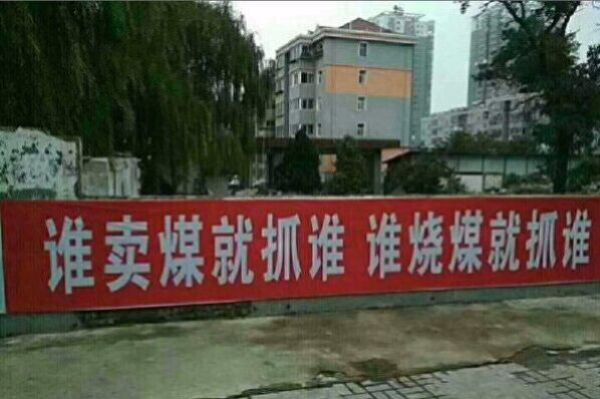
In recent years, the Chinese authorities have been implementing a “coal-to-gas, coal-to-electricity” heating policy in some rural areas under the pretext of environmental protection, prohibiting people from burning coal. However, the high costs make it difficult for villagers to afford. In some places, coal burning is unofficially tolerated, and the centralized procurement of coal is monopolized by local officials, who profit from it.
In many rural areas of Hebei, the winter temperatures have dropped below zero degrees Celsius, but many villagers are reluctant to use electric or gas heating equipment due to high prices. Several villagers told Epoch Times that rural houses generally lack insulation, and most people spend their days outdoors in the sun.
Public records show that some areas have provided a one-time heating subsidy of around 200 yuan to farmers, but villagers believe that this amount is insignificant compared to the overall electricity and gas expenses for the entire winter.
A villager in Hebei, Yang Hao (pseudonym), expressed that the commonly mentioned heating subsidy does not truly address the issue. “If you give me 200 yuan, does that mean I won’t feel cold anymore? That 200 yuan is definitely just for show in response to public opinion pressure. They exploit you, their shamelessness penetrates beyond your imagination, forcing you to spend money, it’s despicable.”
Yang Hao also mentioned that rural houses are generally not insulated, and when the outdoor temperature is around minus two or three degrees Celsius, there is little difference in indoor temperature, making it especially difficult for elderly people with weak immunity. “The authorities force us to use electricity, then gas, and in such cold weather, not allowing open flames for heating, of course, we can’t afford to burn, who can bear it? Even people in the cities can’t afford it, it’s inhumane.”
Another villager from Tangshan area in Hebei, Yu Fei (pseudonym), also informed reporters that in the past, rural areas relied on wood and leaves for heating, but now they are forced to use electricity or natural gas, which villagers cannot afford. “Even if we can’t get through the winter comfortably, we have to manage, having a temperature of around five or six degrees Celsius inside the house is considered good enough.”
Yu Fei disclosed that despite the policy banning the burning of loose coal, in reality, some village officials turn a blind eye to villagers continuing to use coal for heating because they control the purchasing channels and benefit from it. “Burning loose coal is prohibited, so we secretly burn coal. The government allows a certain type of coal briquette to be burned. Everyone knows about this coal briquette, it still causes pollution, but officials profit from it, considering it legal.”
Numerous villagers reflected that local coal is often distributed during the night through hidden channels, with prices controlled by government officials. Under the high-pressure policy, not only has the rural environmental issue not been resolved, but it has further fostered corrupt practices.