
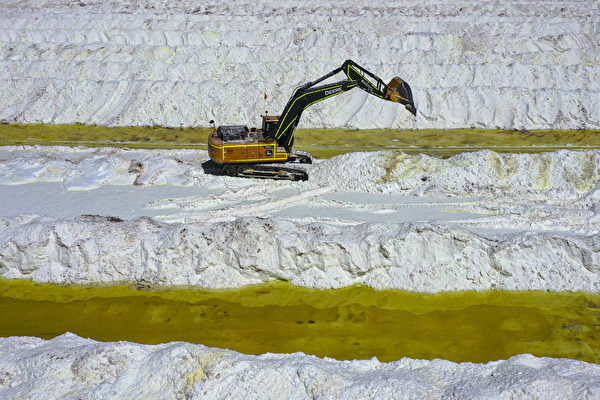
In the coming years, as the European Union pushes for increased lithium metal supply, seen as crucial for energy transition, Europe will initiate a series of new lithium mining projects to break China’s control over the market.
Amid countries racing towards green energy transition, the essentiality of lithium in electric vehicle batteries has become paramount. According to data from commodities research firm Fastmarkets, the demand for Battery Electric Vehicles (BEV) in Europe is projected to triple over the next decade. Currently, 97% of the lithium used by the EU comes from China.
The Russian invasion of Ukraine and the ensuing energy crisis have exposed Europe’s reliance on a single natural gas source. The EU aims to avoid repeating this dependency issue with lithium.
To reduce excessive dependency on Chinese lithium, the EU, under the Critical Raw Materials Act that came into effect in May, has set a target to produce at least 10% of its annual consumption by 2030.
According to a report by The Wall Street Journal on September 5, Fastmarkets predicts that eight mining sites in Europe are expected to begin production in the current decade. By 2034, these mines will increase Europe’s lithium carbonate supply from nearly zero to 58,000 tons annually.
Savannah Resources, listed in London, operates one of Europe’s largest lithium mines, planning to start production by the end of 2026 to supply lithium-ion batteries for at least 500,000 electric vehicles in Europe every year. CEO Emanuel Proenca stated that based on Savannah’s processing optimizations, this number could increase to nearly 1 million vehicles.
In the upcoming years, several other mining companies will join Savannah to meet Europe’s lithium demands.
Steve Schoffstall, a director at Sprott Metal Investment Management, mentioned that “these mines are of a massive scale, all looking for production opportunities.” He added that ensuring local supply helps regain pricing control from China and establish a stable supply chain for Europe.
Two years ago, lithium was priced around $84,000 per metric ton due to high demand for electric vehicles. However, with lower-than-expected electric vehicle sales and oversupply of Chinese lithium in the global market, prices have dropped by 88% to around $10,300 per metric ton.
Schoffstall noted, “The low prices have enabled China to maintain a leading position in the market and retain price control not only in lithium but also in nickel and other metals.” Currently, China holds approximately 37% of the world’s rare earth elements, including lithium.
According to Sprott, prices are expected to start rising towards the end of the decade when the market faces deficits.
As awareness grows about China’s domination over nearly all raw materials, Europe has seen two significant developments that could alter the playing field: Rare Earths Norway discovered one of Europe’s largest rare earth ore deposits in June; European Lithium’s subsidiary acquired the world’s largest and most important metal ore deposit found in Greenland.
The Norwegian parliament has voted to approve deep-sea mining of rare minerals in the country’s remote northern waters, making it the first European country to allow this type of seabed mining activity.
Meanwhile, Critical Metals Corp, a subsidiary of European Lithium, announced on June 10 that it had reached an acquisition agreement for Tanbreez, the world’s largest rare earth ore deposit discovered in Greenland.
Tanbreez is estimated to hold over 28 million tons of total rare earth oxide, with nearly 30% being highly sought-after “heavy” rare earth elements (HREE).
Once operational, the mine is expected to supply minerals to Europe and North America.
According to data from the U.S. Geological Survey, “out of the 35 minerals identified as important by the Department of the Interior, the U.S. fully relied on imports for 13 in 2019.”
As part of broader efforts to enhance national security, the Biden administration has identified a list of critical minerals and announced tariffs on mineral imports.
In May 2022, Reuters reported that over the past four years, at least 30 significant mines or processing plants have started operations or reopened outside of China. These projects include lithium mines in Australia, rare earth mines in the U.S., and tungsten mines reopened in the UK.
Simultaneously, amidst the market impact of China’s low-priced electric vehicle exports, the EU has not only levied tariffs but also made breakthroughs on the technological front. Italian media reported that Italy has successfully developed electric vehicle engines that do not require rare earth elements, which could revolutionize future transportation and counter Beijing’s monopoly position.