
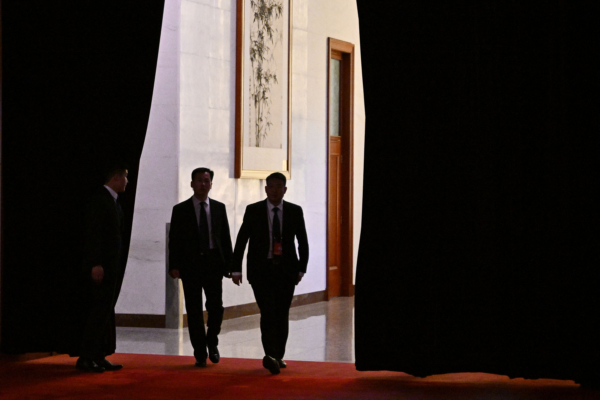
In March this year, a severe earthquake erupted in the power structure of the Chinese Communist Party (CCP). Within a few days, key positions in the provincial party committees and governments of Yunnan, Shandong, Chongqing, Zhejiang, Hunan, Liaoning and other six provinces and cities changed hands intensively, involving control over key functions like discipline inspection, organization, and united front work.
This massive personnel reshuffle, disguised under the appearances of “inter-provincial transfers” and “central parachuting,” is actually a restructuring of local forces by the central authorities in Zhongnanhai. An insider revealed that this is not just a routine rotation of cadres, but a “urgent filling of vacancies” and redistribution of power map after political purges.
According to official CCP media in late March, Huang Yi has been transferred from the central system to serve as the Secretary of the Discipline Inspection Commission in Yunnan Province; Shan Yi was transferred to Shandong and appointed as a member of the provincial party committee and Secretary-General of the provincial party committee; Ma Zhen and Feng Yi were appointed as Minister of the Organization Department of the Chongqing Municipal Committee and Minister of the United Front Work Department of the Zhejiang Provincial Committee respectively. This rhythm of emergency transfers reflects the rapid adjustment of local power structures.
Retired CCP official Xu Xianghui (pseudonym) who previously worked within the CCP system, shared with reporters that this “major bloodletting” was triggered by the ongoing turbulence in officialdom. He said, “From the end of last year to the first quarter of this year, a series of ‘high-ranking officials’ directly appointed by the Organization Department of the CCP in Fujian, Zhejiang, Yunnan and other provinces were successively toppled.” If these power vacuums are not swiftly filled, local factions could easily take advantage of the situation, hence Beijing has to act swiftly to forcefully “fill the seats.”
Xu Xianghui pointed out that there has been a shift in the current logic of personnel selection. He stated, “When selecting personnel in Zhongnanhai now, ‘capability’ is no longer among the top three priorities; what matters most is being ‘politically reliable.’ Those who can absolutely follow orders, have simple backgrounds, and are not involved with the investigated ‘tigers’ are more likely to rise in ranks.”
He further expressed that this large-scale parachuting and cross-appointment essentially serve as “mixing sand” and “dismantling parts,” aiming to break up the existing network of relationships in local areas.
In addition to the shake-up at the provincial level, the initiation of inspections down to the village-level organizations in 2026 is seen as a further extension to the grassroots level. Analysts pointed out that simultaneous changes in high-level positions and grassroots inspections create greater uncertainty for middle-level officials.
Zong Ting, a retired civil servant from Shaanxi Province, expressed to reporters that many newly appointed positions have a transitional nature. He remarked, “Everyone is aware that this is not just a promotion; it is about holding ground amidst changes. Today filling the vacancies, tomorrow it’s hard to judge if one will still be in the position.”
Adjustments in the key executive positions in Hunan and Liaoning provinces have also occurred simultaneously. The Hunan Provincial Government website now displays Wang Daoxi as a member of the Hunan Provincial Party Committee, Deputy Governor of the Provincial Government in charge of routine affairs, and Deputy Secretary of the Party Committee; the Liaoning Provincial Government website announced in March that Zhang Lihong has been appointed as a member of the Liaoning Provincial Party Committee, Deputy Secretary of the Provincial Government Party Committee in charge of routine work. These positions involve finance, finance, and the daily operation of the government, making them crucial nodes in local operations.
Political scientist Fang Zihao (pseudonym), who closely monitors the operations of the CCP’s officialdom, told reporters, “Discipline inspection oversees supervision, organization influences personnel decisions, and executive deputy governor involves financial operations. The simultaneous changes in these areas indicate that the power structure at the local level is being reconfigured.”
He mentioned that this kind of personnel shake-up typically does not initially affect the top leadership but is gradually completed through the replacement of leadership teams. Some newly appointed officials come from central ministries or other provinces, such as Huang Yi who previously worked in the judicial system and is now transferred to a local discipline inspection system, indicating the extension of the central system to key positions at the local level. At the same time, there is also a flow of senior officials from local levels returning to central departments, creating a two-way movement.
Sun Dali, a scholar studying the cadre system, mentioned that in this round of personnel adjustments, being “politically staunch” is repeatedly emphasized, reflecting a tightening of the selection criteria. He stated, “The current logic of personnel selection emphasizes reliability first, followed by capability. When political standards become the primary requirement, the entire cadre system’s operational mode will change accordingly.”
He pointed out that the cross-system and cross-regional appointment methods break up the existing relationship networks and increase the internal uncertainty within the system.
Meanwhile, the adjustments in key positions in multiple regions are coinciding in time with previous anti-corruption campaigns. The simultaneous changes in the discipline inspection and organizational systems allow for the appointment and removal of officials and disciplinary reviews to be advanced within the same framework. Observers pointed out that such arrangements reinforce control in the short term, while further concentrating power in a few positions.
In general, the high-ranking official adjustments involving six provinces and cities are not isolated incidents, but systematic actions unfolding against the backdrop of anti-corruption and internal purges. The turnover of personnel and the reshuffling of power proceed simultaneously, enabling the local officialdom to complete structural adjustments in a short period, showcasing the continuous tension within the CCP system between control and corruption.