
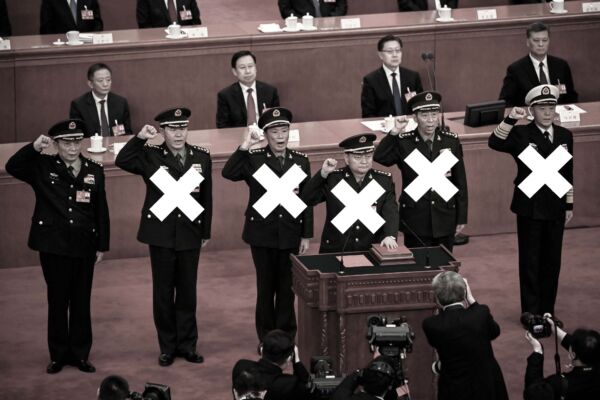
On January 24, 2026, the announcement of the investigation into Chinese Communist Party (CCP) Central Military Commission Vice Chairman Zhang Youxia and Member Liu Zhenli sent shockwaves both domestically and internationally. A mainland human rights lawyer bluntly stated that this round of military purging is fundamentally about power struggles rather than legal procedures, with the law having been reduced to a political tool. He predicted that the military will face a new round of reshuffling, potentially leading to increased dangers in the Taiwan Strait situation.
The CCP Ministry of National Defense announced on January 24 that CCP Central Military Commission Vice Chairman Zhang Youxia and Member Liu Zhenli were under investigation for serious violations of discipline and law. The People’s Liberation Army Daily promptly published an editorial categorizing the two with five “serious” descriptions, including “seriously trampling on and undermining the system of the Chairman’s responsibility system of the Military Commission,” and “seriously promoting influences that challenge the CCP’s absolute leadership over the military.”
Mainland human rights lawyer Chen Weimin (alias) expressed in an interview with the media on January 28 that from the procedures to the rhythm of public opinion, such events are not purely disciplinary or legal issues but typical power struggles within the system.
“No matter if it’s party discipline, national laws, or internal regulations, in practical operations, they all exhibit distinct characteristics of instrumentalization: emphasized when advantageous, bypassed when not.” Chen Weimin stated that the sequence of events starting from the Ministry of National Defense’s announcement, followed by the editorial qualification by the military newspaper, along with the advance of public opinion and the early damage to reputations, paves the way for legitimacy in the recurrent operational paths of power struggles within the CCP.
He analyzed that through leaking information to foreign media, pre-stigmatizing the individuals involved, and then seeking or fabricating “evidence,” it is not done to seek the truth but to serve the political needs of internal purges. “Its fundamental logic is not about ruling the military by law but about the redistribution of power within the ‘Party-State-Military’ system.”
Regarding legal issues, lawyer Chen Weimin expressed that the current system’s understanding of “law” is highly utilitarian. He cited the power transition period in 2012 as an example when there were obvious deviations from established procedures, demonstrating that the law is not the ultimate standard in the face of power.
This lawyer, who has been persecuted multiple times by the CCP, emphasized that unjust laws do not possess legitimacy, and people are not obligated to comply with unjust laws.
“Law only carries true meaning when it restrains power and protects rights.” He also stated that while some senior military officials may have different views on the nation’s future or system direction, in the eyes of the top leaders, these are seen as intolerable “noise.”
Against the backdrop of a significant reduction in the number of senior military personnel within the Military Commission, Lawyer Chen Weimin concluded that the military and the CCP government system highly associated with the military are likely to face a new round of reshuffling.
He pointed out that this process entails a high degree of uncertainty; it could either advance through intensive purges or escalate into uncontrollable infighting, leading to greater political chaos. Regardless of the outcome, such power struggles are unlikely to alleviate societal crises but may instead exacerbate the structural contradictions and pressures on livelihoods that have persisted for over a decade.
Regarding the external belief that “clearing out senior military officials is conducive to easing tensions in the Taiwan Strait,” Chen Weimin expressed reservation. He believed that in a situation where internal power is highly concentrated and risks can spill over, the Taiwan Strait situation may not necessarily calm down but could become even more perilous.
Chen Weimin criticized some political forces in Taiwan for continuing to bet on the mainland’s reluctance to use force, deeming it as “an extremely irresponsible political gamble for Taiwan’s tens of millions of people.”
Shanghai resident Tang Yifei (alias), who has been closely following the Zhang Youxia incident, provided a different perspective on the reasons for the rapid disclosure of Zhang Youxia and Liu Zhenli’s downfall by the authorities.
Tang Yifei compared the current situation with historical events: Mao Zedong took several months to announce the defeat of Lin Biao’s coup due to his firm control of the military, whereas the rapid announcement now reflects insufficient control over the military, intending to intimidate relevant factional powers.
He further analyzed that in the information age, if not swiftly disclosed, revelations on the international Internet could be exploited by relevant powers to mobilize the military for various reasons. In addition, the public places hopes of overthrowing the current regime on the military; if not promptly disclosed, it could lead to broader support.
Tang Yifei told the media that for the past thirteen years, tyranny has escalated, grassroots officials have disregarded the people’s demands, avenues for rights protection have increasingly been blocked, and officials only need to show loyalty with abilities and virtues not considered. He believed that the pendulum swings to the opposite extreme, with the public becoming increasingly aware of reality and continuously awakening.
Lawyer Chen Weimin concluded by stating that for mainland China to truly emerge from its current predicament, the fundamental solution lies in conforming to the tide of history and proactively returning power to the people; otherwise, one can only rely on social awakening and coercive reforms. However, in reality, the people are often trapped by their livelihoods, and the international environment is in a period of turbulence and reorganization, with conditions both internally and externally not favorable.
He predicted that in the coming years, Chinese society may face even more challenging and potentially agonizing stages, with structural pressures further intensifying.