
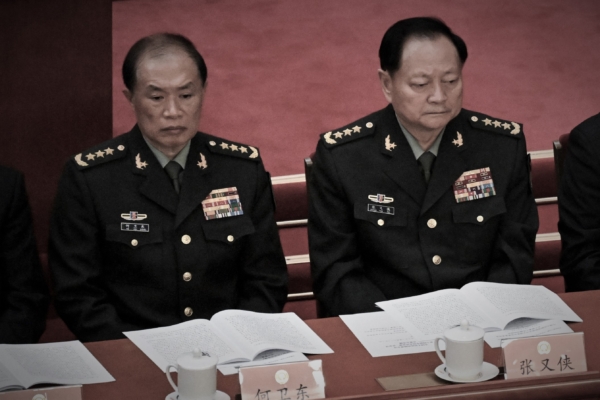
The top Chinese military leaders, Vice Chairman of the Central Military Commission Zhang Youxia and member of the Central Military Commission Liu Zhenli, have both fallen from grace, sparking the attention of China watchers. Georgetown University Professor and former senior U.S. official Dennis Wilder described this as the Chinese version of the Nazi “Night of the Long Knives.”
On Saturday, the official Chinese media formally announced that Zhang Youxia and Liu Zhenli are under investigation for “serious violations of discipline and law,” igniting public opinion.
According to the Financial Times, in Chinese Communist Party terminology, “violations of discipline” usually refer to corruption but are closely related to power struggles among factions. Since last year, Xi Jinping’s rectification actions have focused on ensuring the loyalty and political reliability of senior military officials, making high-ranking military officers more vulnerable to being targeted.
This purge directly targets the highest echelons of military power in the Chinese Communist Party, further expanding the most extensive purge of generals since the chaotic rule of Mao Zedong ended in 1976. In response to the downfall of Zhang and Liu, Georgetown University Professor Dennis Wilder commented on the social media platform X, describing it as the Chinese Communist Party’s version of the Nazi “Night of the Long Knives.”
Wilder has long been closely monitoring the Chinese situation due to his expertise and experience in various high-level positions related to China in the U.S. government and intelligence agencies.
The “Night of the Long Knives,” also known as the Röhm Purge, was a ruthless political purge carried out by the Nazi regime in Germany from June 30 to July 2, 1934. It targeted conservative elements and internal party opponents, primarily members of the SA.
Historical information shows that Hitler sought to eliminate the SA and its leader Ernst Röhm due to their perceived threat to his power and to appease the fears of the senior leaders of the military who were wary of the SA’s growing influence. Ultimately, Hitler’s purge eliminated his political adversaries.
Regarding the analysis suggesting that Zhang Youxia and Liu Zhenli were targeted due to slow progress in military construction and low efficiency in defense resource utilization under their leadership, Wilder expressed skepticism, stating that this purge is about politics and power, not performance.
Wilder emphasized that this move is because Zhang Youxia posed a potential threat, citing the history of the Communist Party’s military where challenges from strong military leaders against civilian leaders have occurred repeatedly. Xi Jinping’s pursuit of a fourth term at any cost further complicates the situation.
The removal of Zhang and Liu has reduced the size of the top military command structure “Central Military Commission” within the Chinese Communist Party to the lowest historical level, with only two members remaining: Chairman Xi Jinping and Vice Chairman Zhang Shengmin.
This investigation follows the purge of He Weidong in April last year. He Weidong, who was the second-ranking military leader within the Chinese Communist Party after Zhang Youxia, was also a Vice Chairman of the Central Military Commission. While many analysts view Xi Jinping’s actions as targeting corruption, some believe there are larger political motives at play.
Quoting Wilder, the report highlighted that the recent developments in Chinese politics are the most shocking since Xi came to power and initiated the removal of senior generals who he perceived as opposing him. The concentration of power within the Central Military Commission solely on Xi Jinping raises concerns about the operational effectiveness of the Chinese military.
Yashiro Akio, Executive Director of the Indo-Pacific Strategic Think Tank and a veteran Japanese media professional, commented on the X platform that China today is gradually approaching a historical turning point. When power is held together by fear and loyalty replaces capability as the sole criterion, the country’s outward appearance may appear strong, but internally it is increasingly fragile.