
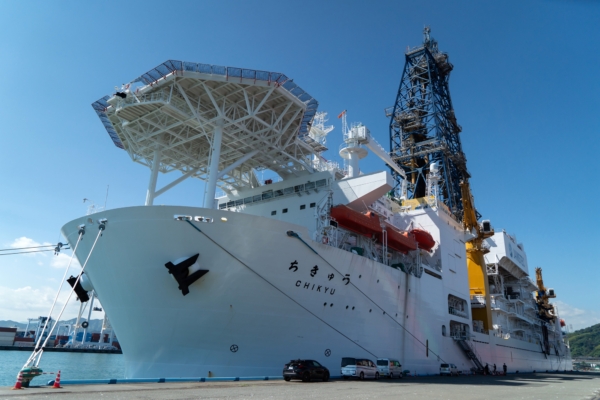
The Japanese government officially launched a milestone deep-sea rare earth trial mining operation on Monday (January 12). The research vessel “Chikyu”, equipped with drilling equipment, set sail from Shimizu Port in Shizuoka Prefecture, heading to the waters near Minamitori-shima, about 1,900 kilometers southeast of Tokyo, to attempt to recover rare earth element-rich seabed mud from a depth of about 6 kilometers. This move is an important step for Japan to strengthen supply chain security and reduce dependence on China, amid continued economic threats from the CCP.
This approximately month-long mission is the first in the world to use a pipeline to transport rare earth-rich seabed slurry from such depths to the ship.
The project is led by the Japanese government’s cross-agency Strategic Innovation Promotion Program (SIP) and carried out by the Japan Agency for Marine-Earth Science and Technology (JAMSTEC). If successful, it will lay the foundation for larger-scale deep-sea rare earth development in the future.
“After seven years of continuous preparation, we are finally able to start the verification test, a moment that is very moving,” said project leader Masakazu Ishii as the ship left port.
He said that if rare earth can be successfully recovered from the 6,000-meter deep sea, “it will not only be a significant technological achievement but will also have profound implications for diversifying Japan’s sources of rare earth.”
Rare earths are essential materials for electric cars, smartphones, wind turbines, and military equipment. For a long time, China has controlled about 70% of the global rare earth supply and has repeatedly used it as a tool for geopolitical pressure.
During a tense period in Sino-Japanese relations in 2010, Beijing cut off rare earth exports to Japan. Since then, Japan has accelerated investment in overseas projects, promoted rare earth recovery, and developed low rare-earth manufacturing processes, reducing its reliance on China from 90% to 60%.
Recently, with the CCP strengthening export controls on certain key minerals and “dual-use” items, Japan’s concerns about facing economic threats have risen significantly.
The Japanese side believes that it is this kind of threat risk from the CCP that forces Japan to accelerate the establishment of a more resilient rare earth supply system.
Although Japan has no land-based mineral resources, its Exclusive Economic Zone (EEZ) ranks sixth globally in terms of area. If successful in mining, Japan will successfully transform into a key mineral supply country.
Scientific research shows that the waters around Minamitori-shima contain over 16 million tons of rare earths, ranking third globally in terms of scale. Among them, the high-performance magnetic element “dysprosium” used in electric car motors can supply Japan for 730 years, while the reserves of “yttrium” used in lasers and medical equipment can last for up to 780 years.
It is worth noting that the radioactive element content in these deep-sea rare earth muds is lower than that in land-based ore deposits, making them more environmentally friendly in waste disposal.
The Japanese authorities plan that if this trial mining is successful, a larger-scale collection test will be conducted in 2027.
However, analysts also caution that deep-sea rare earth development still faces challenges such as high costs, insufficient technological maturity, incomplete environmental impact assessments, and international norms.
Studies estimate that the cost of mining near Minamitori-shima could far exceed the current market price of rare earths in China.
Nevertheless, the Japanese government still considers this project a long-term strategic investment. At a SIP achievements briefing in December, Japan’s Minister of Economic and Security Affairs, Norimi Kitaoka, stated that the government is aiming to achieve a stable domestic rare earth supply, which is of utmost importance for economic security.