
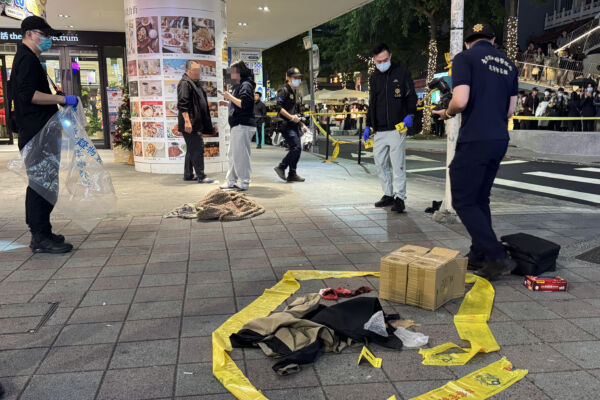
On December 20, 2025, a young man deliberately launched a random stabbing attack at a Taipei Metro station, resulting in 4 deaths and 11 injuries. Military experts pointed out that this significant and terrifying serial killing incident, despite the assailant jumping to his death under police pursuit, raised suspicions about the motive behind the killings, with concerns that it could be an act of the Fifth Column of the Chinese Communist Party lurking in Taiwan.
The incident took place at Taipei Main Station and Zhongshan Station on the 19th evening, where a 27-year-old man named Zhang Wen threw smoke bombs and indiscriminately attacked people with a knife. Chang Jung-hsing, director of the National Police Agency of the Republic of China, stated today (20th) that Zhang Wen’s indiscriminate killing spree was a planned random attack on civilians, with preliminary investigations ruling out a terrorist attack.
Prime Minister of the Republic of China, Su Rong-tai, called on the police to enhance vigilance at railway stations, metro stations, airports, and crowded areas to reassure the public.
President of the Republic of China, Lai Ching-Te, issued three directives today, aiming to provide immediate medical care, follow-up health care, and psychological counseling; establish a task force to conduct in-depth investigations into the assailant’s background, motives, possible accomplices, instigators, and sources of funding; and strengthen police deployment at airports, stations, metros, and other crowded places, or major events to enhance rapid response capabilities and focus on counter-terrorism force training.
Peng Jieshen, a former Marine Corps instructor and lecturer at the Thunder God Consulting Company, told Dajiyuan that random acts and planned acts are two entirely different thought processes, making it difficult to rationalize the two in logic. He analyzed and discussed Zhang Wen’s indiscriminate killing spree, whether he was a lone wolf or part of a national security terrorist attack.
According to Peng, international experts identify characteristics of indiscriminate attacks as: 1) no clear target in the incident, 2) long-term accumulation of psychological stress and real setbacks, and 3) the incident occurring in densely populated areas where weapons are easily accessible. Except for points 2 and 3, Zhang Wen’s psychological state aligns with the patterns observed in indiscriminate attacks and the choice of locations. However, the most crucial point, the lack of a specific target, contradicts Zhang Wen’s detailed plans and prepared actions.
He further explained the detailed actions of Zhang Wen at the Taipei Metro station:
1. Zhang Wen chose peak hours when people are getting off work and crowded Taipei Metro stations, even scouting out escape routes in advance.
2. Zhang Wen pre-ordered multiple smoke bombs, gasoline canisters, and concealed 13 knives, indicating a premeditated crime. An investigation team found burned laptops in Zhang Wen’s rented room in Zhongzheng District and two tablets in a hotel in Datong District, but did not recover Zhang Wen’s used mobile phone. The police decrypted the tablets found in the hotel, discovering details of his crime plan.
3. Most lone wolf attacks occur at the same location, rather than planned multiple-point, multi-area consecutive attacks, like Zheng Jie’s killing spree in Taipei Metro or lone wolf attacks abroad.
4. Zhang Wen’s purpose in releasing smoke bombs at Taipei Main Station was to instill maximum fear and panic in the primary transportation hub area. This intent to disturb public peace and security is more aligned with motives against enemies rather than typical lone wolf or simple criminal intent.
5. Zhang Wen’s killing method with a knife striking to kill is a special forces technique, demonstrated by his lethal attack on a 57-year-old man who intervened to stop the violence and another 37-year-old man killed while waiting at a red light.
Zhang Wen, armed with a sharp knife, mercilessly targeted innocent people, inflicting fatal wounds to their hearts, throats, armpits, inner thighs, and even their aortas – indicating meticulous training in specialized techniques. Although Zhang Wen chose to jump from the fifth floor of the Eslite bookstore according to his plan, the absence of previously available cushioning paper boxes led to fatal injuries, raising doubts about the intention behind his death. His possession of a gas mask and bulletproof vest reinforces the notion that his death was not a suicide. Whether Zhang Wen’s death was to silence him depends on whether the removal of the paper boxes was routine or purposefully executed for that reason, indicating a need for further police verification.
Due to unemployment and lack of livelihood, Zhang Wen, who worked as a security guard for a year until June 2024, had no income records thereafter. His strained relationship with his family raises questions about whether he acted under someone’s influence or received support from foreign forces. These aspects warrant thorough investigation.
Peng Jieshen emphasized that based on his analysis, Zhang Wen’s deliberate killing spree was an attempt to disrupt society in Taiwan with specific intentions to create fear and insecurity, possibly involving a national security attack from enemies. Following Zhang Wen’s death, there were online threats targeting future locations, including Kaohsiung Railway Station and a department store in Taichung, indicating escalating threats and intimidations.
The Taichung Sixth Police Station reported receiving threats of violence targeting the department store, prompting immediate monitoring of the comments’ IP addresses located abroad to ensure public safety and maintain order.
Mayor Chen Chi-mai of Kaohsiung City inspected police operations at the train station this morning, revealing that the Criminal Investigation Section was tracking down the individuals behind the threatening posts, narrowing down six suspicious accounts. One account has been ruled out, while another account was traced to an overseas IP address.
Regarding the indiscriminate killing incident by Zhang Wen that resulted in 4 deaths and 11 injuries, Peng Jieshen believed it could be linked to the Fifth Column operating in Taiwan. Zhang Wen’s tactical approach, including the sequential arsons and attacks in Taipei’s bustling areas, indicated a strategy to evade capture by spreading chaos and diversion.
Peng Jieshen urged Taiwan to enhance vigilance not only at important military units but also at schools, power plants, power transmission towers, reservoirs, as well as public gatherings such as large-scale concerts in Kaohsiung, and even water treatment facilities. Remote areas could benefit from surveillance using small drones to maximize efficiency.
He highlighted the admirable spirit displayed by the Taiwanese people during the tragic incident, reminiscent of the heroism witnessed during the Hualien earthquake relief efforts. Individuals like Zhang Wen sacrificing their lives to defend against violence, Eslite staff calmly evacuating the crowd, and various establishments swiftly securing their premises to ensure public safety exemplify the unique spirit of solidarity in Taiwan. This united rescue belief forms the unbreakable essence of the Taiwanese spirit against adversaries.
Furthermore, Peng Jieshen pointed out that in recent years, several significant cases have been downplayed or overlooked, concealing their potential severity. Instances like a major power plant blackout caused by an employee’s negligence in triggering a switch, or a thief stealing cables from Taoyuan International Airport, leaving behind tools that might have been intentional, both raise national security concerns but were dismissed as minor incidents.
He raised questions about how a power plant employee could negligently trigger a switch leading to a large-scale blackout affecting thousands of households and whether the cable theft at Taoyuan Airport was an inadvertent act of leaving tools behind or a deliberate misdirection in investigations, shedding light on possible national security implications often overlooked as minor issues.