
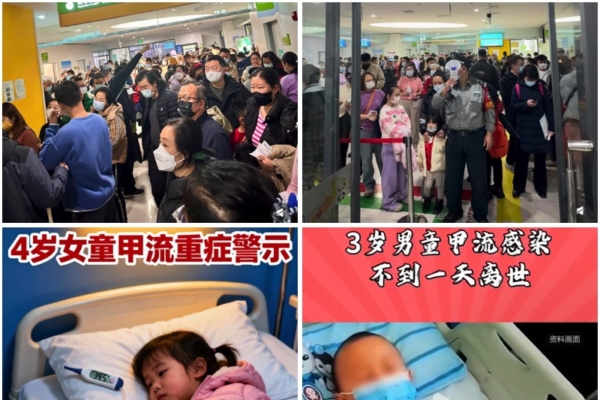
In recent times, after entering December, influenza outbreaks in various parts of China have been worsening continuously, with state media even using the term “peak” to describe the situation. Doctors from a women and children’s hospital introduced that according to the Chinese Center for Disease Control and Prevention, the ICU admissions and death rates for severe cases of influenza have increased by 40.2% compared to the same period last year in the past three months. Multiple doctors have issued warnings that the mortality rate of complications from H3N2 influenza is high, and survivors may experience long-term effects, with the first 48 hours being considered the golden treatment period.
In Beijing, Mr. Wang recently told a reporter that his child, who attends kindergarten, has recently contracted influenza. He mentioned, “The infection is widespread in the school now. If one person gets infected, the entire family ends up getting it.”
“The medicines for treating influenza are running out, especially the imported Tamiflu cannot be found. However, the domestic brands have not shown much improvement even after being taken for five or six days.”
He felt that the current wave of influenza in Beijing started spreading widely from November. “The fever clinics in various hospitals are quite crowded. Medical staff are dressed like pockets (in protective suits), just like they were during the COVID-19 pandemic, specifically receiving patients with influenza. Now everyone is relying on Oseltamivir to get through this tough situation. Without at least seven days of treatment, one can hardly recover, and even after recovery, there is still persistent coughing.”
He further explained, “If you take two or three days off, whether or not you have influenza, if you want to return to school, including kindergarten, you must obtain a medical certificate from the hospital stating that you do not have influenza or any other infectious diseases; otherwise, you will not be allowed to attend classes.”
He emphasized that people are now afraid of the spread of this virus, so they have started wearing masks again, especially in public places like the subway.
On the 13th, Ms. Xu from Beijing introduced to a reporter that the current wave of influenza in Beijing is quite severe, and initially, many people thought it was just a common cold. Even her neighbor’s child thought so, stayed at home for two days before going to the hospital, and unfortunately passed away the next day. Initially thought to be a common cold, it later turned out to be acute necrotizing encephalopathy caused by influenza.
She also mentioned that whether it’s in shopping malls or amusement parks, the number of people has drastically decreased, with two-thirds of the children in her child’s class not attending kindergarten due to being infected.
In addition, on the 15th, a mother in Zhejiang province mentioned that today when she took her child to the pediatric hospital, the doctors are now testing for influenza directly if the patient has a fever, without missing anyone.
Another mother from Shanghai also mentioned on the 15th that in her daughter’s class, five children were infected with influenza on the first day, seven on the second day, and directly fifteen on the third day. She said, “My child is one of them; this influenza is really fierce this time.”
The Chinese CDC Viral Disease Institute stated in early December that influenza activity in 17 provinces in the country is at a high level, while the remaining provinces are at a medium level. The positivity rate of influenza virus detection in flu-like illness patients who visited emergency departments reached 51%, which is the highest rate in nearly three years. The positive rate of influenza detection in the 5 to 14 age group is significantly higher than other age groups.
Based on the latest monitoring situation, it is expected that nationwide influenza activity will peak in the middle of December. The H3N2 influenza A virus still dominates the current outbreak, accounting for over 95%, with a small number of H1N1 influenza A and influenza B viruses also circulating.
Many doctors in China have issued warnings that the complication mortality rate of this H3N2 influenza variant is high, and even if survived, severe complications may persist. They remind parents, “If the following symptoms occur, immediately take the child to the hospital: if the child has a persistent high fever (above 39°C) and experiences confusion, convulsions, or loss of consciousness, prompt medical attention is necessary! Acute necrotizing encephalopathy progresses rapidly, early diagnosis and treatment are crucial for saving lives.”
Director Tian from a public tertiary hospital recently produced a video program in which he referred to H3N2 as the “virus king” in 2025, directly indicating a high rate of severe cases and hospitalization, and greater severity. It can suddenly cause high fever, convulsions, impaired consciousness, with temperatures reaching 39°C to 40°C, lasting for three to five days without relief, accompanied by nasal congestion, runny nose, continuous dry cough, sore throat, and body aches. Moreover, the onset is rapid, and it is highly contagious. The most frightening aspect is that it can lead to various complications such as pharyngitis, pneumonia, otitis media, myocarditis, and meningitis. It is particularly dangerous for the elderly, infants, pregnant women, and those with chronic illnesses, making them more susceptible to severe crises.
He also mentioned that the first 48 hours of confirmation are crucial, and timely use of antiviral medications under the guidance of a physician, such as oseltamivir and baloxavir marboxil, can significantly shorten the illness duration, improve symptoms, and reduce the risk of complications.
Doctor Zhang Chao from Hubei highlighted the case of a 3-year-old boy from Henan who passed away a day after contracting influenza. The family believed it was a misdiagnosis by the hospital, initially treated as a common cold, but the child passed away the next day, later diagnosed as influenza.
A parent from Jiangxi shared on social media on the 12th that ten days ago, a senior high school student in their local area treated influenza as a common cold, struggled to continue going to school and delayed seeking medical attention, which led to death.
A mother from Zhejiang province mentioned on the 12th, “Today I received a call that a relative’s child passed away last night. Just two days ago, the child was fine. My mother-in-law is currently at the crematorium. It’s the first time something like this has happened around me; it’s too terrifying. The child was just over a year old.”
A parent from Guizhou shared in a discussion group about influenza deaths at the end of last month, “My 3-and-a-half-year-old baby also passed away due to influenza on the 23rd.”
Another parent from Shandong added, “My daughter, who was less than 3 years old, contracted influenza and passed away just two days later.”
Doctor Wang Mengguang from the chest surgery department in mainland China also warned that during the peak severity of this virus strain, it can lead people to respiratory failure, emphasizing that this is not a scare tactic as it can be truly witnessed in the intensive care unit.
A mother from Shandong posted on social media on the 15th, sharing that her 1-and-a-half-year-old child had seizures due to influenza and was hospitalized, as many children experienced seizures during this wave of influenza, escalating rapidly.
The mother of a 4-year-old girl from Xuzhou City, Qingfeng County, Jiangsu province, mentioned on the 11th that her child had a fever of 38.7°C one day, complained of stomach pain, and suddenly experienced rapid breathing difficulties the next night, leading to a rapid deterioration of the condition into acute lung injury. The hospital initiated ECMO (extracorporeal membrane oxygenation) for rescue. Based on the child’s medical records, she was diagnosed with severe pneumonia, acute respiratory distress syndrome caused by H3N2, and acute encephalopathy syndrome.
On the 10th, the news of the 7-year-old girl from Zhengzhou, Henan, whose right lung turned completely white hours after contracting influenza, went viral on Weibo. The girl has been in the pediatric intensive care unit (PICU) for eight days and has not regained consciousness. The diagnosis by doctors indicated that the influenza caused a bacterial infection, leading to septicemia affecting multiple organ functions.
The mother of a 4-year-old girl named Duoduo from Puyang, Henan, stated on the 9th to local media that her child had a high fever recently, accompanied by abdominal pain, initially thought to be a common cold. However, within 24 hours, the situation worsened rapidly, developing into “white lungs,” requiring intensive care unit admission.
A mother from Beijing directly sought financial assistance online on the 9th, “My daughter was diagnosed with severe encephalitis and acute brain necrosis due to influenza this time. She has been rescued, her life has been saved, but her awakening remains uncertain. It is heartbreaking to see that the daughter who was by your side, full of dreams about the future and acting cute, is now lying in the intensive care unit at only seven years old.”
Furthermore, on the 9th, the Women and Children’s Health Hospital in Pingxiang City issued an urgent video advisory, quoting the latest influenza testing data released by the 2025 CDC that “in the past three months, the number of severe influenza and death cases nationwide has increased by 40.2% compared to the same period last year,” emphasizing that it “easily leads to serious complications such as myocarditis and acute necrotizing encephalitis.”
Renowned professional in the infectious disease field Zhang Hua (pseudonym) shared with reporters that during the global pandemic of 1968 caused by H3N2, the mortality rate was very high but was not specifically recorded. He mentioned that this year’s virus strain has undergone 7 variations compared to the past and is categorized as a K-type subtype. Initially, the authorities suppressed information about this disease, but when they couldn’t contain it, they gradually revealed the severity of the disease, even stating that it can lead to “myocarditis at best, death at worst.”
He stressed that this virus poses a significant threat to children, with an extremely high overall mortality rate.
Regarding the official statement about influenza peaking in mid-December, Zhang Hua believes that since it’s the winter season, viruses tend to spread faster. He indicated that it will likely continue to spread next year, will not disappear, and will maintain a moderate level of circulation. Due to the large population, even in the summer, the transmission rate may slightly decrease but will not be significantly lower.
According to the World Health Organization’s review of “Global Influenza” data, there have been three major influenza pandemics in the 20th century (1918, 1957, 1968). The pandemic from 1968 to 1969, caused by H3N2, had a significant impact.
With the virus originating from the outbreak in Hong Kong, it was internationally referred to as the “Hong Kong flu” or “Mao Zedong flu.” WHO estimates that the virus caused between 1 to 4 million global deaths at that time.
Traditional epidemiological textbooks and historical research materials show that the number of global infections ranged from 300 million to 500 million during that period.