
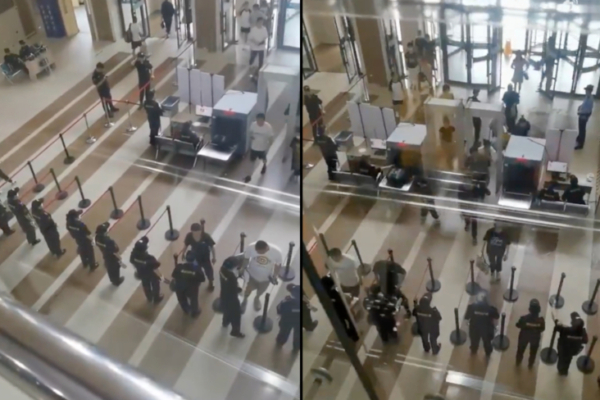
High drug prices, difficulty in seeking medical treatment due to its cost, declining medical ethics, and escalating doctor-patient conflicts in Mainland China have been resulting in tragic incidents of medical personnel being attacked. On June 29th, a video showing security checks being conducted at the Harbin Medical University Second Hospital to prevent accidents from happening went viral online, sparking discussions among netizens.
The video depicted patients or their family members undergoing security checks upon entering the hospital, followed by a row of metal pillars with only one person allowed to pass through each gap between the pillars. Behind the pillars stood over ten security personnel lined up, some male patients or family members being subjected to body searches upon entering the hospital. The netizen who shared the video commented, “Isn’t this video a reflection of the current doctor-patient relationship?”
According to legal professional Mr. Li from Mainland China, hospitals nowadays are driven by profit motives, setting targets for doctors with the promise of bonuses upon completion. Consequently, doctors resort to any means necessary to fulfill their quotas, exacerbating doctor-patient conflicts. The number of doctors being killed due to conflicts with patients has been rising nationwide each year, prompting the reinforcement of security measures.
Mr. Li emphasized that with the commercialization of China’s healthcare industry, healthcare has become a major revenue source for the authorities. From the production and distribution of medicines to hospital administration and ultimately reaching the hands of the common people, a vast industry chain has been established, with overtreatment in hospitals becoming rampant. As a result, doctor-patient conflicts have been intensifying, leading to heightened anxiety among doctors and necessitating increased security measures.
Mainland civil servant Mr. Yang, speaking to Dajiyuan, revealed that doctor-patient conflicts have always existed, alongside phenomena such as overtreatment, falsified medical records, and misdiagnoses. These conflicts are essentially a byproduct of the corrupt system perpetuated by the Chinese Communist Party. Would such circumstances have arisen if China had implemented free healthcare?
On June 28th, a 28-year-old man in a county hospital in southern Sichuan Province underwent a hemorrhoid surgery, tragically ending his life on that day, leaving his loved ones in disbelief.
On June 27th, a 23-year-old university student attended a medical consultation at a hospital in Sanshui District, Guangdong for examination. After receiving an injection, he was immediately transferred to the intensive care unit and passed away, with his family not being allowed to see his body.
Mr. Yang highlighted that hospitals now treat minor ailments as serious conditions, causing frustration among patients and sometimes resulting in fatal outcomes, as evidenced by cases around him. He narrated the story of a woman in her forties suffering from varicose veins, who, in a bid to generate more medical fees, was administered intravenous drips until she developed renal hydrops, ultimately leading to her death. The hospital attributed her demise to disease progression, deceiving her family members. According to reports from a classmate, the intern responsible for administering the drips was from their department, and a routine case ended tragically.
Describing the increasing frequency of such incidents, Mr. Yang pointed out the lack of medical security in China, where patients have become mere tools for doctors to earn money. Moreover, many individuals cannot afford medical treatment and are left to face a grim fate. Owing to the specialized nature of healthcare, viruses pose the greatest threat, but due to the non-professionalism of patients’ families who are at the mercy of doctors, a significant ethical void exists in the system.