
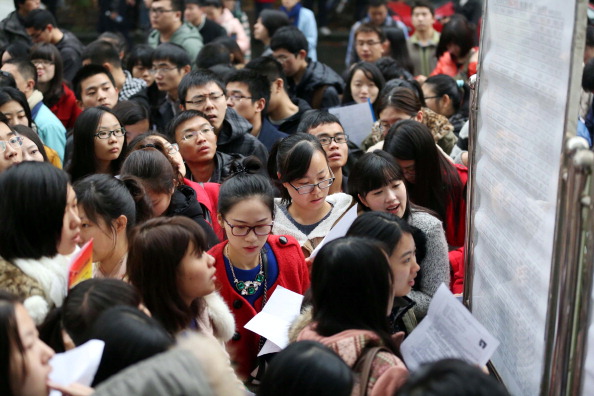
With the economy stagnating and the labor market weak, youth unemployment in China remains high, far exceeding that of other countries. Young people are finding it difficult to secure jobs and are increasingly turning to pursue careers in government. However, as local Chinese Communist Party (CCP) governments face fiscal crises, news of salary cuts and layoffs are rampant, leaving young individuals contemplating the uncertain future of pursuing a career as civil servants.
China’s economic woes are no secret, with local governments drowning in debt. The sluggish real estate market is undermining the foundation of family wealth and eroding investor confidence. Cautious consumers are stockpiling cash, and major companies are resorting to widespread layoffs.
This year saw a record influx of 3.4 million Chinese youth taking the civil service exam, a surge of about 400,000 compared to the previous year. Since 2014, the number has doubled, highlighting the lackluster development of private enterprises in China under the repressive CCP regime, pushing disillusioned Chinese Gen Z individuals to seek stability in the form of government jobs.
At an investor conference in Shenzhen on December 3rd, Guo Shanwen, chief economist at Guotou Securities, cited an analysis of regional data from various provinces, revealing that a staggering 47 million Chinese labor force members nationwide are struggling to find employment. According to Bloomberg’s calculations using official statistics, this amounts to 10% of China’s urban working population in 2023.
A December 30 report from Reuters quoted an unnamed Chinese sociology professor who expressed that many Gen Z individuals in China “feel a strong sense of weariness and do not know what is meaningful,” as their university years coincided with the challenges posed by the pandemic and China’s economic downturn.
Guo Shanwen also noted that post-pandemic, middle-aged individuals on the mainland are disillusioned, while young people are feeling listless.
The Chinese sociology professor further highlighted that this generation of Chinese graduates, having not experienced the massive layoffs in the state-owned sector during the 1990s, hold an idealized view of government work.
Amid the CCP’s efforts to prioritize safeguarding the leadership core over economic growth, the three-year austerity measures have depleted local finances. Moreover, the international environment is becoming increasingly unfavorable for the CCP, with slower economic growth, foreign investment and companies exiting, and a deceleration in the real estate sector, depleting the regime’s financial resources.
Since 2022, mainland China has witnessed a wave of salary cuts for civil servants, primarily affecting economically developed coastal provinces in the southeast. The bonuses and allowances for civil servants have been significantly reduced.
A rare interview conducted by Reuters with ten public sector employees in four provinces in China revealed widespread bonus cuts and salary reductions of up to 30% this year, prompting some civil servants to consider resignation, while local government austerity measures have also led to sporadic layoffs.
Some civil servants reported not receiving their salaries for several months. Some are barely sustaining their livelihoods on a monthly income of 4,000 yuan (about $550), supporting their families and repaying loans. Many requested anonymity to avoid retaliation.
Katherine Lin resigned from her civil service position in Shenzhen in July, as her monthly salary of 15,000 yuan ($2,000) was slashed by a quarter, bonuses were canceled, and management hinted at further downsizing.
“Some departments choose to cut salaries by 30% or dismiss employees in response to cost-cutting policies,” she said.
Government announcements indicated that at least three district-level bureaus in Shenzhen merged this year, resulting in the termination of nine employees.
Another rural civil servant in Guangdong province mentioned that her monthly 1,000 yuan ($140) bonus was halted in June, making her 4,000 yuan ($550) monthly salary fall into the category of “stable poverty.”
In Shandong, civil servants complained on social media in September that they were receiving only one month’s salary each quarter as part of a policy named “secure four months’ salary, strive for six months.”
According to Reuters, an anonymous elite Chinese university management professor emphasized that salary arrears are “systematic and widespread nationwide and not likely to be substantially resolved in the short term.”
He added that this phenomenon could exacerbate corruption, as officials supplement their incomes through tips and bribes, as well as increase administrative fines on citizens.
First Finance reported that in 2023, fines and confiscation revenues significantly increased in seven out of sixteen provinces, with Chongqing and Beijing witnessing growth rates of 22.4% and 21.9%, respectively. Many local governments have ceased disclosing information on fines.
“The most pressing issue now is social stability,” the professor remarked. “Therefore, weighing the lesser of two evils will lead to an expansion in civil service recruitment and the oversight of institutional reform.”